Wave Parts
Light & Sound
Reflection / Refraction
Analog/Digital
Misc. Waves
100
This is the top of the wave
What is a crest?
100
What kind of wave is an electromagnetic wave, and how does it move?
A transverse wave - It moves perpendicular (up and down or side to side) to the direction of the wave.
100
The bouncing of light off a reflective surface
What is reflection?
100
Continuous waves with variations or fluctuations (noise).
Analog Signal
100
Makes reflected images larger
What is a concave mirror?
200
This is the distance between two crests or two troughs
What is a wavelength?
200
What do all types of waves carry?
Energy
200
The bending of light
What is refraction?
200
Fast and quick processing
Digital Signal
200
Every wave, regardless of type or medium transfers this
What is energy?
300
This is the bottom part of a wave
What is a trough?
300
What kind of wave is a sound wave? How does it move?
Longitudinal - Parallel (back and forth) with the direction of the wave.
300
List the colors in order from highest frequency to lowest frequency.
Violet, indigo, blue, green, yellow, orange, red.
300
List 3 devices that use digital signals.
Computers, MP3 players, streaming devices, smartphones, digital clocks, digital cameras, thumb drives, etc.
300
A lens that focuses light
What is a convex lens?
400
This is the vertical distance between the middle of the wave and a crest or trough
What is an amplitude?
400
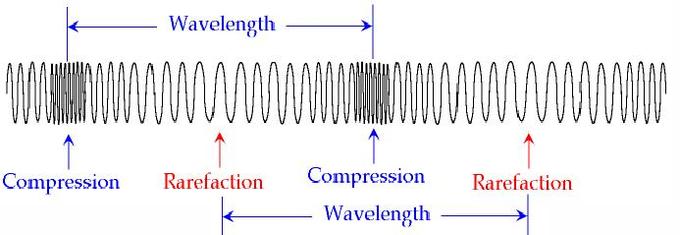 What type of wave is this?
Sound or longitudinal wave
400
Any substance that a wave can travel through
What is a medium?
400
List 3 devices that use analog signals.
Analog clocks (with hands), AM/FM radios, dimmer switches, microphones, speakers, pressure gauges, thermometers, oscilloscopes,
400
How does a prism separate light waves?
As the light passes through the denser medium, it slows down and bends/refracts. This separates the different waves into their colors.
500
This is the number of waves passing a point in one second
What is frequency?
500
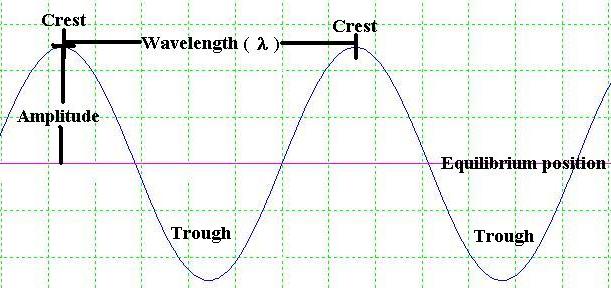 What type of wave is this?
Transverse, electromagnetic, or light wave.
500
The line perpendicular to the reflecting surface
What is the normal?
500
List the pros and cons of analog and digital signals.
Digital - Pros: Transmit over long distances, takes less storage space, doesn't degrade over time, reduces outside noise, easy to reproduce, etc. Cons: Images/sound are pixilated
Analog - Pros: Richer colors/sounds, more variations in dials or sensors, Cons: Uses more storage space, degrades over time, isn't easy to reproduce, doesn't broadcast as far without interference.
500
The angle of reflection equals the angle of ________.
Incidence