Nature of Science
Space
Physical Science 1
Life Science
Physical Science 2
100
This is the variable changed by the experimenter
Independent Variable
100
Earth and the Moon influence each other in different ways. Which of the following is expected when the position of the Moon's orbit brings it closer to Earth?
High tides on Earth are higher, and low tides are lower.
100
define the law of conservation of mass
The mass of a closed system cannot change over time; mass cannot be created nor destroyed.
100
which pigment reflects orange, yellow, and red light and absorbs the other colors to provide energy for photosynthesis?
chlorophyll
100
This kind of change in matter is usually reversible, changes texture, shape, temperature, or change in the state of matter
Physical change
200
This variable changes based on the independent variable
dependent variable
200
The heliocentric model of the solar system states that all objects in the solar system orbit the sun. Which statement explains why the scientists accept this model?
a) It is an exact description of how the solar system actually works.
b) It is a close approximation of how the solar system actually works.
c) It is an idea that was developed over time based on many observations.
d) It is a better model that the geocentric model because it is much simpler.
c) It is an idea that was developed over time based on many observations.
200
How can the law of conservation of energy be expressed in the case of a chemical reaction?
Total energy before the reaction is always equal to the total energy after the reaction.
200
Plants and animals exchange materials through the processes of photosynthesis and respiration. Which is true about the way these two processes are related?
*Answer in terms of reactants and products*
The products of photosynthesis are the reactants of respiration.
200
Give two examples of a chemical change and explain how one can verify this
Cooking
Burning
etc etc
300
At which temperature is plant height maximized?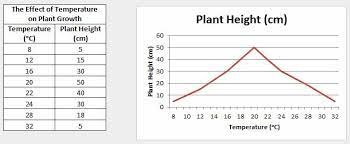
20 C
300
List (7) objects the hierarchy of the universe, smallest to largest.
*hint Moon is first*
Moon, planet, star, solar system, nebula, galaxy, universe
300
This is the smallest unit of an element.
*for double points name all of the parts, locations and their charges*
Atom
Proton- positive, nucleus
Neutron- neutral, nucleus
Electron- negative, orbiting the nucleus
300
Which substance is used for producers during photosynthesis, and is released during respiration?
Carbon Dioxide
300
Changes phase from liquid to gas is called this
*Bonus if you can describe the atomic difference between these two phases
Evaporation or vaporization
Gaseous molecules move much faster than liquid
400
What are the independent and dependent variables? Must give units!
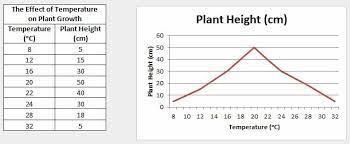
Independent- Temperature in C
Dependent- Plant height in cm
400
On an HR diagram why is the x- axis unique?
It goes from hotter to cooler
400
These are the vertical columns in the periodic table.
*for bonus points tell me what they tell us
Groups
Similar properties
400
Cellular respiration happens in this organelle and the products and reactants are these
Mitochondria
Reactants- Oxygen+glucose (sugar)
Products- Carbon dioxide + Water + ATP (energy)
400
Define homogenous mixtures
Define heterogeneous mixtures
Give an example of each
homogeneous- same properties at everypoint (looks the same throughout)
heterogeneous- mixture is not uniform
Homogeneous example- salt water
heterogeneous example- salad dressing
500
Ketanji and Adrianna conducted an investigation with potato bugs. They proposed the hypothesis; Potato bugs are more likely to seek out moist soil than dry soil. The data did not support their hypothesis. They decided to determine whether other invertebrates may seek out moist soil. Which statement best explains why the original hypothesis was valuable to them?
It was valuable because it led to further investigation.
500
These are the two aspects that play into the amount of gravitational force between two objects.
*Bonus if you can tell me the difference between mass and weight*
Mass and distance
Mass is the amount of matter in an object
Weight is the gravitational force applied to mass
500
If you change the number of electrons of an element it becomes this
If you change the number of neutrons of an element it becomes this
If you change the number of protons of an element it becomes this
MUST ANSWER ALL 3 FOR POINTS!
Ion
Isotope
NEW ELEMENT
500
) Kendall plants flower seeds and places caterpillar larva in a sealed container with enough light, soil, moisture, and gases to thrive. When she opens the container later, she finds that the flowers have sprouted, and caterpillars have eaten some of their leaves. If it was possible to measure the carbon content of every part of this enclosed container before and after Kendall performed her experiment, what would Kendall find?
The total amount of carbon was constant throughout the experiment.
500
An object has a mass of 50 g and a volume of 2 mL What is the density of the object?
***Double points if you do not need to be told the density formula***
*Bonus if water has a density 1g/ml will this object sink or float? Why?
25 g/mL
Sink, because the density is much higher than water.