Light Properties
EM Spectrum
Light Behaviors
Light & Matter
TRUE or FALSE
100
How does the speed of light compare to the speed of sound?
Light is much faster
100
Which of these electromagnetic waves would have the longest wavelength and lowest energy?
Radio Waves
100
When you look into a still lake and see the trees above, what behavior of light are you seeing?
Reflection
Light bounces off the smooth surface of the water back to your eyes.
100
A wooden door does not let any light pass through it. What category of matter does the door belong to?
Opaque
The material either absorbs or reflects all the light that hits it.
100
Light travels at the same speed as sound
FALSE
Light is the 'speed limit' of the universe
200
In a wave, what is the distance between one "peak" (crest) and the next peak called?
Wavelength
This is the main way we measure and identify different types of light.
200
Which type of EM wave has the highest energy and the shortest wavelength (often used to treat cancer)?
Gamma Rays
These have the most "punch" and can pass through almost anything.
200
Clear plastic wrap allows almost all light to pass through it so you can see the food inside. What is this behavior called?
Transmission
The light "transmits" or travels straight through the material.
200
If you can see light through a shower curtain, but you can’t see clear shapes or details, what is that material called?
Translucent
Some light passes through, but it is scattered in different directions.
200
Opaque materials allow most light to pass through them, but scatter it in many directions.
FALSE
That describes translucent materials. Opaque materials block light entirely.
300
What is Light?
A type of electromagnetic radiation wave that can be detected by the human eye
Electromagnetic (EM) radiation: a type energy that travels and spreads out as it moves, composed of vibrating electric and magnetic fields.
300
Which of color of visible light has the LEAST amount of enegy?
RED
300
If you wear a black shirt on a sunny day, why do you feel much hotter than if you wore a white shirt?
Absorption
The black material "soaks up" the light energy and turns it into heat.
300
Which type of matter (Transparent, Translucent, or Opaque) creates the darkest, most defined shadows?
Opaque
Because it blocks all light rays, it leaves a dark area (shadow) behind it.
300
When light strikes a transparent material, most of the light is reflected.
FALSE. Most like is transmitted
400
If an electromagnetic wave has a very high frequency, what can you conclude about its energy?
It has high energy
400
Which type of invisible light wave can cause a sunburn if you stay out in the sun too long?
Ultraviolet (UV)
UV rays have more energy than visible light, which can damage skin cells.
400
What happens to a light wave's direction when it moves from air into a glass of water?
It bends
This is called refraction, and it happens because light changes speed
400
Why can’t we see through Translucent objects clearly, even though some light gets through? (Hint: Think about what happens to the light rays inside the material).
ScatteringThe light waves bounce off internal particles, "scrambling" the image.
400
The energy of an Electromagnetic wave is related to its Frequency
TRUE
500
How does the energy of an electromagnetic wave relate to its wavelength?
Shorter wavelength have higher energy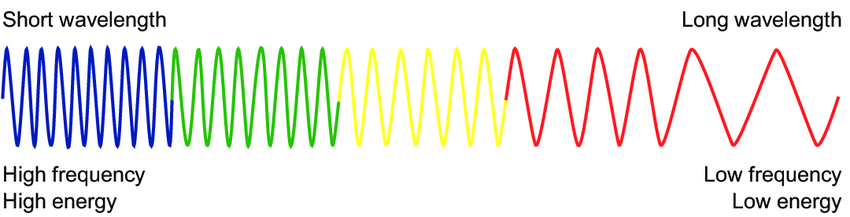
500
List the colors of the rainbow in order from longest wavelength to shortest wavelength
Red, Orange, Yellow, Green, Blue, Indigo, Violet
500
Why is the sky blue during the day? (Hint: Think about what happens when sunlight hits gas molecules in the atmosphere).
Scattering OR Diffuse Reflection
The rough surface of the foil bounces light in random directions, blurring the image.
500
When light hits an Opaque black stone, most of that light energy is turned into what other form of energy?
Thermal Energy (Heat)
Absorption turns electromagnetic energy into heat.
500
The amplitude of a light wave determines its color.
False
Frequency (or wavelength) determines color. Amplitude determines the brightness or intensity.