1900-1920
1920s/1930s
World War II
After WWII
1945-1990
Modern U.S. History
100
American women voted in their first presidential election in 1920 because of this Constitutional Amendment
nineteenth
100
The increase of organized crime in the 1920s was linked to this policy put in place by the 18th Amendment.
prohibition
100
The mass slaughter of Jews in Europe
the holocaust.
100
In 1949, this nation became the second to detonate an atomic bomb
the Soviet Union / U.S.S.R. / Russia
100
It began when World War II ended and ended around the time the 1990s began.
The Cold War
100
America's first African American president, he was elected in 2008
Barack Obama
200
in the 1920s it exposed the whole nation to the same information and entertainment.
the radio
200
Only two were used, one on Hiroshima, the other on Nagasaki.
atomic bombs.
200
The main reason for United States military involvement in Vietnam in the early 1960s was to stop the spread of this political and economic system.
Communism
300
The goal of this movement was to secure full voting rights for all people, not just men.
The Women's Suffrage Movement
300
This invention encouraged tourism and created new businesses in the 1920s.
the automobile
300
Major battle that opened the way for the Allies to enter Germany from both the east and the west.
D-Day / The invasion of Normandy
300
The 15 year period of increased birth rate that happened after World War II
The baby boom
300
A contest in which nations compete to build more and more powerful weapons.
arms race
400
Depicted in this cartoon, He believed good trusts must be controlled and bad trusts broken up.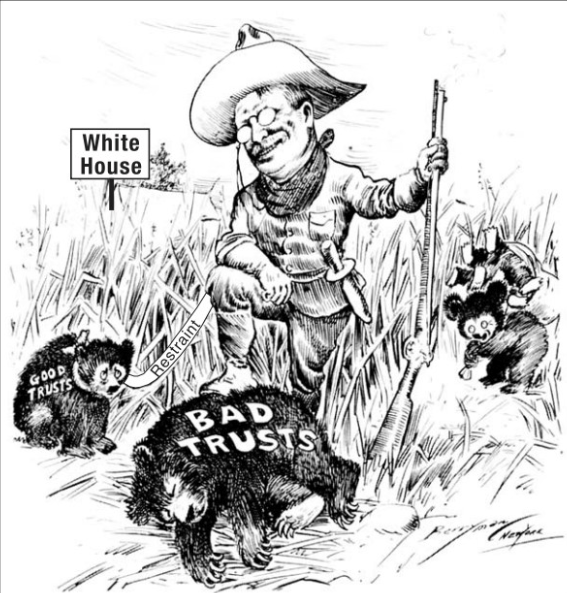
Theodore Roosevelt
400
Franklin Roosevelt's plan to provide relief, recovery, and reform to help with the problems of the Great Depression
New Deal
400
British Prime Minister Winston Churchill used this term to referring to a barrier to understanding and information between Eastern and Western European nations.
iron curtain
400
His name has come to be associated with accusing someone of disloyalty without having any evidence.
Joseph McCarthy
400
He was the mastermind of the September 11th attacks.
Osama bin Laden
500
As a way of criticizing the federal government during the early 1930s, areas such as those shown in this photograph were often referred to by this mocking name.
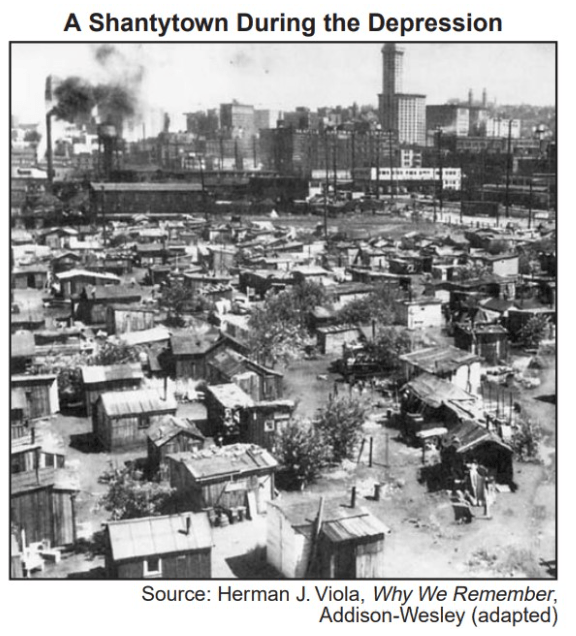
hoovervilles
500
In a speech delivered to Congress, President Roosevelt called this even on December 7, 1941, “a date which will live in infamy.”
the Japanese attack on Pearl Harbor
500
This war, fought between 1950 and 1953, ended in a stalemate with neither side making any substantial territorial gain.
The Korean War
600
Constructed in 1903, this waterway connected the Atlantic and Pacific Oceans.
The Panama Canal
600
Nickname for October 29, 1929, the day the stock market crashed.
black tuesday
600
Even before Pearl Harbor, Congress prepared for entry into World War II by enacting one of these to increase the number of soldiers in the U.S. Army.
draft / military draft / peacetime draft
600
The United States policy of limiting Soviet expansion.
containment
600
The terrorist organization that claimed responsibility for the 9/11 attacks
Al-Qaeda
700
Area of the United States affected by the Dust Bowl.
plains / the great plains
700
A country whose military, economic, and political strength is so great that it can influence events worldwide
super power
700
He resigned as a result of the Watergate scandal.
Richard Nixon
700
He was president at the time of the September 11th attacks
George W. Bush