🔥Feeling the Heat🌡️
🧫Tiny Builders, Big Impact 🌊
💧Hidden Water, Living Land🌾
🌙Out of This World☄️
🚄Forces in Motion🌎
100
Heat transfer always moves:
A. From higher temperature to lower temperature.
B. From larger objects to smaller objects.
C. From objects with more mass to less mass.
A. From higher temperature to lower temperature.
100
This is the basic unit of life.
Cell
100
Prairies are mostly made up of:
A. Tall trees
B. Grasses
C. Moss
D. Sandy desert
B. Grasses
100
A massive "blanket" of gases surrounding the Earth; where weather occurs and where water moves to during evaporation.
Atmosphere
100
Maglev trains use this force to float above the tracks.
Magnetism
200
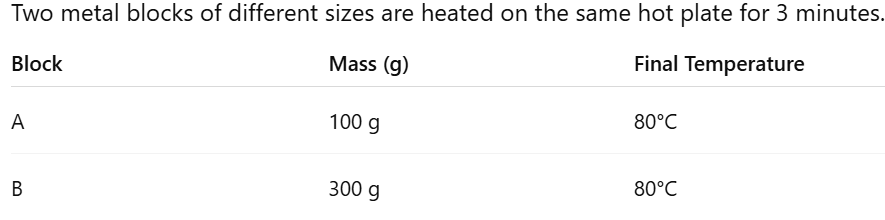
Which block has more thermal energy...or do they have the same amount?
Block B has more thermal energy because it has more mass.
200
This level of organization comes after tissues but before organ systems.
Organs
200
Water (H2O) is classified as a molecule because:
A. it's composed of multiple chemically bonded atoms
B. it changes phases when exposed to thermal energy
C. it's composed of elements that are gases
D. it has mass and takes up space
A. is composed of multiple chemically bonded atoms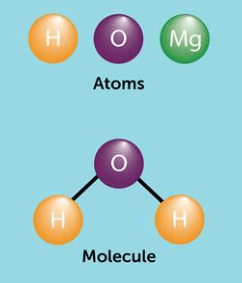
200
When the Moon appears completely lit, it is known as this phase.
Full moon
200
This type of plate boundary is responsible for the majority of earthquakes.
Transform Boundary
300
As thermal energy increases, the __________ energy, also called the energy of motion, of a substance also increases.
Kinetic
300
Coral reefs are most commonly found in shallow, warm water because the algae attached to them require this process to create food.
Photosynthesis
300
The movement of tectonic plates is driven by this process in the mantle.
Convection currents
400
This material has a high conductivity of heat and therefore is often used in cooking.
Metal
400
Imagine looking at a grain of salt under a microscope.
A. Is the salt living or non-living?
B. From looking through the microscope, how would you know?
A. Non-living
B. It does not have cells.
500
This event is primarily caused by increased ocean temps due to climate change. Coral becomes stressed and expels the algae living in their tissues, turning them white.
Coral bleaching
500
The gravitational pull between Earth and the Moon is responsible for this ocean phenomenon.
Tides