Periodic Table
Bonds / Valance Electrons
Valence Electrons
Chemical Reactions Basics
Balancing Chemical Reactions
100
The columns (up and down) on the periodic table are called ___________.
Groups
100
What can you find by looking at the groups on the periodic table?
Valance Electrons
100
How many valence electrons does Calcium have?
2 Valance Electrons
100
This law states that matter is neither created nor destroyed in a chemical reaction it is only rearranged.
Law of Conservation of Mass
100
In the following equation, what are the reactants?
GaF3 + Cs --> CsF + Ga
GaF3 and Cs
200
The rows (right to left) on the periodic table are called _________.
Periods
200
What type of bonds happen between metals and nonmetals?
Ionic Bonds
200
What rule do you use to find the number of valence electrons that are in groups 13 - 18?
Drop the 1 rule
200
If a reaction starts with 30 grams of reactants, then the reaction should end with ______ grams of products.
30
200
Where are the products found in a chemical equation?
After the arrow, on the right side of the equation
300
Calcium is what type of element? (Metal / Nonmetal / Metalloid)
Metal
300
Covalent bonds happen between ____________. (type of element)
Nonmetals
300
How many valance electrons does carbon have?
4
300
In the following reaction, 10 grams of Hydrogen were added to 40 grams of Nitrogen. How many grams of NH3 will be produced?
N2 + 3 H2 --> 2 NH3
50 grams of NH3
300
Is this reaction balanced or unbalanced?
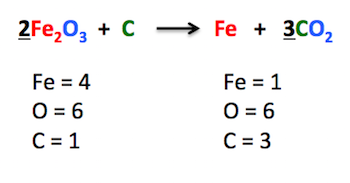
Unbalanced
400
Elements in the same __________ have similar properties.
Group
400
What type of bonds form between the elements in the following compound?
SO2
Covalent bonds
(BOTH ELEMENTS ARE NONMETALS)
400
How many valence electrons does Lithium have?
1 valence electrons
400
How does this reaction show the law of conservation of mass?
N2 + 3 H2 --> 2 NH3
The number of N and H on the reactants is the same as the number of N and H on the products.
400
Balance the following:
____ N2 + ____ H2 --> ______ NH3
N2 + 3 H2 --> 2 NH3
500
Which elements have similar properties?
a. Hydrogen and Helium
b. Oxygen and Sulfur
c. Carbon and Nitrogen
b. Oxygen and Sulfur
500
When Na and F form a compound, what type of bond is formed.
Ionic Bond
(Metal + Nonmetal)
500
Which group on the periodic table meets the octet rule and will not form any bonds?
Group 18
500
How many grams of product X would there be?
10g reactant + 20g reactant -> product X + 5g product Y
25 grams of product X
500
Balance the following:
___ GaF3 + ____ Cs --> ___ CsF + ___ Ga
GaF3 + 3 Cs --> 3 CsF + Ga