General Chemistry
Periodic Table
Chemical Equations
Chemical Equations 2
Miscellaneous Chemistry
100
Where the nucleus of an atom is located.
What is the center of the atom?
100
The periodic table is organized by this aspect of an atom.
What is the atomic number of an atom?
100
Two or more atoms chemically combined. May be the same.
What is a molecule?
100
Two or more atoms of different elements chemically combined.
What is a compound?
100
The region surrounding the nucleus of an atom. It is actually mostly space.
What is the electron cloud?
200
The positively charged subatomic particle found in the center of the atom.
What is a proton?
200
What rows are called.
What is a period?
200
How you determine the number of elements in a formula.
What is count all the capital letters?
200
This number tells you how many atoms of an element are found in the formula.
What is a subscript?
200
The element that is brittle and does not conduct electricity is letter _____. 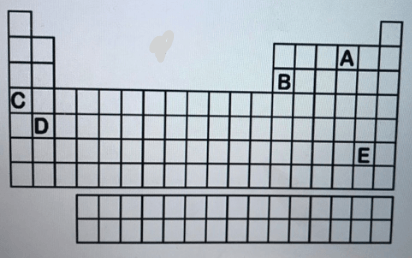
What is letter A?
300
The subatomic particle which does not have any charge at all.
What is a neutron?
300
What columns are called.
What are families or groups?
300
A symbolic representation of a chemical reaction, like the process of photosynthesis, for example.
What is a chemical equation?
300
In a chemical equation, these are the materials that we start with.
What are reactants?
300
Rust on a bicycle is an example of this type of change.
What is a chemical change?
400
The mass of each of the subatomic particles found in the nucleus.
What is 1 atomic mass unit, or AMU?
400
The sum of protons plus neutrons
What is the atomic mass number (accept mass)
400
This number tells you how many molecules (or sometimes atoms) of a formula are in the equation.
What is a coefficient?
400
The chemicals that result from a chemical reaction.
What are products?
400
Element letters C and D have luster and conduct electricity. They are ____________. 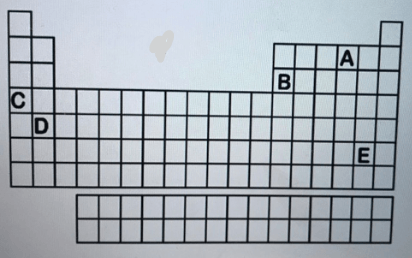
What are metals?
500
The subatomic particle that is 1/2000 the size of the other subatomic particles.
What is the electron?
500
Elements in a period all share this same aspect of atomic structure.
What is the number of electron shells?
500
The large-sized number found in front of the N.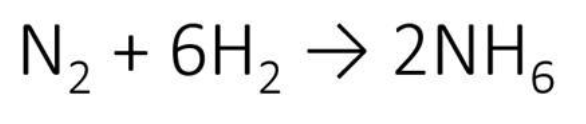
What is the coefficient?
500
The small number found behind and below the element symbols.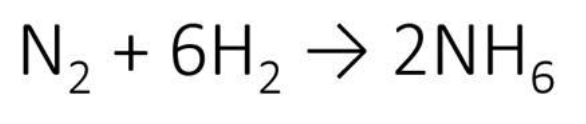
What is a subscript?
500
Argon (Ar) and Magnesium (Mg) have the same number of ___________.
What are electron shells?
600
positive, negative and neutral
What are the charges on the subatomic particles?
600
Elements in a family/group all share the same number of these.
What are valence electrons?
600
When the number of atoms of all elements going into a rxn are the exact same as the number of atoms of those elements coming out.
What is balanced?
600
What goes in must come out (the same number of atoms).
What is the Law of Conservation of Mass?
600
Neon (Ne) and Krypton (Kr) have the same number of _______________.
What are valence electrons?
700
The name for the outer shell of an atom
What is the valence shell?
700
All elements in a column share this same characteristic.
What is reactivity?
700
The total number of oxygen atoms in the reactants.
What is 6?
700
The total number of atoms in the reactants. 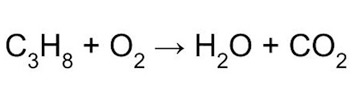
What is 13?
700
The most reactive element in the table is letter ____.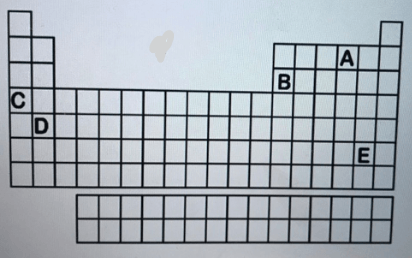
What is letter C?
800
Determines the reactivity of an element.
What is a valence electron?
800
All elements in a row have this property in common.
What is nothing?
800
This is how to determine whether a chemical equation is balanced or not.
What is counting the number of atoms of each element on each side?
800
This equation is ______________. 
What is unbalanced?
800
Element C is in the ______ period and the ______ group.
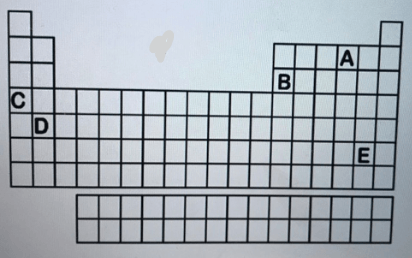
What is the 4th period and 1st group?
900
Subatomic particle that determines the identity of an atom.
What is a proton?
900
All element symbols start with this.
What is a capital letter?
900
The five signs of a chemical reaction.
What are GETPC (gas emitted, energy released, temperature change (unexpected), precipitate formed, color change (unexpected)?
900
These two equations have the same number of oxygen atoms.
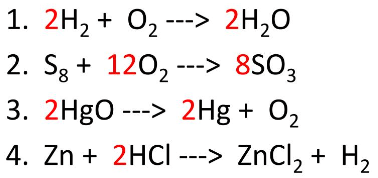
What are equations 1 and 3?
900
This element has the greatest atomic mass of those shown.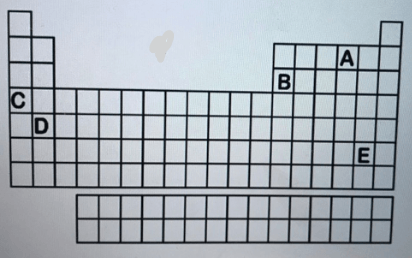
What is element E?
1000
An atom whose numbers of protons and electrons are not the same.
What is an ion?
1000
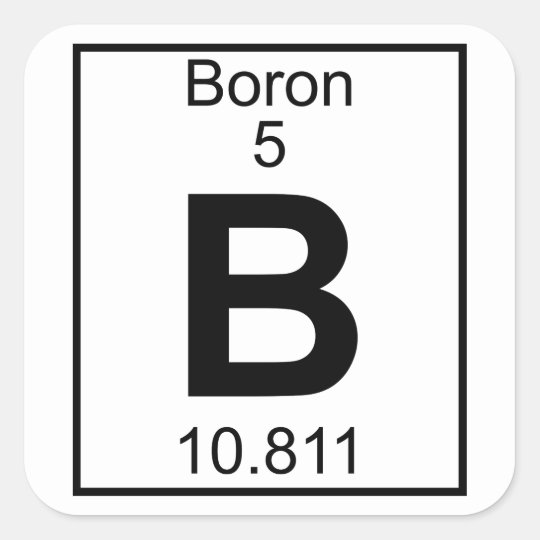 The names for the top and the bottom numbers in this element square.
What are atomic number and atomic mass?
1000
The number of elements in carbon dioxide.
What is 2?
1000
The total number of grams of reactants if the outcome is 10 grams of water and 5 grams of carbon dioxide.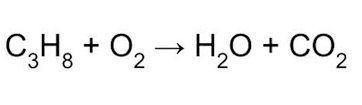
What is 15 grams?
1000
The two elements most likely to form a chemical bond together are ______ and ______. 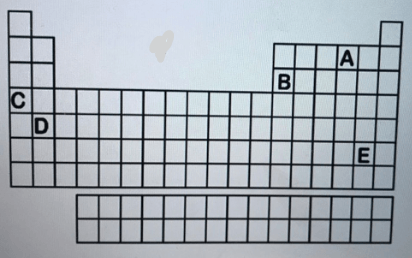
What are C and E?