Declaration of Independence and Thomas Paine
What Challenges faced the continental army?
Winning Independence
A weak Confederation and Ideas that shaped the Constitution
Drafting a Constitution/ Understanding the Constitution
100
What does the Declaration of Independence open with?
The Preamble
100
How did the Continental Army compare to the British Army?
The Continental Army was significantly weaker, was untrained, and had very limited weapons, food, and clothing. The British Army was much larger, trained, disciplined, and had a better availability of weapons, food, and clothing.
100
What were some of the challenges that the Patriot Army faced at Valley Forge?
Through the bitter winter of 1777–1778, Washington and his troops suffered terribly at Valley Forge, Pennsylvania. The army was undersupplied, with shortages in food, clothing, and medicine. Drafty huts could not keep out the chill. Many soldiers were sick. Nevertheless, the soldiers gathered their strength and sharpened their skills for the battles to come.
100
What group of people led Shay’s Rebellion? Why was this Rebellion important?
During the mid-1780s, economic hard times in Massachusetts caused many farmers to lose their land because they could not pay their taxes. In Shays’ Rebellion, a group of Massachusetts farmers rose up against the state in protest. The rebellion failed, but it led to calls for a stronger national government.
100
What was the Great Compromise?
In one house of Congress, the House of Representatives, each state’s representation would be based on population, and larger states would have more representatives. In the other house, the Senate, each state would have two senators.
200
Who was Thomas Paine?
Thomas Paine was a British writer and editor who moved to Philadelphia in 1774. After Lexington and Concord, Paine wrote the Pamphlet Common Sense.
200
What was the major turning point of the Revolutionary War?
The American victory at the Battle of Saratoga was a major turning point in the war
It ended the British threat to New England
It boosted American spirits at a time when Washington’s army was suffering defeats
Most importantly, it convinced France to become an ally of the United States
200
Describe how women helped with the war effort
Many women supported the war effort, they took on added work at home. Some planted and harvested the crops. Others made shoes and wove cloth for blankets and uniforms. Some joined their husbands at the front, taking care of the wounded, washing clothes, and cooking. Others fought in battles.
200
What ideas of John Locke influenced the Framers?
Locke declared that every person has a natural right to life, liberty, and property.
200
What was the Three-Fifths Compromise?
The southern states wanted enslaved people to count toward representation in the House. Northerners argued that enslaved people should not be counted. It was agreed that each enslaved person would count as three-fifths of a person. This was called the Three-Fifths Compromise.
300
Was Common Sense a success? What did Common sense cause many colonial leaders to do?
Common sense was a great success, it played an important role in moving toward revolution. Common Sense caused many colonial leaders to move toward declaring independence from Great Britain. It also deeply impressed many members of the Continental Congress.
300
Why did France start to aid the Americans in the Revolutionary War?
The American victory at Saratoga convinced France that the United States could stand up to Britain.
300
What did the British offer African Americans to attempt to get them to fight for them? How did Washington respond?
At first, the Continental Congress banned African Americans, both free and enslaved, from joining the army. However, the British offered freedom to all enslaved people who would serve on their side. Washington changed American policy after seeing how many African Americans joined the British cause.
300
What ideas of Montesquieu’s influenced the Framers?
Montesquieu suggested the concept of separation of powers. Separation of powers states that the powers of government must be clearly defined and divided into legislative, executive, and judicial branches.
300
What branch of Government do Articles 1, 2, and 3 of the Constitution focus on?
Article 1 of the Constitution sets up the Congress to make the nation’s laws.
Article II of the Constitution sets up the executive branch to carry out laws and to run the affairs of the national government.
Article III of the Constitution established a Supreme Court and authorizes Congress to establish other courts that are needed.
400
What do the first, second, and third sections of the Declaration of Independence state?
First section - unalienable Human Rights: The first section of the declaration stress the idea of natural rights
The second part of the declaration list’s the wrongs, or grievances, that led the Americans to break away from Britain
The last part of the declaration announces the colonies are the United States of America
400
When did Washington cross the Delaware River, and what occurred?
On the night of December 25, 1776, Washington led his ragtag army across the frozen Delaware River to Trenton, where a force of German soldiers, or Hessians, was camped. The Americans took most of the Hessians prisoner. They were able to escape British forces who tried to retake Trenton.
400
How did the French help the Americans win at Yorktown?
The French Army advances from the west and the American Army advances from the south toward the British Army in Yorktown on the banks of the York River. The British and French Navies have ships in the river. Across the water, there are more British forces on the banks of the river, with American and French troops pinning them in.
400
Name 1 strength and Weakness of the Articles of Confederation
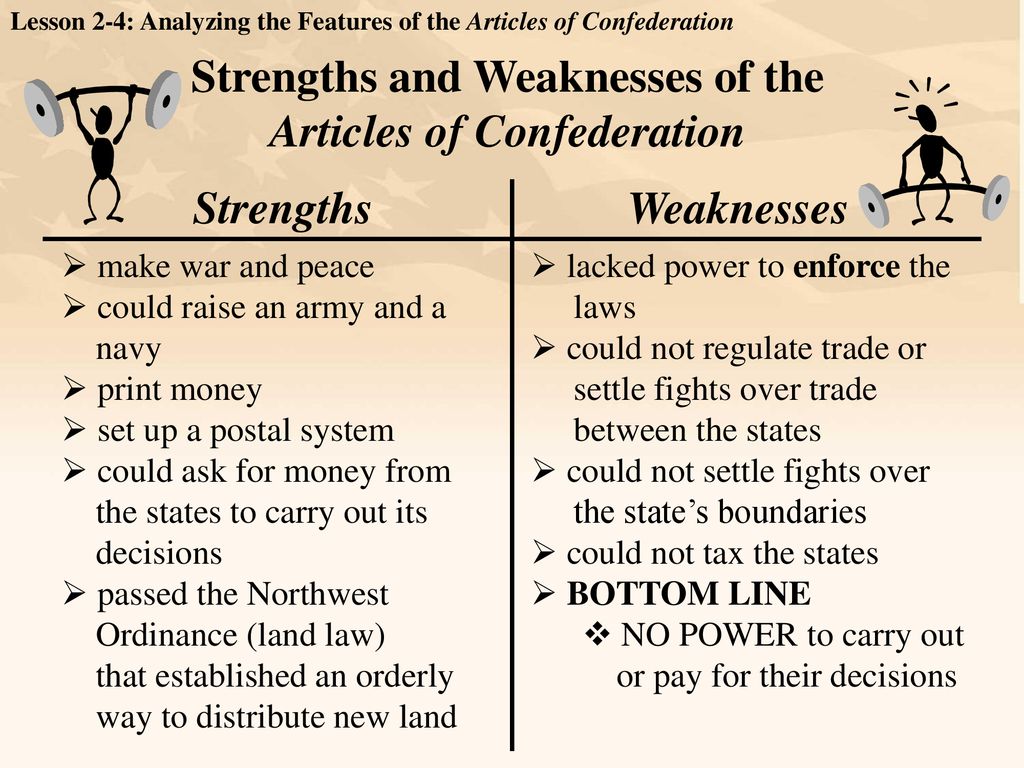
Strengths
It left states free to make decisions for themselves.
It prevented the federal government from gaining too much power.
Congress did have the power to declare war.
It could appoint military officers, coin money, and operate post offices.
It also could conduct foreign affairs and sign treaties.
Weaknesses
Congress had very limited powers.
Congress could pass laws, but nine states had to approve a law before it could go into effect.
Even then it was up to the states to enforce the laws passed by Congress.
The Articles included no president to execute laws.
Congress could not regulate trade between states or between states and foreign countries.
Congress did not have the power to tax.
To raise money, Congress had to ask the states for funds or borrow them.
No state could be forced to contribute funds to the national treasury.
There was also no system of courts to settle conflicts between states.
400
Which amendments are known as the Civil War amendments? Name what the amendments do specifically.
The Thirteenth Amendment abolished slavery.
The Fourteenth Amendment guaranteed citizenship to former slaves.
The Fifteenth Amendment declared that states may not deny the vote to any citizen on the basis of “race, color, or previous condition of servitude.” This guaranteed African-American men the right to vote.
500
What did the book Common Sense set out to do? What did the book specifically state?
Common Sense set out to change the colonists’ attitudes towards Britain and the King of England. It specifically stated that the colonists did not owe loyalty to George III or any other Monarch, and that the colonists believed that they did not owe anything to Britain, either.
500
Who was Nathan Hale? Why did he go behind British lines?
Washington needed information about Howe’s forces. Nathan Hale, a young Connecticut officer, volunteered to go behind British lines. As Hale waited to be hung, he stated: “I only regret that I have but one life to lose for my country.”
500
What was Sir Henry Clinton’s plan for the South? Did it work?
Sir Henry Clinton, the new British commander-in-chief, knew that many Loyalists lived in the southern backcountry and he hoped that Loyalists would join the British troops. At first, Clinton’s plan seemed to work. However, After 1780, attacks by British troops and Loyalist militia became especially cruel. As a result, more settlers began to side with the Patriots.
500
What were the two laws that Congress set up to help settle the disagreements about the western lands?
Congress passed two laws that set up a method for settling the territories, and thestates agreed. The first, the Land Ordinance of 1785, divided public western lands into square townships. Within each township were 35 sections that were sold to settlers, and one that was set aside to support schools. This reflected the belief of the nation’s leaders that democracy depended on education.
The second law, the Northwest Ordinance of 1787, established a government for the Northwest Territory. It guaranteed basic rights to settlers and established a process for creating new states in the territory. Eventually, five states would be settled in the Northwest Territory, including Michigan!
500
Name the 3 things a person must do in order to become a naturalized citizen.
Take a test to show that you are comfortable with the English language and that you are familiar with American history and government. Have/show “good moral character.” Then, a naturalization examiner interviewed you about your reasons for becoming a citizen.