Solar System Objects
Learning About The Universe
Stars
Galaxies
Timeline
100
What is the solar system?
The solar system consists of the Sun (Sol), planets, their moons, and other objects.
100
orbiter
100
what's are nebulas and what do they tend to form?
A large cloud of gas and dust where protostars form.
100
What makes irregular galaxies different from the others?
it has no defined shape or pattern
100
Who was the pilot of the Apollo 11 moon landing?
Michael Collins
200
What is the main difference between inner and outer planets?
Inner planets are rocky, while outer planets are made of gases and liquids.
200
What is electromagnetic radiation?
Energy that travels through space in the form of waves.
200
What happens when a supergiant dies?
It will explode in a supernova and form a neutron star or black hole.
200
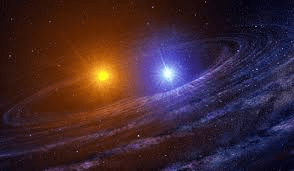
binary star system
200
What decade was the first artificial satellite launched?
1957
300
difference between asteroid, meteor, and meteorite.
asteroid - in space, meteor - in our atmosphere, meteorite - crash landed
300
What makes a space probe different than a space shuttle?
An unmanned spacecraft designed to collect data in space.
300
More than what % of the stars in the known universe are not main sequence stars?
10%
300
What is parallax used for?
When trying to determine the distance of nearby stars
300
What was the goal of building the ISS?
to have a space-based laboratory that scientists could use to conduct research.
400
The furthest mars can be from the moon is about 2.6 AU. how many km is that?
390 million km
400
What is the difference between optical and non-optic telescopes?
optics look at light radiation while non-optics look at non-light radiation.
400
Why do stars that are bigger die faster?
because they burn through their own fuel faster. Like a big bonfire.
400
How many stars can globular clusters end up having
around a million
400
What was the name of the first space observatory made in 1990?
Hubble Space Telescope
500
What happens in the sun's core
hydrogen atoms fuse together through nuclear fusion to make helium and much of the energy released is gamma rays.
500
Heat signatures and heat-based imagery use what EM radiation?
infrared
500
If a star is the the top left corner of the H-R diagram, what does that mean for its temperature and brightness.
it's super bright and and very hot.
500
Who discovered the idea that the universe is ever expanding?
Edwin Hubble
500
What did Voyager 1 and 2 do that was so impactful?
They were the first man-made objects to visit the outer planets of the solar system.