Transformations
Transformations 2 Electric Boogaloo
Transformations 67
100
What type of rigid transformation is this?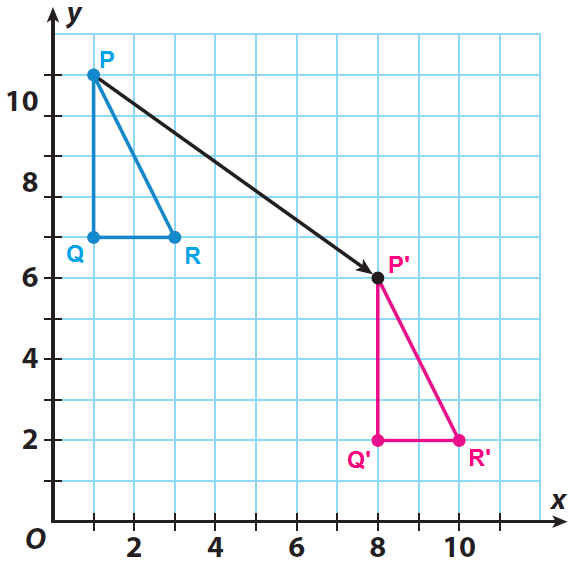
Translation
100
What is the algebraic rule for reflection over the x-axis.
(x,-y)
100
What is the transformation that represents a slide?
Translation
200
Reflect the point (3,4) over the y-axis
What is (-3,4)
200
What is the algebraic rule for a rotation 180 degrees.
(-x,-y)
200
What is the transformation that represents a turn
Rotation
300
Translate the point (4,6) right 4 units and up two units
What is (6,10)
300
What is the algebraic rule for a translation 7 left and 1 up.
(x - 7, y+1)
300
Which is a true statement about dilations?
A. A dilation always preserves congruence.
B. A dilation sometimes enlarges a figure.
C. A dilation always changes the orientation of a figure.
B.
400
A triangle in quadrant II (2) is going to be reflected over the y-axis. Which of the following is a true statement?
A. The image will be in quadrant III (3).
B. The orientation of the vertices will not change.
C. The image will be in quadrant I (1).
C.
400
What is the algebraic rule for a rotation 270 degrees counterclockwise?
( y, -x)
400
Triangle PQR is translated 9 units right and 11 units up. What is the algebraic rule?
(x + 9, y + 11)
500
Luke is going to reflect point R(6, 10) over the y-axis. What are the coordinates for R’?
(Hint: Find the rule for reflection over y-axis)
(-6,10)
500
Which of the following is the correct algebraic representation for a translation 8 units right and 4 units down?
A. (x + 8, y – 4)
B. (x – 4, y + 8)
C. (8x, 4y)
A.
500
Ben transformed a figure from quadrant IV to quadrant I. The pre-image and image are congruent figures, but the orientation of the figure changed (The vertices are in different spots). Which could be the transformation Ben used?
A. A rotation 90° counterclockwise
B. A dilation by a scale factor of 2
C. A translation up
A.