Scientific Investigation
Theories & Laws
Measurement & Atom Forces
Matter & Energy
Earth Cycles & Spheres
100
Name at least 2 (of 4) criteria for Scientific Explanation
What are Follows Logic, Peer Review, Global Access and Rules of Evidence
100
Once a THEORY is tested and proven, it becomes a LAW. True or False
FALSE
100
"g" stands for in measurement
g=gram
100
Forms of ____________ that can perform work include heat, movement, electricity, and gravity. _____________ is any substance that has mass and takes up space.
What is ENERGY and MATTER?
100
This is the release of water vapor from plants into the atmosphere.
What is Transpiration?
200
PSEUDOSCIENCE
What is lacking scientific method with untested or proven claims and biases.
200
Scientific _________ give detailed accounts of what does and will happen in nature, and ________ attempt to explain why something happens. (Hint: category)
What are LAWS and THEORIES
200
Type of graph and best use. Intersecting Circles (2)
What is a Venn Diagram used for finding similarities and differences or comparing/contrasting
200
The heat from the bonfire is transferred to the student's hands through this process.
What is RADIATION?
200
Starting with Transpiration, name the other parts of the Water Cycle. (At least 4 more of the 7)
What are transpiration (given), evaporation, condensation, precipitation, run-off, infiltration/groundwater, and collection-body of water?
300
Hypothesis
What is an educated guess that can be proven or disproven, using variables to explain a relationship, prior knowledge, observations, and theories?
300
Name at least 3 of the 5 steps that make up the Scientific Method.

300
Seconds and Kelvin (s) and (k) SI stand for
What are the International System of Units for time and temperature?
300
The three types of Energy Transfer
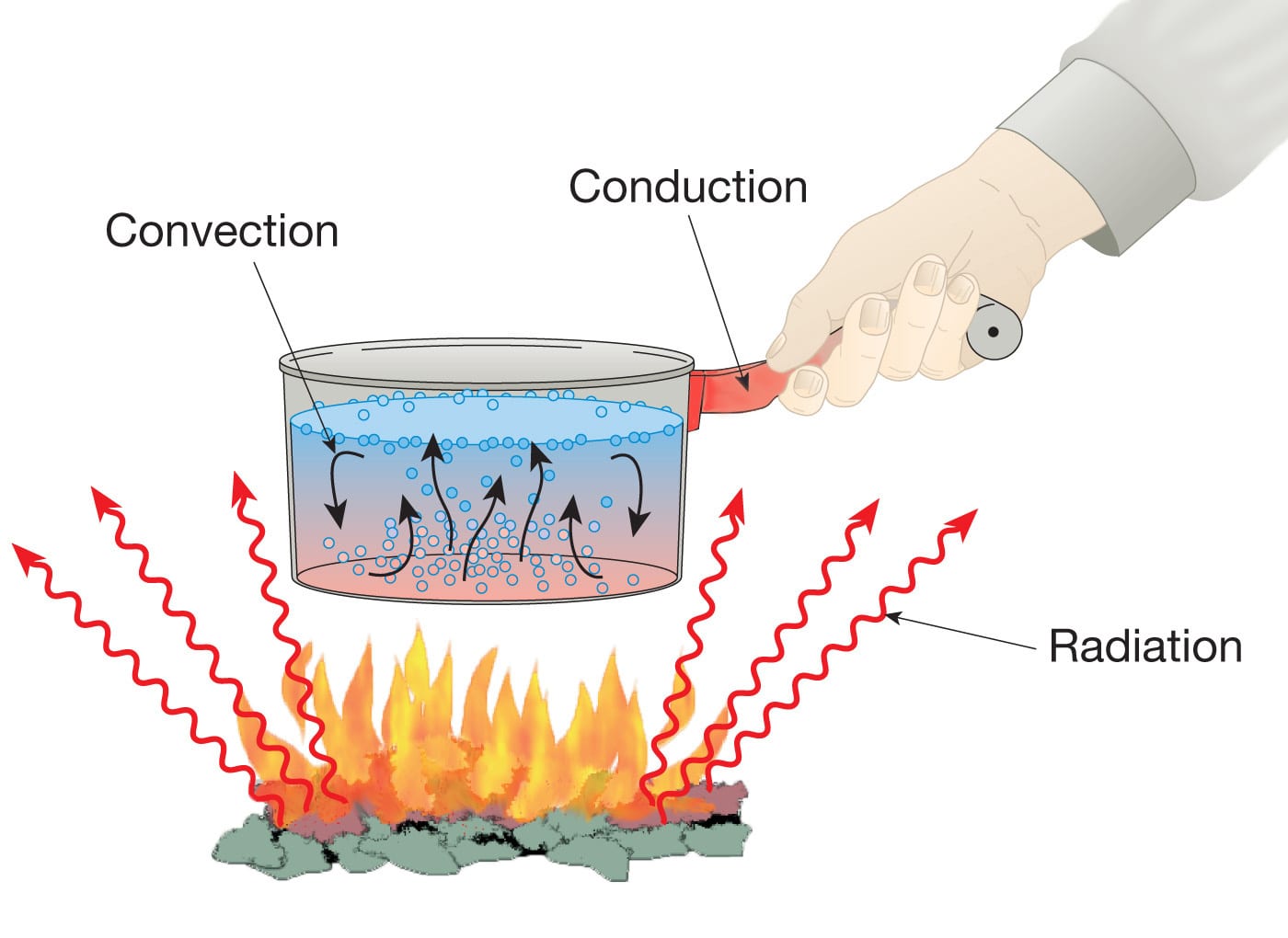
300
The 5 Atmospheric Layers in order. (Remember "The Silly Monkeys Throw Eggs)
What are the Troposphere, Stratosphere, Mesosphere, Thermosphere, and Exosphere
400
Scientific knowledge is both long lasting and always ______________.
What is CHANGING?
400
Where you will find VARIABLES in the Scientific Method steps
HYPOTHESIS and EXPERIMENT
400
Dmitri Mendeleev created
The Periodic Table
400
At least three (3) of the four (4) States of Matter.
What are solid, liquid, gas, and plasma?
400
The number of waves that pass a given point in a given amount of time, on a wavelength, is called this.
FREQUENCY
500
To prove a hypothesis and make the conclusions of an experiment reliable, scientists do this.
What is REPEATING an experiment several times and getting the same results?
500
The _________ variable is the factor a scientist chooses to keep constant over the course of an experiment.
The _________ variable is the factor that changes in response to the ___________ variable.
- The CONTROLLED variable is the factor a scientist chooses to keep constant.
- The DEPENDENT variable is the factor that changes in response to the INDEPENDENT
- The controlled variable allows the scientist to focus only on the results that occur.
500
Neutrons _____ charged
Protrons _____ charged
Electron _____ charged
Neutrons are Neutral/none/0
Protons are Positive/+/+1
Electrons are NEGATIVE/-/-1
500
Briefly describe the process involved for a phase change to occur between gas and solid, and provide an example.
What is Deposition, where gas particles have high kinetic energy, moving freely and far apart. For deposition to occur, these particles must release significant thermal energy. As energy is lost, gas particles slow down, and their intermolecular forces become strong enough to hold them in fixed positions. Instead of becoming a liquid, the particles transition directly into a solid lattice structure, forming a solid substance. Ex: Frozen fog, Frost Dry Ice, soot in fireplace
500
These are the 4 main interconnected systems known as Spheres of our Earth and what they pertain to.
Biosphere (life), Geosphere (land), Hydrosphere (water), and Atmosphere (air)