Scientific Method & Inquiry
Lab Safety
Lab Equipment
SI Units, Metric Conversion, Scientific Notation
Organizing Data and Analyzing Graphs
100
“If tomato plants receive more hours of sunlight per day, then they will grow taller.” Is this an observation, hypothesis, or prediction?
Prediction.
100
Which item protects your eyes against chemical splashes?
Safety goggles.
100
Which tool measures the mass of an object?
A balance.
100
What is the SI BASE unit of mass?
Gram (g).
100
Which graph type is used to compare categories?
A bar graph.
200
A student says, “The plant’s leaves wilted because it did not receive enough water.” Is this an observation or an inference?
Inference, because the student explains a possible cause of the wilting.
200
Which safety equipment flushes chemicals from the eyes?
Eyewash station.
200
Which tool magnifies biological specimens that are too small to see clearly?
A microscope.
200
Convert 0.075 meters to millimeters.
75 mm.
200
Which graph type commonly shows change over time?
A line graph.
300
A student observes that several bean plants grow toward a light source and concludes that plants generally grow toward light. Is this inductive or deductive reasoning?
Inductive reasoning, because the student uses specific observations to form a general conclusion.
300
Where should broken laboratory glass be disposed of?
In the designated broken-glass container.
300
Which tool is most appropriate for measuring 37 mL of water?
A graduated cylinder.
300
Convert 2,400 milliliters to liters.
2.4 L.
300
On which axis is the independent variable usually plotted in an experiment?
The x-axis.
400
Lydia gives fertilizer to bean plants in bright light and no fertilizer to bean plants in dim light. Why can she not conclude that fertilizer caused the difference in growth?
She changed both fertilizer and light exposure, so either could have affected growth.
400
Ben places his nose directly over a chemical container to smell it. What technique should he use instead if the teacher permits checking its odor?
Wafting: gently fan vapors toward his nose.
400
A balanced triple-beam balance has rider readings of 100 g, 50 g, and 4.2 g. What is the sample’s mass?
154.2 g.
400
Write 86,000,000 in scientific notation.
8.6 × 10⁷.
400
The accepted mass of a sample is 50.0 g. A student measures it three times and records 35.5 g, 35.6 g, and 35.5 g. Are these measurements accurate, precise, both, or neither?
Precise but not accurate, because the measurements are close together but far from the accepted value of 50.0 g.
500
Stiles investigates how salt concentration affects bean-seed germination. He gives three groups of seeds solutions containing 0%, 1%, or 2% salt. Each group receives 10 mL of solution daily and is kept at the same temperature. After five days, he counts how many seeds germinated in each group.
Identify the independent variable, dependent variable, and two constants.
- Independent variable: Salt concentration.
- Dependent variable: Number of seeds that germinated after five days.
- Constant 1: Amount of solution added daily (10 mL).
- Constant 2: Temperature.
500
Aya heats a test tube with its opening pointed toward her partner. How should she position the opening?
Away from herself and everyone else.
500
Which part of the water meniscus should you read when measuring volume in a graduated cylinder?
The bottom of the meniscus, viewed at eye level.
500
Write 0.0000064 in scientific notation.
6.4 × 10⁻⁶.
500
How does this graph make the differences between the students’ measurements look misleading?
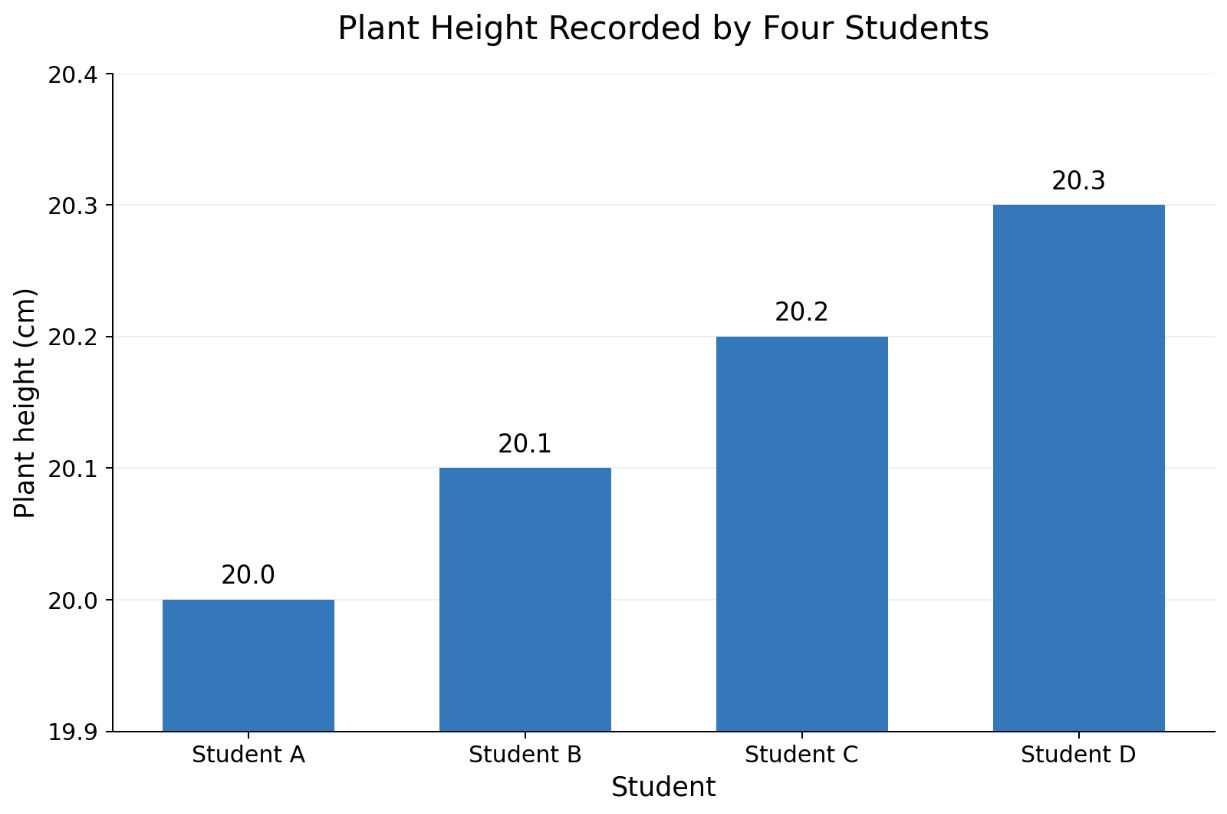
The vertical axis starts at 19.9 cm instead of zero, making small differences of only 0.1–0.3 cm look much larger.