Key Features
Graphing
Solving (rational)
Solving (irrational)
Systems
100
Find the zeros of the quadratic function.
y=x^2-6x-16
0=x^2-6x-16
0=(x-8)(x+2)
x-8=0, x+2=0
x=8,-2
100
What are the x-intercept(s)? y-intercept?
y=-x^2+12x-27
*will have to also graph on test
x-int: (3,0) & (9,0)
y-int: (0,-27)
100
Solve.
3(6-w)(5w-2)=0
w=6, 2/5
100
Find the roots:
y=x^2-18x+68
Complete the Square
x^2-18x=-68
x^2-18x+81=-68+81
(x-9)^2=20
sqrt((x-9)^2)=sqrt(20)
x-9=+-sqrt(20)=+-2sqrt(5)
x=9+-2sqrt(5)
100
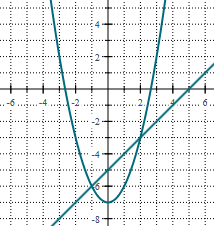
What is the solution?
*will also have to graph on test
Intersection points:
(-1,-6) and (2,-3)
200
What is the axis of symmetry?
y=(x+7)^2-8
*will have to also graph on test
Symmetry line: x=-7
200
What is the vertex?
y=-(x-5)^2-1
*will have to also graph on test
Vertex: (5,-1)
200
Solve.
3v^2=21v
Zero Product Property
3v^2-21v=0
3v(v-7)=0
3v=0, v-7=0
v=0,7
200
Solve. Give exact answers.
u^2-40=0
Complete the Square
u^2-=40
sqrt(u^2)=sqrt(40)
u=+-sqrt(40)=+-2sqrt(10)
u=+-6.3245...
200
Solve the system algebraically.
y=x^2-3x+2
y=5x-10
5x-10=x^2-3x+2
0=x^2-8x+12
0=(x-6)(x-2)
x=6,x=2
Answer: (6,20)&(2,0)
300
Which function has the largest min/max? What is the min/max?
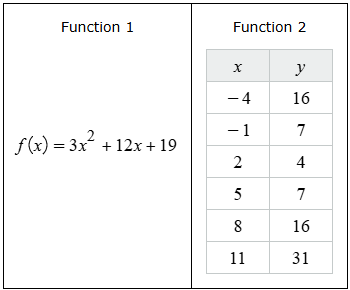
Function 1 VERTEX: (-2,7) --> min =7
Function 2 VERTEX: (2,4) --> min = 4
Largest min is 7 (function 1)
300
Let a<0, b>0, and c<0
Describe the graph:
y>ax^2+bx+c
Downward parabola (u-shape)
Dashed curve
Shade outside
300
Solve.
9w^2=30w-25
Zero Product Property
9w^2-30w+25=0
(3w-5)^2=0
3w-5=0
w=5/3
300
Use the quadratic formula to solve for x.
2x^2+4x=7
x=(-4+-sqrt(72))/4=(-4+-6sqrt(2))/4
x=(-2+-3sqrt(2))/2=-1+-3/2sqrt(2)
300
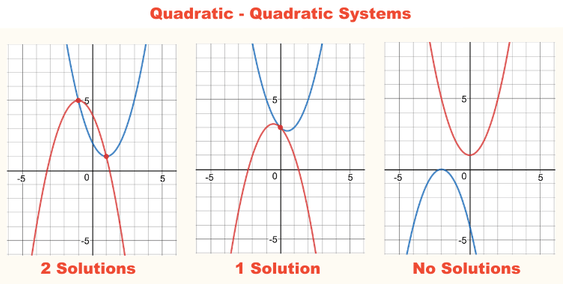
Draw a picture of a system with no solutions, one solution, and two solutions.
y=ax^2+bx+c
y=ax^2+bx+c