Exponential Growth & Half Life
Triangles & Trig
Compound Interest
Unit Circle
Logarithms
100
The population of a bacteria can be modeled by the function B(t)=150(1.23)t , where B(t) is the population t hours since 9 AM. What does the 1.23 represent in this function?
The bacteria grows 23% every hour
100
Solve for x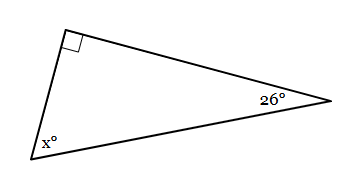
64 degrees
100
Dylan invested $93,000 in an account paying an interest rate of 3% compounded quarterly. Assuming no deposits or withdrawals are made, how much money, to the nearest cent, would be in the account after 17 years?
$154577.64
100
What is cos(pi/3)?
1/2
100
Convert this log to exponential form:
log4 8 = 2
42 = 8
200
The population of a school of fish can be modeled by the function F(t)=75(1.06)t , where F(t) is the population t years since 2022. What does the 1.06 represent in this function?
The population of fish grows 6% every year
200
Solve for x.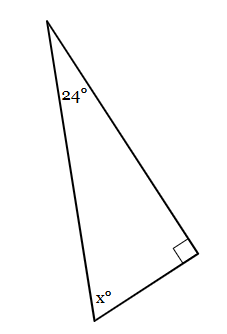
66 degrees
200
Alexander invested $240 in an account paying an interest rate of 2.3% compounded annually. Assuming no deposits or withdrawals are made, how much money, to the nearest dollar, would be in the account after 9 years?
$295
200
What is
sin((2pi)/3)?
sqrt(3)/2
200
Convert this log to exponential form:
log k = w
10w = k
300
A gallbladder scan involves an injection of 0.9 mL of a radioactive material called Technetium-99m. Technetium-99m has a half-life of 5 hours. How much of the radioactive material will be left in the patient’s bloodstream after 8 hours?
0.2969 mL (about 0.3 mL)
300
Solve for x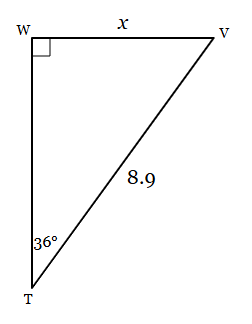
x = 5.2
300
Hudson invested $8,400 in an account paying an interest rate of 5.4% compounded quarterly. Assuming no deposits or withdrawals are made, how much money, to the nearest ten dollars, would be in the account after 13 years?
$16870
300
What is
cos(pi/4)?
sqrt(2)/2
300
Evaluate the logs:
a. logr sqrt(r)
b. logk(k)
a. 1/2
b. 1
400
A new car is purchased for $18,000 and over time its value depreciates by one half every 6 years. What is the value of the car 19 years after it was purchased. to the nearest cent?
$2004.52
400
Solve for x.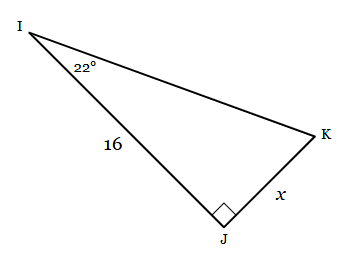
x = 6.5
400
Ian invested $90,000 in an account paying an interest rate of 2.6% compounded quarterly. Assuming no deposits or withdrawals are made, how much money, to the nearest dollar, would be in the account after 7 years?
$107902
400
What are the two angles (in radians) at which
sin theta = cos theta ?
pi/4 AND
(5pi)/4
400
log28 = ????
(NO CALCULATOR)
3