Equipment Connections & Circuitry
Compressors, Pressures & Design Codes
Hoses, Nozzles & Mechanics
Abrasive Media, Nozzles & Techniques
Safety
100
The key components of the blast equipment are connected using this primary component.
Answer: What are hoses?
Key Point: Blast hoses must be heavy-duty, static-dissipating, and rated for high-pressure abrasive media flow.
Inspect hose outer walls daily for wear, bulging, or soft spots caused by high-velocity abrasive friction.
100
Pressurized blast machines (blast pots) are ASME coded for a working pressure of at least this value.
Answer: What is 125 psi?
Key Point: All portable or stationary pressure vessels in abrasive blasting must meet strict ASME (American Society of Mechanical Engineers) safety standards.
Don't operate an uncertified or a compromised blast pot
100
Blast nozzle orifice sizes are traditionally measured in increments of this fraction of an inch.
What is sixteenths of an inch? (e.g., a No. 3 nozzle is 3/16", No. 4 is 4/16" or 1/4")
Key Point: Knowing exact orifice sizing is necessary for matching compressor CFM output to prevent pressure drops.
Nozzle wear over time enlarges the orifice, which quietly starves the system of required air pressure if the compressor isn't adjusted.
100
This is the most common metallic abrasive used in industrial blasting.
Answer: What is cast steel?
Key Point: Cast steel shot("Steel shot") and grit offer high durability, allowing them to be recycled hundreds of times in automated recovery systems.
metallic abrasives used in permanent shop facilities with consumable mineral/slag abrasives utilized in open-air field projects.
100
Question: Communications radios used on busy abrasive blasting sites are typically configured for this radio frequency band.
What is UHF-FM?
Key Point: UHF signals penetrate heavy industrial steel structures and complex scaffolding much better than VHF frequencies.
Clear, reliable communication between the nozzle operator and the compressor/pot tender is vital for safety.
200
: Dual lines (electrical or pneumatic) that form a complete circuit between the control valve on the blast pot and the deadman switch are called these.
Twinline Control Hose
twinline pneumatic control hoses, which consist of joined dual lines running parallel to connect the blast pot remote control valves with the deadman switch at the nozzle.

200
No matter what the source, breathing air supplied to a helmet must meet this specific quality standard.
Answer: What is Grade-D?
Key Point: Grade-D breathing air limits oxygen content (19.5%–23.5%), hydrocarbons/oil vapor, carbon monoxide (max 10 ppm), and odor.
Regular compressed shop air is never safe for breathing without dedicated purification and monitoring systems.
Grade D Air Quality Standards: Air supplied to blast helmets must meet strict purity standards under 29 CFR 1910.134, ensuring it is free of hazardous levels of moisture, oil mist, particulates, and carbon monoxide.
200
A pop-up valve inside a blast machine allows for this specific automated function.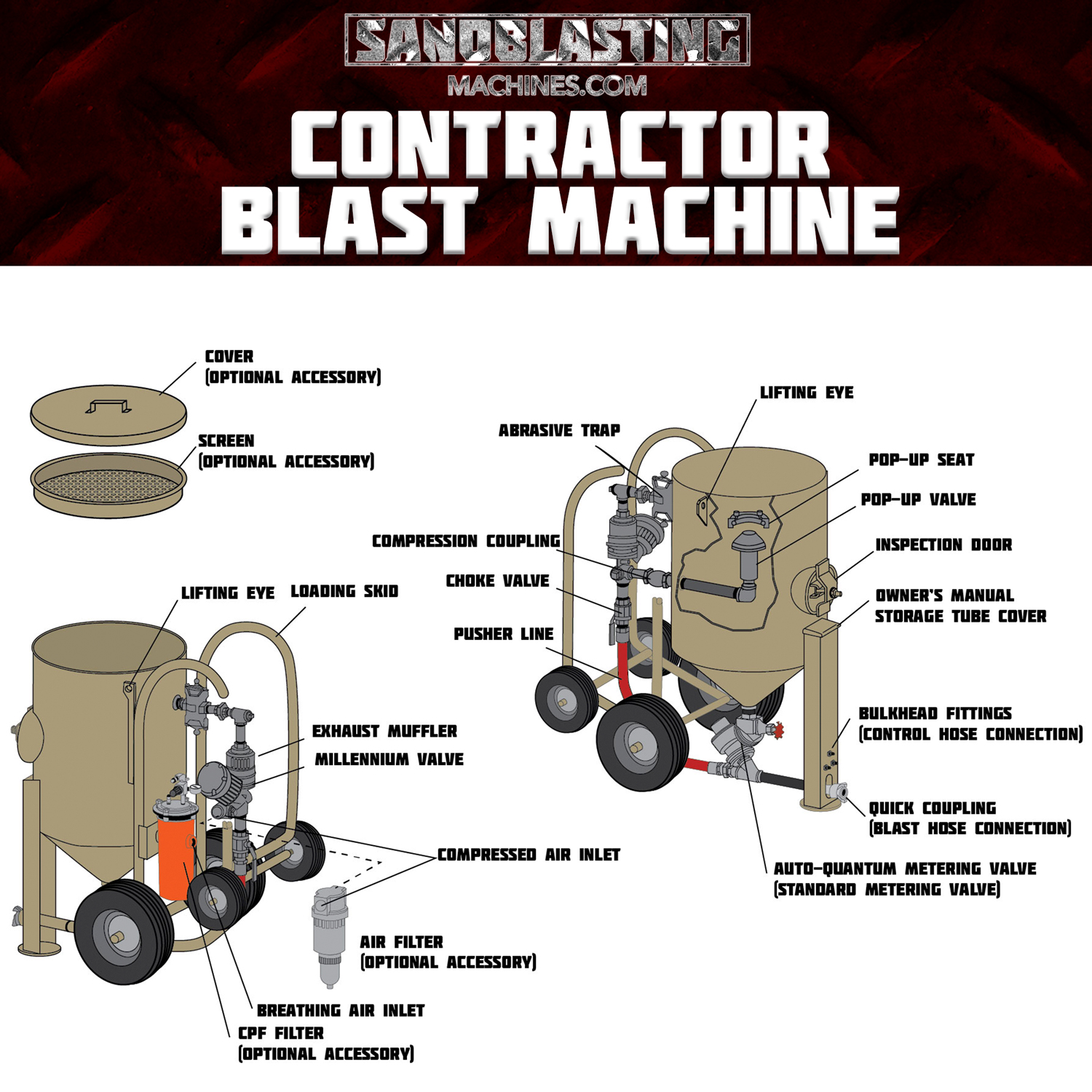
Answer What is automatic refilling of a blast machine?
Key Point: When pressurization drops or when filling, the internal pop-up valve seals tightly against the top opening to allow the vessel to pressurize.
Inspect the pop-up valve o-ring and seat regularly; a worn seal causes leaks and prevents the pot from holding pressure.
200
There are two primary designs of blast nozzles: the straight bore and this style.
Carbide Nozzles for Abrasive Blasting: Venturi vs Straight Bore—Choosing by Media + Airflow
● If your compressor can’t hold pressure at the nozzle, tungsten carbide sandblasting nozzle “shape” won’t save you. Start by matching orifice size + nozzle pressure to available CFM, then choose Venturi vs straight bore.
● Straight bore = tighter stream and concentrated pattern, typically better for small areas / spot work and when you want a narrow pattern.
● Venturi = wider pattern and higher particle acceleration for larger surfaces;
● Nozzle wear is a hidden airflow tax. At 100 PSI, a #6 (3/8") can move from ~196 CFM (new) to ~254 CFM (worn). If your compressor was sized “just enough,” your nozzle pressure will sag mid-life.
What abrasive are you actually running? and (2) What airflow can you truly deliver at the nozzle? Everything else follows.
200
Question: The minimum oxygen concentration percentage required in a supplied-air respirator system under OSHA standards.
Answer: What is 19.5%?
300
Question: This type of material is used to construct the most comfortable and durable blast suits for operators.
Answer: What is lightweight canvas weave?
Key Point: Heavy rubber or leather causes extreme heat exhaustion, while standard canvas weave balances breathability with protection against rebounding abrasive grit.

300
Question: For work environments where concentrations of toxic dust exceed the level of protection offered by a standard supplied-air respirator, OSHA requires that operators use this type of respirator
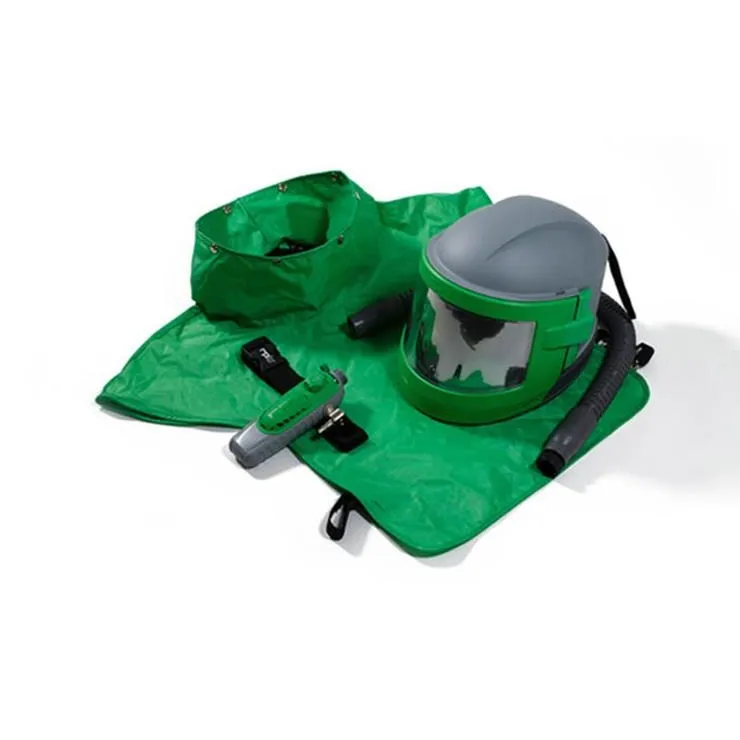
Answer: What is a pressure-demand respirator?
Key Point: Pressure-demand systems maintain positive internal pressure inside the hood at all times, preventing any toxic dust from leaking inward even if the shroud is slightly compromised.
Positive pressure safeguards workers when handling hazardous coatings like lead-based paint or asbestos abatement residues.
300
Air hoses supplying the system should be sized this many times larger than the blast nozzle orifice.
Answer: What is 3-4 times larger? (maintaining the standard 4:1 hose-to-nozzle inner diameter ratio)
Key Point: Undersized air lines choke off airflow velocity, destroying production rates at the nozzle.
"bull hoses" leading from the compressor must maintain a wide diameter right up to the moisture separator and blast pot.
300
Which specific job condition is typically addressed with a nozzle attack angle of 45° to 60°?
Answer: What is pitted surfaces? (or removing deep rust/heavy buildup)
Key Point: Angling the nozzle allows the abrasive stream to undercut and clean out deep corrosion pits that flat angles skip over.
Instructor Highlight: changing nozzle angle and standoff distance alters the blast pattern and profile depth on irregular substrates.
300
Question: The specific type of helmet protection required for abrasive blast operators exposed to rebounding media.
Answer: What is a Type CE supplied-air respirator helmet?
Mandatory Respiratory Compliance (Type CE): OSHA (29 CFR 1910.94) and NIOSH mandate that all abrasive-blasting operators use a NIOSH-approved Type CE supplied-air respirator equipped with a full-coverage blast helmet that protects the head, neck, and shoulders from rebounding abrasive.
400
Question: Blast helmets or hoods used for operator protection should be inspected on this frequency schedule.
Answer: What is before each use?
Key Point: Lenses, inner seals, shrouds, and air supply hoses must be checked daily to guarantee clean air delivery and prevent dust leaks.

400
This device or filter may be used to remove certain amounts of carbon monoxide from breathing air.
What is a breathing filter (containing purifying catalysts like hopcalite)?
Key Point: Specialized purifying filters convert toxic carbon monoxide into harmless carbon dioxide, though continuous electronic CO monitors are still legally mandatory.
Instructor Highlight: Stress that standard moisture/oil separators do not remove carbon monoxide; a dedicated purifying breathing air filter is required.


400
Question: The control handle lever (deadman switch) at the blast nozzle must be depressed by the operator to perform this action.
Answer What is start blasting operation?
Key Point: Releasing the deadman lever instantly vents control air/pressure, cutting off abrasive flow and shutting down the nozzle.
Instructor Highlight: bypassing or tying down a deadman switch is a zero-tolerance OSHA safety violation that has caused fatal accidents.
400
Question: To blast steel effectively, the standard operating air pressure typically falls within this range.
What is 90 to 100 psi?
400
The maximum parts-per-million (ppm) limit for carbon monoxide in breathing air lines.
Answer: What is 10 ppm?
Breathing Air Threshold Limits:
Carbon Monoxide (CO): Maximum limit is 10 ppm; requires continuous electronic monitoring with visual and audible alarms.
Carbon Dioxide Capped at 1,000 ppm to prevent worker fatigue and impaired judgment.
Oxygen Content: Must be maintained between 19.5% and 23.5%.
500
Question: Gravity-flow blast machines are categorized as this type of abrasive feed system.
Answer: What are siphon feeds (or gravity/suction-fed tanks where media drops by gravity into the airstream)?
Key Point: Gravity-flow setups rely on a conical tank design to feed media smoothly down into the metering valve.
Instructor Highlight: Show how moisture can cause media to bridge or clog at the bottom of gravity-fed pots.
500
Question: What does CFM stand for and measure regarding an air compressor?
Answer: What is a measure of the compressor capacity (Cubic Feet per Minute)?
Key Point: CFM measures the volume of air delivered, which determines the maximum size and number of blast nozzles you can run simultaneously.
Running a nozzle too large for the compressor's CFM rating causes an immediate drop in blast pressure and cleaning efficiency.
500
This specialized tool should be used routinely to check and measure nozzle orifice wear against manufacturer sizing standards.
What is a nozzle sizing gauge? 
500
Question: This physical hazard is built up inside standard blast hoses by high-velocity dry abrasive rushing through the tube, requiring static-dissipating rubber compounds.
Answer: What is static electricity?
500
Question: This is the primary reason why operators must never lift their helmet capes or pull out hearing protection inside active containment just to catch a message.
Answer: What is exposure to toxic airborne dust and extreme noise levels?
Never shut the compressor off wile actively Basting.
no explain why
When you shut off the compressor while actively blasting inside a containment, you lose the compressed air powering your supplied-air respirator hood.
Without that continuous positive pressure inside your helmet:
The air delivery fails, allowing toxic airborne dust, lead paint chips, and rebounding abrasive grit to contaminate your breathing zone.
You risk acute inhalation of hazardous particulates and serious respiratory damage.