Med Rec
Seizure Styles
Infection Invasion
Before They are Born
The Metabolic Maze
100
This drug is a broad spectrum anti-epileptic that is often first line for many types of seizures.
Leviteracetam (Keppra)
100
These seizures involve repetitive jerking movements of one part of the body, such as one arm, and the child usually stays awake.
Focal Seizure
100
A seizure that occurs in children aged 6 months to 5 years and is associated with fever in the absence of CNS infection or metabolic abnormalities.
Febrile Seizure
100
What condition classically presents with chorioretinitis, hydrocephalus, and diffuse intracranial calcifications?
Toxoplasmosis
100
This electrolyte abnormality can occur in SIADH, leading to seizures in severe cases.
Hyponatremia
200
This class of drugs is often the first-line treatment for acute seizure cessation in the emergency setting.
Benzodiazepines
200
This generalized seizure type causes rhythmic jerking of the body with stiffening, often with loss of consciousness.
Tonic-clonic seizure
200
What is the screening and treatment process for this common cause of neonatal meningitis and sepsis?
GBS
Screen at 36 weeks and treat with penicillin before delivery.
200
A patient presenting with a failed hearing test and the following findings likely has what condition?

Congenital Rubella
200
This can cause jitteriness, seizures, and lethargy in children. Common in infants of diabetic mothers.
Hypoglycemia
300
This drug is the first line treatment for absence seizures.
Ethosuximide - An antiepileptic medication that reduces excitability in the brain by blocking thalamic T-type calcium channels.
300
These brief seizures are often mistaken for daydreaming with school-aged children.
Absence Seizures
300
This Gram-positive coccobacillus can cause neonatal meningitis and sepsis.
Listeria
300
A patient presenting with persistent rhinitis and the following skin findings is likely to have which congenital condition?

Congenital Syphilis
300
A baby presents with a cleft palate, recurrent infections, and seizures, likely has this condition.
DiGeorge (Hypocalcemia)
400
This antiepileptic is known for causing teratogenicity, including neural tube defects, and is avoided in pregnancy.
Valproic acid (Depakote)
400
These brief seizures in children cause a sudden loss of muscle tone and sudden falling, often with no convulsions, sometimes called “drop attacks.”
Atonic Seizure
400
This infection has a high onset of fever that resolves and then causes this rash.

Roseola
400
A patient presenting with seizures and these skin findings likely has what condition?

HSV
400
Untreated, this condition can cause seizures, developmental delay, and a musty body odor.
PKU
500
What antiepilleptic medication was taken during pregnancy for this condition?
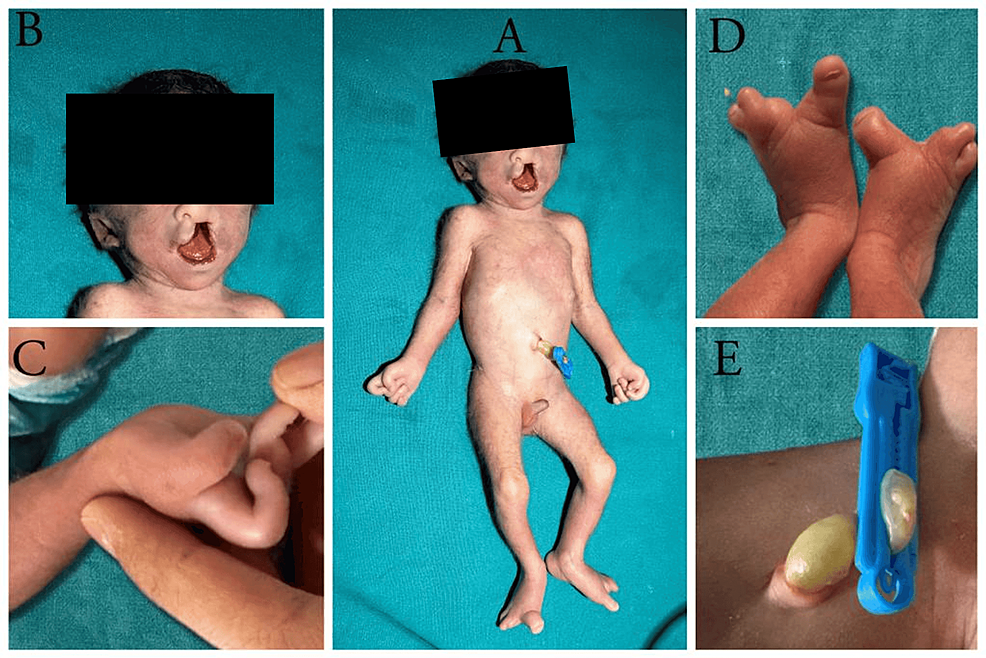
Phenytoin --> Fetal Hydantoin Syndrome
A collection of congenital defects including intrauterine growth restriction, microcephaly, craniofacial deformities, nail hypoplasia, and intellectual disability.
500
This temporary focal weakness, often in an arm or leg, occurs after a seizure and typically resolves within hours.
Todd Paralysis
500
What is the virulence factor for E. coli meningitis?
K1 capsule
500
A patient with seizures and these CT scan results likely has what condition?

CMV
500
A patient with this muscle biopsy finding likely has what condition?

MERRF (Myoclonic epilepsy with ragged red fibers)