Geometry
Algebra
Vocabulary
fighting scientist
Science
100
1. In a 30-60-90 triangle, the length of the hypotenuse is 6. What is the length of the shortest side?
- 2
- 3


2. 3/ the length of the longer leg is  times the length of the shorter leg, and the hypotenuse is twice the length of the shorter leg. Therefore, the smallest side is half the length of the hypotenuse, so its length is
  .
.
100
Evaluate: 30 - 12÷3×2 =
22/ 12/3=4, 4*2=8, 30-8=22
100
2 angles on a straight line that add up to equal 180
supplementary angles
100
Malaria is an infectious disease that kills more than 600,000 people every year. Several species of the genus Plasmodium cause malaria, with two of the most common being Plasmodium falciparum and Plasmodium vivax. Though both species cause a very similar illness, P. falciparum malaria is more likely to result in fatalities than P. vivax malaria, while P. vivax malaria is more likely to recur — to return after a period of time during which the patient is healthy and has no parasites present in the blood.
The two species of malaria parasites respond differently to antimalarial medications, but in many areas where malaria is common, testing to determine what type of malaria a patient has is not widely available. Therefore malaria treatments are often tested against both species of the parasite, and first-line malaria treatments in these regions ideally should be effective against both parasites.
Experiment 1
For many years, public health professionals in Papua New Guinea have recommended a treatment regimen, Drug Combination A, as a first-line malaria treatment. Recently a new treatment regimen, Drug Combination B, has been proposed as a potential replacement for Combination A, and a study was conducted to compare their effectiveness.
Children entering a local health clinic with malaria symptoms were tested to determine which Plasmodium species they carried. The patients were then randomly assigned Drug Combination A or Drug Combination B, and their blood was tested periodically for the presence of parasites.
Figure 1
Experiment 2
On rare occasions, patients have severe allergic reactions to a compound that is found in both Drug Combination A and Drug Combination B. In these cases, a second-line treatment must be used. A second study was conducted to determine which of several drug combinations would be the best second-line drug to recommend for use in Papua New Guinea. Table 1 shows the treatment response to the second-line drug combinations.
Table 1
Choose the option that best answers the question.
Suppose a patient is brought to the clinic with a life-threatening case of P. falciparum malaria. As the patient’s condition is deteriorating quickly, it is essential that they be given the treatment that eliminates parasites from their blood within 7 days. Based on the data from Experiments 1 and 2, which treatment should they be given?
A. Drug Combination A
B. Drug Combination D
C. Drug Combination E
D. Drug Combination B
C. Drug combination E
100
what are the 3 types of questions on science portion on the act
charts/ graphs, experiments, fighting scientist
200
2. What is the area of a circle with a diameter of 16?
- 8

- 16
- 64
- 128
- 256
1. 8/ 
Now substitute this value into the area formula and calculate the area.
200
Write 230,000,000,000 in scientific notation.
2.30x10¹¹
200
A2+B2=C2 used to find the missing angle of a triangle
Pythagorean theorem
200
Ethylene glycol, a popular industrial chemical used in the manufacture of polyester fibers and in industrial applications like antifreeze, has the structure shown below:

Figures 1-3 each show how a property of solutions of ethylene glycol in H2O varies as the concentration of ethylene glycol increases at 1 atmosphere (atm) of pressure. Concentration is given as the percent ethylene glycol by mass in H2O. Figure 1 shows how the freezing point varies with % ethylene glycol. Figure 2 shows how the boiling point varies with % ethylene glycol. The surface tension is the property of the surface of a liquid that allows it to resist an external force due to the cohesive forces between molecules in the liquid. Figure 3 shows how surface tension varies with % ethylene glycol at 25°C.


Choose the option that best answers the question.
According to Figure 1, at 1 atm, the melting point of pure 100% ethylene glycol is closest to which of the following?
A. 0°C
B. -13°C
C. -33°C
D. -52°C
B. -13oC
200
what are questions called when you save them for when you finish everything else and come back for them?
Later Questions
300
3. What is the sum of the measures of the interior angles of a hexagon?
- 540°
- 720°
- 810°
- 1080°
- 1440°
2. 720/ The sum of the measures of the interior angles of a polygon with n sides is 180 . (n – 2) A hexagon has six sides. Therefore, substitute 6 for n into the formula and calculate.
300
Evaluate: -18 + 4(6 ÷ 2)2
=-9/ 62=36, 22=4, 4*36=144, 4*4=16, 144/16=9, -18+9=-9
300
The amount of space inside of a shape/ surface space A=lxw
Area
300
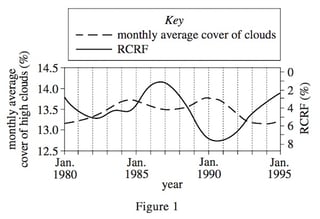
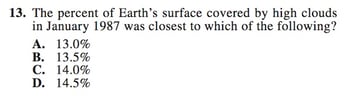
B. 13.5%
300
what are Questions that you do, that you either know the answer or can figure it out fairly easy?
Now Questions
400
Which of the following could be the side lengths of a right triangle?
- 3, 13, and 14
- 4, 5, and 6
- 4, 9, and 10
- 5, 10, and 15
- 5, 12, and 13
5. 5, 12, 13/ If a triangle is a right triangle, then the lengths of its sides satisfy the Pythagorean Theorem, a2 + b2 = c2. The only values that satisfy the Pythagorean Theorem are 5, 12, and 13.
400
Solve the equation: -5x + 20 = 25
-1/ 25-20=5, -5/5=-1
400
6.23x10²³ This is the mass of substance containing the same number of fundamental units
Mole
400
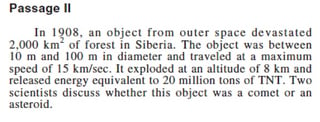
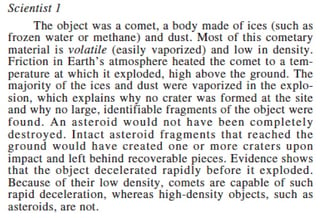
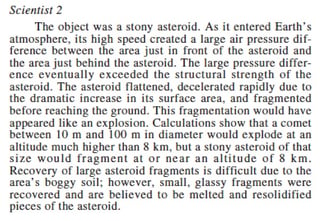
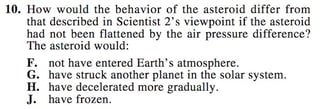
H. Have decelerated more gradually
400
What are questions that you use LOTD on?
Never questions.
500
5. Find the measure of the missing angle in the triangle below.
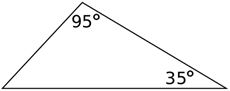
1. 35°
2. 40°
3.45°
4.50°
5.55°
4. 50/
The sum of the angles of a triangle is 180°. Therefore, if we subtract the two given angles from 180°, the result will be the missing angle.
180 – 95 – 35 = 50
500
Evaluate: |4 - 8(3 - 12)| - |5 - 11| =
70/ 8*3=24, 8*12=96, 24-96=-72, |4-(-72)|=76, |5-11|=6, 76-6=70
500
A part of an atom that has 0 charge
Neutron
500
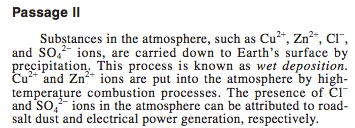
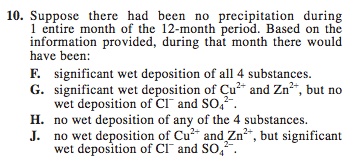
Since it wasn’t mentioned that what normally happens during precipitation will NOT happen without precipitation. So, there will be no wet deposition of the 4 substances since all 4 are normally carried down by precipitation.
500
what is the speed of something in a given direction.
velocity