Exponents and Radicals
Inverse Variation
Solving quadratic equations
Rational Expressions and Equations
Grab Bag
100
sqrt((6y)^6)
Simplify.
216y^3
100
Is this an example of an inverse relationship or not? Why?
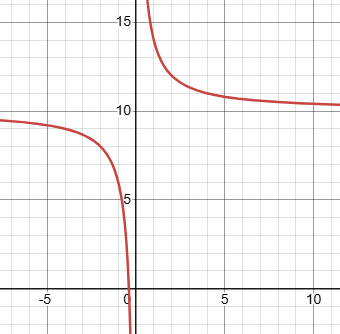
Yes, it has the hyperbola shape. OR
Yes, as x increases, y decreases and vice versa.
100
What are the zeros of the quadratic function shown?
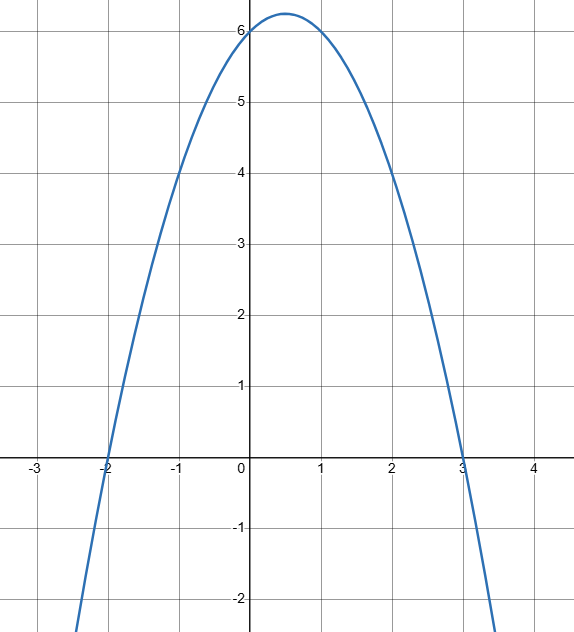
-2 and 3
100
Simplify.
(6x^2-18x)/(5x-15)
(6x)/5
100
Which ocean is off the California coast?
The Pacific Ocean
200
Simplify.
sqrt[(16a^6)/(25b^10)]
(4a^3)/(5b^5)
200
g(x)=5/x
Does this equation represent an inverse relationship? Why or why not?
Yes, because the x is in the denominator.
200
Use the discriminant to describe the number and type of solutions.
x^2-x-9=0
The discriminant is positive and not a perfect square so there are two irrational solutions.
200
How many solutions does this equation have?
(x)/(x-3)=(x+5)/x
One solution
200
What do you call animals that eat both plants and meat?
Omnivores
300
Simplify.
(sqrtx)^10(sqrtx)^-8
x
300
Is this table an example of an inverse relationship? Why or why not?
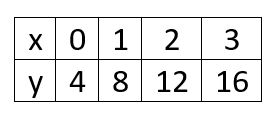
No because it doesn't have a constant of proportionality OR
No because as x increases, y increases OR
No because it has a constant rate so it is linear
300
The equation for a ball's height in the time (t) since it was thrown into the air is
h(t)=-12t^2+15t
How long was the ball in the air?
1.25 seconds
300
Solve.
1/(x+4)=x/(x^2-16)
No solution
300
What sport is played at Wimbledon?
Tennis
400
Simplify.
sqrt((3x)^5)
9x^2sqrt(3x)
400
The graph shows the relationship between the number of attendees on a trip and the cost each has to pay. The van costs $50 and each person is responsible for a $10 ticket. Is there a horizontal asymptote at y=0?
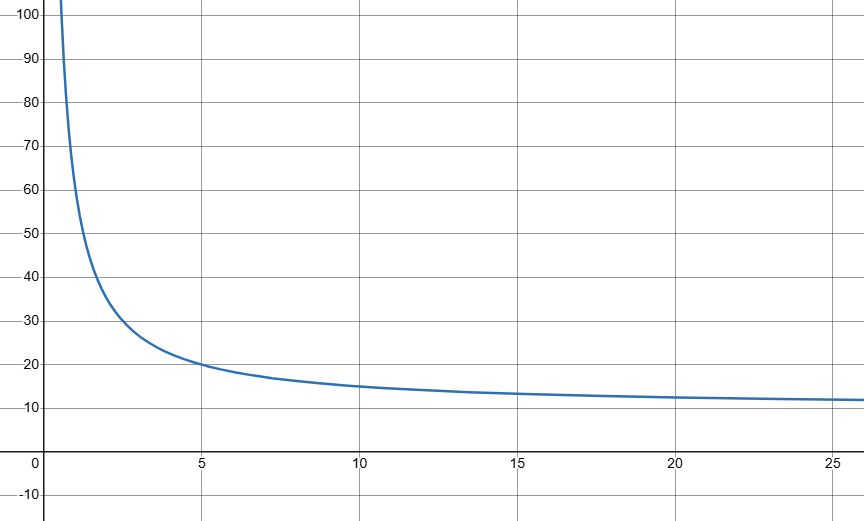
No. (The asymptote is at y=10 and represents the ticket cost.)
400
If the two roots of x^2-8x+20=0 are p and q, find p and q.
p=4+2i and q=4-2i
400
Multiply.
(4x^2-20x)/(3x+15)*(x+5)/(x-5)
(4x)/3
400
Who is the youngest recipient of a Nobel Prize?
Answer: Malala Yousafzai.
Fun Fact: She was 17.
500
Simplify.
∛(24c^7)
2c^2∛(3c)
500
Write an equation to model this relationship.
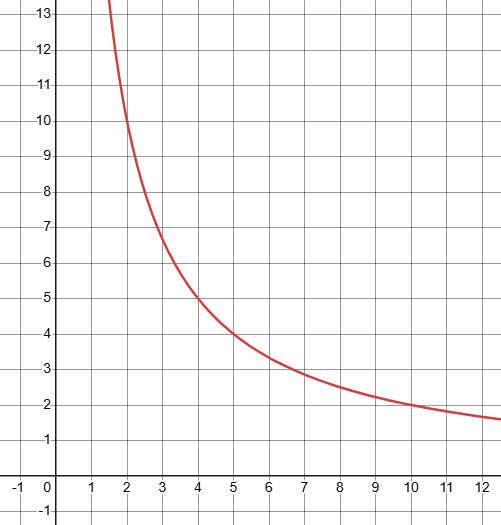
y=20/x
500
Solve and give an exact answer.
x^2-x=9
(1+sqrt37)/2 and (1-sqrt37)/2
500
Add.
(2x+1)/(x^2-3x-4)+x/(x+1)
(x^2-2x+1)/((x+1)(x-4))
500
Why do otters hold hands?
Answer: To stay together while they sleep on the water.
Fun Fact: There are 13 species of otter.