Properties of Equality
Infinite and No Solutions
Solving Proportions
Absolute Value Equations
Literal Equations
100
What three properties of equality were used to solve this equation?
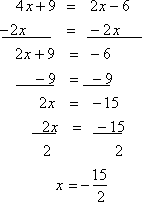
What is the
Subtraction Property of Equality,
Subtraction Property of Equality,
and Division Property of Equality?
100
2n-5=8+2n
What is no solution?
100
x/17=4/5
What is x = 13.6?
100
abs(t+7)=9
t = {-2,16}
100
Solve for t.
r=7s+6t
What is
t=(r-7s)/6
200
The first property done in solving this equation.
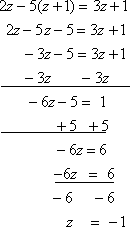
What is the Distributive Property?
200
x-2(x-6)=6
What is x = 6?
200
3/4=(y-7)/(y+5)
What is y = 43?
200
abs(6v)=48
v = {-8,8}
200
Solve for g.
h=1/3f^2g
What is
g=(3h)/f^2
300
What is the second "property" used to solve this equation?
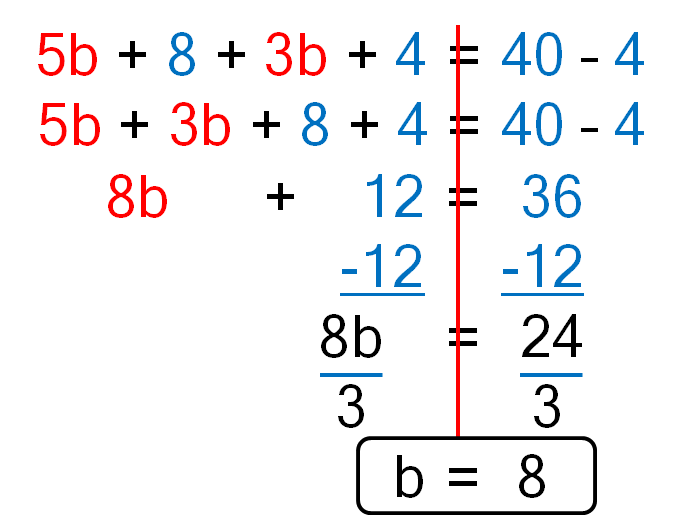
What is to Combine Like Terms?
300
-4(2k-3)+2k=6(-k+2)
What is infinite solutions?
300
2/(r+4)=4/r
What is r = -8?
300
abs(4y-1)=21
y = {-5, 5.5}
300
Solve for x.
(x+9y)/4=3y
What is
x=3y
400
True or False: Solving this equation would involve the Subtraction Property of Equality.

What is False?
400
7(1-2x)-3=4-2x
What is x = 0?
400
7/(2x+8)=3/(x-6)
What is x = 66?
400
abs(3-2p)/-7=-3
p = {-9,12}
400
Solve for r.
m=1/5pr^2
What is
r=sqrt((5m)/p)
500
All the properties involved in solving this equation:
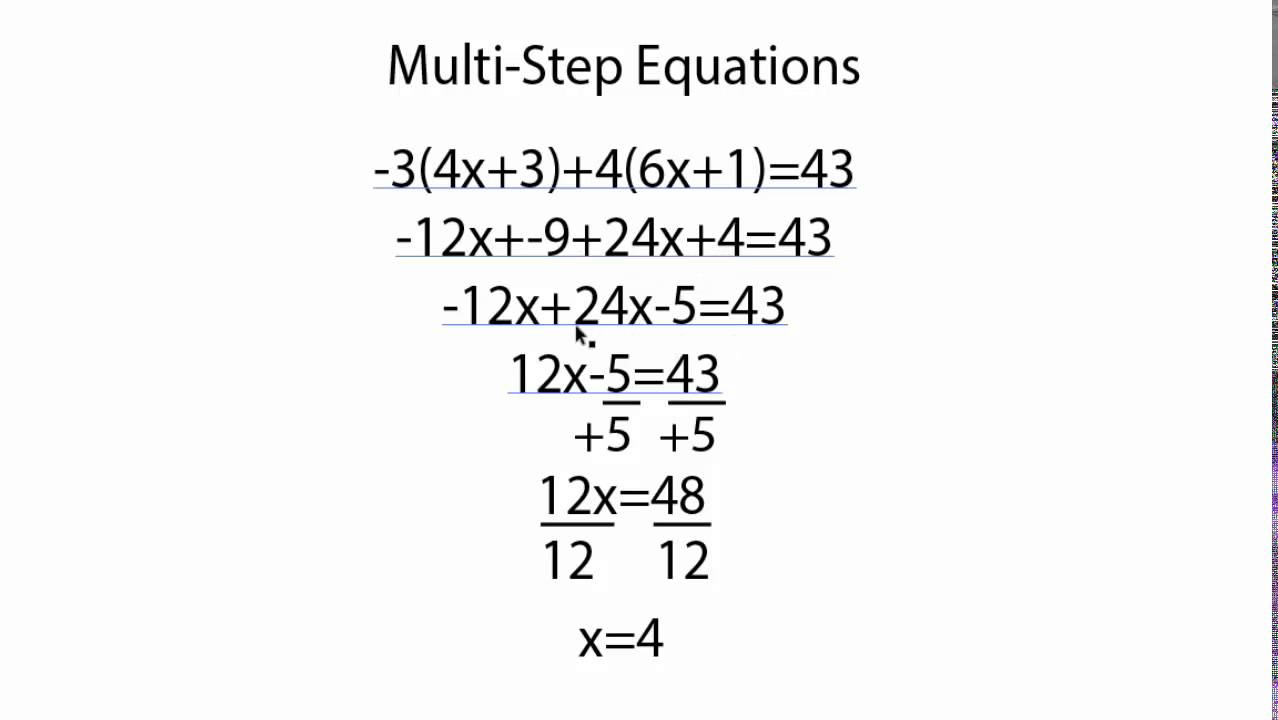
What is the Dist. Property, Combine Like Terms, Addition Property of Equality, and Division Property of Equality?
500
11+3p-7=6p+5-3p
What is no solution?
500
5/3=(-x+4)/(3x+6)
What is x = -1?
500
5abs(2n+8)+3=23
n = {-6,-2}
500
Solve for r.
V=1/3pir^2h
What is
r=sqrt((3V)/(pih)