Graph What?
Log Rolling
Up or Down
Solve What?
100
Is the graph shown an exponential or logarithmic equation?
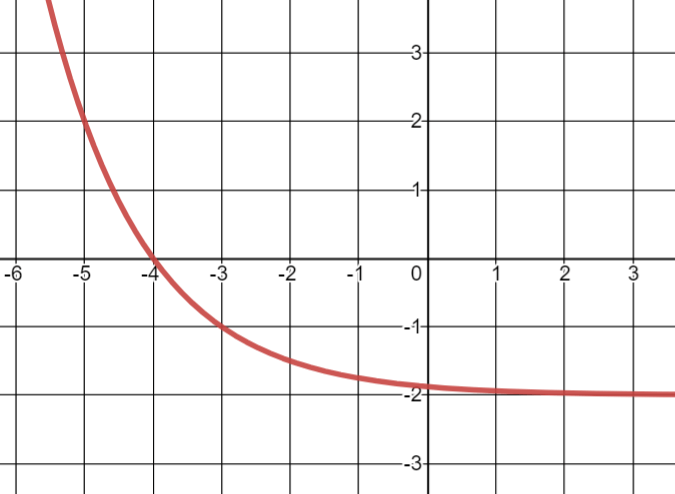
Exponential
100
Evaluate y = log5 1/25
-2
exponentiate both sides with base 5
5^y=5^(log(5)1/25
5^y=1/25
100
Does the following equation represent exponential growth or decay?
y = 4*(1/2)^(x+3)-7
Explain why.
Decay.
The 1/2 is the base of the function.
100
Solve the equation
2=log(x+1)
x=99
exponentiate both sides with base 10
10^2=10^(log(x+1))
100=x+1
200
What is the asymptote for the equation y=4^(x+2)+3 ?
Give your answer as x = or y =.
y=3
200
Condense log 4x - log 2x^2
Simplify your answer.
log (2/x)
log subtraction condenses to division
log((4x)/(2x^2))
200
A bank accout receives 3% interest per year. If you deposit $500, how much money would you have in 4 years.
Set up the equation only. Do not solve.
A=500(1+.03)^4
200
Solve the equation
5=4^x+1
x=1
subtract 1 to both sides
4=4^x
take the log base 4 of both sides
log4 4 = log4 4x
300
What is the asymptote for the equation y=log(x-6)+10 ?
Give your answer as x = or y =.
x=6
write the inverse equation
y=10^(x-10)+6
and use the horizontal asymptote to get the vertical asymptote for the log equation.
300
Condense
log 2x + 2log 3x
Simplify your answer.
log 18x^3
bring the 2 up as the exponent on 3x
log 2x + log (3x)^2
log 2x + log 9x^2
log addition condenses to multiplication
log((2x)*(9x^2))
300
If an investment of money goes up or down based on the equation A=3,500(1.10)^t , with it be worth more or less money in 2 years?
Why?
How much does the investment go up or down each year?
MORE, because the 1.10 indicates growth.
The investment goes up 10% per year because
1.10 = (1 + .10) and the .10 is 10%
10% of 3500 is 350
300
Solve the equation
2 = log3 (x + 5) - 1
x=22
add 1 to both sides
exponentiate both sides with a base of 3
33 = 3log3 (x + 5)
27 = x + 5
400
If you wanted to graph y=log(x-3)+2 , what equation would you use to help?
Give the equation.
f^-1(x)=10^(x-2)+3
Use the inverse which is an exponential equation.
400
Condense log x - 3 log x^2
Simplify your answer.
log (1/x^5)
bring the 3 up as the exponent on x2
log x - log (x^2)^3
multiple the exponents
log x - log x^6
condense using division
log(x/x^6)
400
Evaluate
y=log_3(3)^(2^3)
8
exponentiate both sides with a base of 3
3^y=3^(log_3(3)^(2^3))
which gives
3^y=3^(2^3)
400
Solve the equation
8=2^(x-1)
No Calculator
x=4
log2 both sides
left side becomes log28 which is 3
right side becomes x - 1
500
What is the critical point for y=4^(x)-5 ?
Give your answer as a coordinate: (x, y)
(0, -4)
the value that makes the exponent zero is
x=0
plug that value into the equation and solve for y.
500
Condense -2 log 3 + log 4x^3 - log x
Simplify your answer.
log ((4x^2)/9)
500
Write an exponential growth equation that has a critical point at (3, 5) .
y=a^(x-3)+4
where a is a number greater than 1
you need x - 3 in the exponent to get a critical value of x = 3.
a0 is 1, so
1+4=5
500
Solve
log_3(x)-log_3(x-1)=2
x=9/8
condense the logs using division
exponentiate both sides with a base 3
x/(x-1)=9/1
put the 9 over 1 and cross multiply