Unit 1: Sequences
Unit 2: Quadratics
Unit 3: Polynomials
Unit 4: Complex Numbers and Exponents
100
The pattern -10, 20, 50, 80... is this kind of sequence.
What is an arithmetic sequence?
100
The x-intercepts of the function
f(x)=2(x-1)(4x+3).
What are (1,0) and (-¾, 0)?
100
The degree of the polynomial x3+2x2+3x5+1.
What is 5?
100
The value of 16¾.
What is 8?
200
The common ratio of the sequence 5, 15, 45, 135...
What is 3?
200
The general form of the function f(x)=(x+2)2-3.
What is f(x)=x2+4x+1?
200
The x-intercepts of the function
f(x)=2x2(x+3)(2x-1).
What are (0,0), (-3, 0), and (½,0)?
200
The value of d if 2d·3d=65.
What is 5?
300
The initial term in the sequence an=16•5n.
What is 16?
300
The factored form of the equation x2-x-12.
What is (x+3)(x-4)?
300
The multiplicities of each root in the function f(x)=x2(x+1)(x-3)4.
What are 2, 1, and 4?
300
The solutions to the equation f(x)=2x2-4x+4.
What are 1+i and 1-i?
400
The explicit formula for the sequence 8, 4, 2, 1...
What is f(n)=8·½n?
400
The vertex of the function f(x)=x2-10x+9.
What is (5, -16)?
400
The factored form of f(x)=x3-4x2+x+6 if (x+1) is a factor.
What is f(x)=(x+1)(x-2)(x-3)?
400
The number of real solutions for this graph.

What is 0?
500
The explicit formula for this sequence.

What is f(n)=6+3n?
500
The value a of a parabola with a vertex at (3, 27) and an x-intercept at (6,0).
What is -3?
500
An equation for the graph below.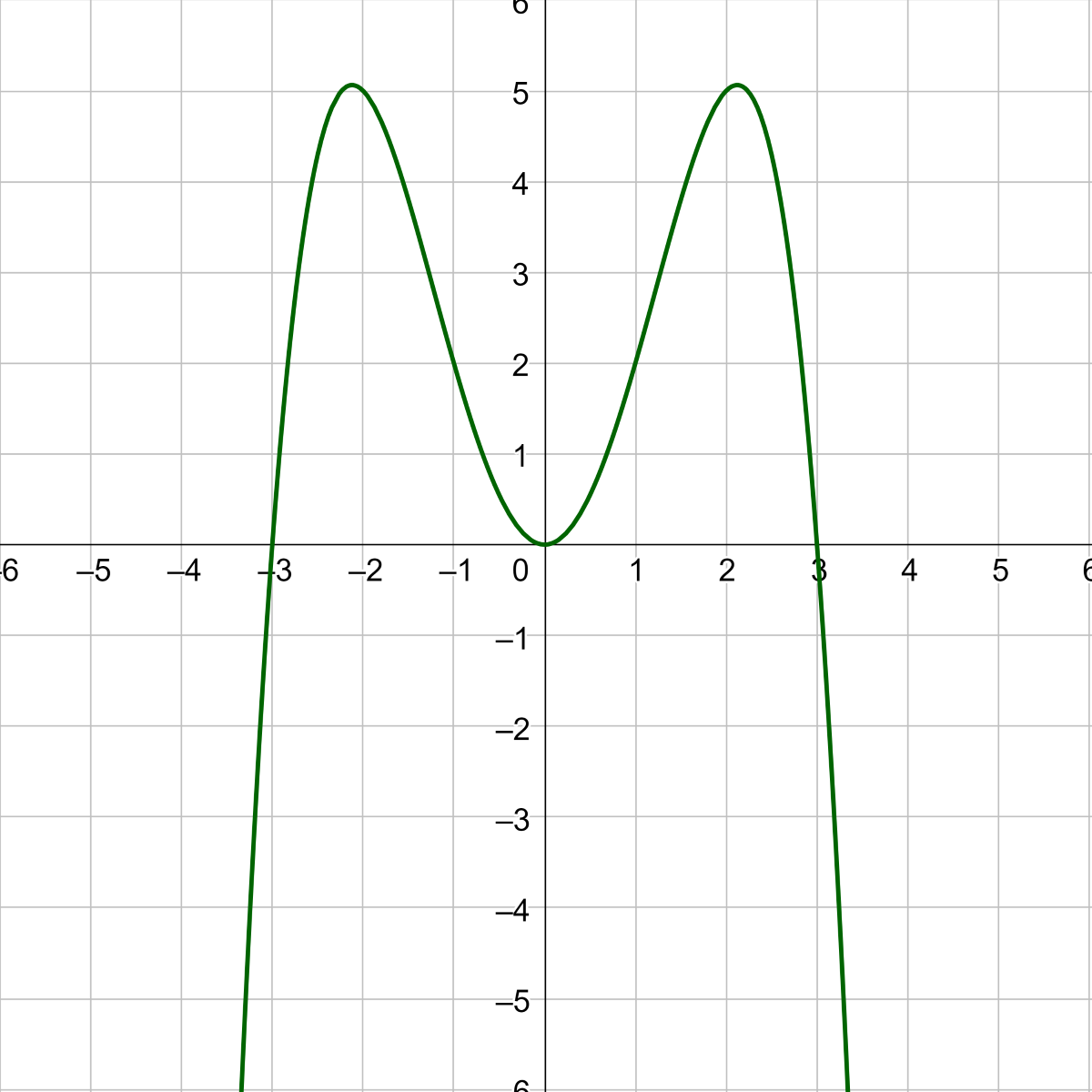
What is f(x)=x2(x-3)(x+3)?
500
The value of i(2+i)(3-2i).
What is 1+8i?