Functions
Evaluate the Function
Slope
graphing
Mystery
100
Using demos to graph and describe the function 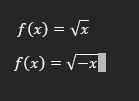
The function reflects across the y-axis 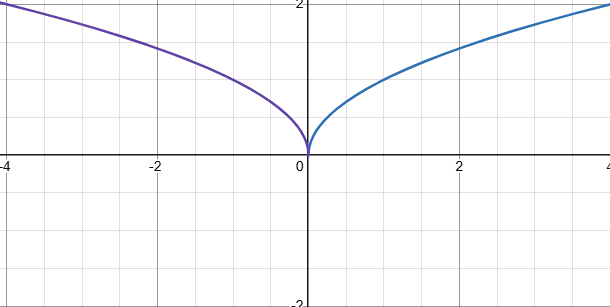
100
Evaluate the function f(x) for f(4)

f(4) = 16
100
Determine the slope of the two points (3,1) (7,6)
The slope is
5/4
100
What is the minimum point of this function?
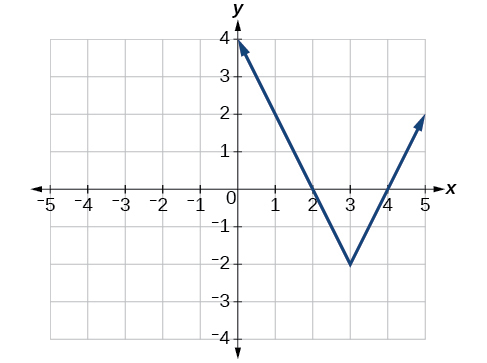
(3, -2)
100
Using demos graph the equation x=10
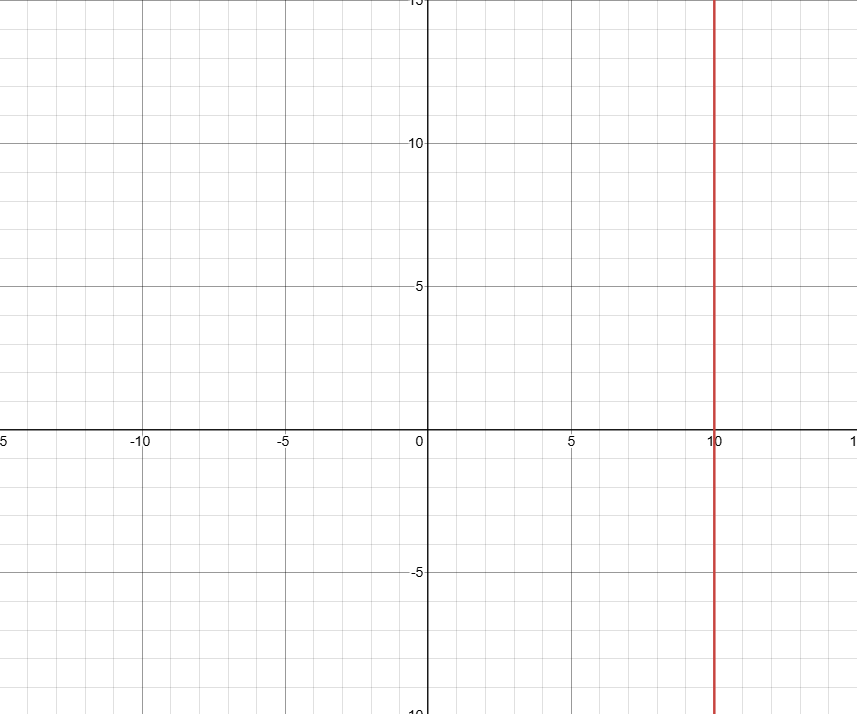
200
Solve the piecewise function for the given values.
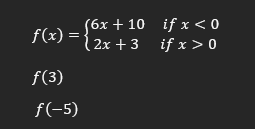
f(3)=9
f(-5)=-20
200
Is the following a function (4,3) (12,2) (8,1) (10,11)
Yes this is a function.
200
Find the average rate of change for f(x)=x3 from x1=3 x2=2
The average rate of change is 19
200
What is the maximum point of this function?
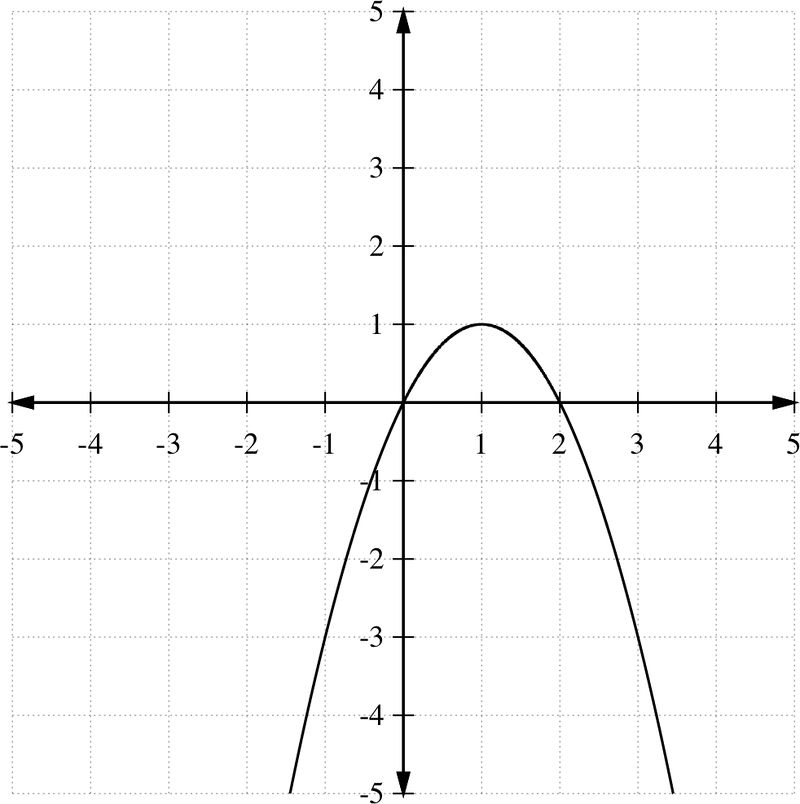
(1,1)
200
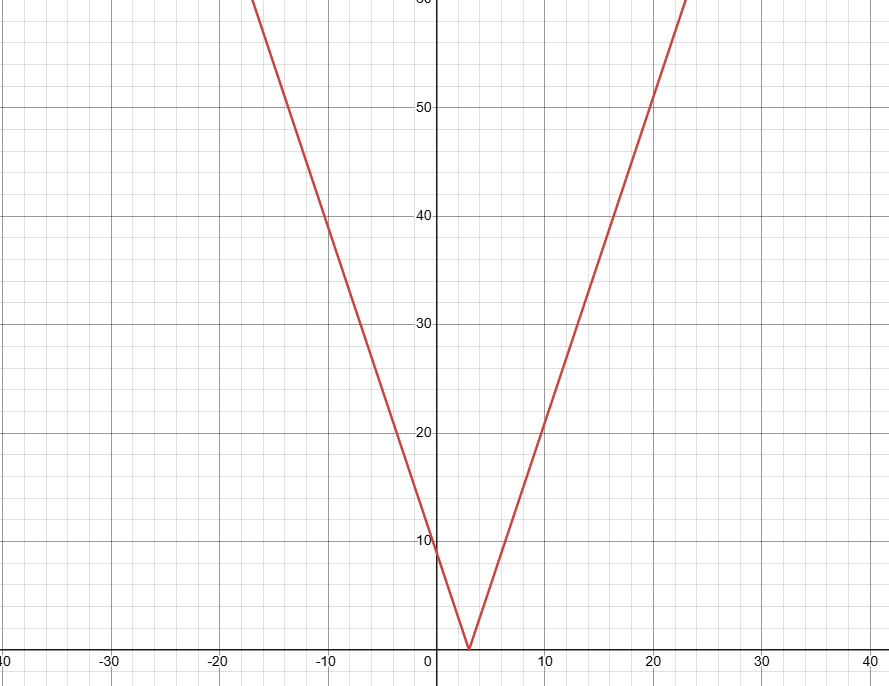
Using demos graph the absolute value f(x)=|3x-9|. What is the domain and range, and is the function even, odd, or neither.
Domain: (-♾️,♾️) Range: [0,♾️) The function is odd
300
Using desmos and the graph f(x)=x2 describe the shift, stretch, or shrinkage in the problem
f(x)= 6(x-1)^2+2
The graph moves 1 unit right, stretches by a factor of 6 and shifts the graph up 2 units
300
Is the following a function x2+y2=7
The ± shows that for certain values of x, there are two values of y. For this reason, the equation does not define y as a function of x.
300
Write an equation of a line that passes through (6,-5) and that's parallel to y=6x+3.
Write the equation in point-slope form as well as slope-intercept form
Point-slope form is y+5=6(x-6) Slope-intercept form is y=6x-41
300
Using desmos and the graph f(x)=x2 describe the shift, stretch, or shrinkage in the problem
f(x)=3(x+2)^2-2
The graph moves 2 units left, stretches by a factor of 6 and shifts the graph down by 2
400
Using the vertex form and desmos identify the vertex, x-intercept(s), y-intercept(s), which way the parabola opens, and the axis of symmetry of
f(x)=-(x+2)^2+9
The vertex is (2,9) x-intercepts are (-1,0) and 5,0) y-intercept is (0,5) the parabola opens downwards and the axis of symmetry is x=2
400
Evaluate f(6) for f(x)=2x2-3x+10
f(6)=64
400
Use the point-slope form for the line with slope 3 that passes through (3,-2) to find the slope-intercept form and the point-slope form. Then find the slope and y-intercept
Point-slope form y-2=3(x-3) The slope-intercept is
y=3x-11 Slope is 3 y-intercept is -11
500
Consider the parabola defined by the quadratic function to find the vertex, determine which way the graph opens, the x-intercepts, y-intercept, axis of symmetry, then graph the equation on desmos to determine the domain and range. Simplify to the hundreds.
f(x)=2x^2-8x+3
The vertex is (2,-5) the parabola opens upwards x-intercepts are (0.42,0) and (3.58,0) y-intercept is (0,3) axis of symmetry is x=2 the domain is (-♾️,♾️) Range: [-5,♾️)
500
Using the general form of the Equation of a Line to find the slope and the y-intercept for the equation 6x-3y+15=0
The slope is 2 and the y-intercept is 5