Derivative Formulas
e and ln
Graphing
Related to Money
100
This rule states that the derivative of x^n=nx^(n-1)
The Power Rule
100
True or False: The derivative of e^x is e^x
True
100
If the sign diagram for the first derivative changes from positive to negative, the original graph has this feature at that point.
(answer is 2 words)
relative maximum
100
In the compound interest formula V=P(1+r/m)^(mt) , this letter represents the initial amount of money invested.
Double points if you can also say what the letter stands for!
P (Principal)
200
Use this rule when you need to differentiate two functions that are being multiplied together, like f(x)*g(x)
The Product Rule
200
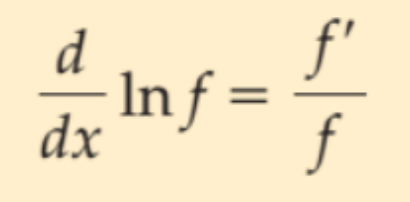
Use this formula to find d/dx ln(2x+1)
2/(2x+1)
200
The Second Derivative is used to determine this property of a graph, often described as "opening up" or "opening down."
(answer is 1 word)
concavity
200
This method of differentiation is used when there is more than one variable but only one of them is the primary variable.
Implicit Differentiation
300
Use this rule to find the derivative of a fractional function.
The Quotient Rule
300
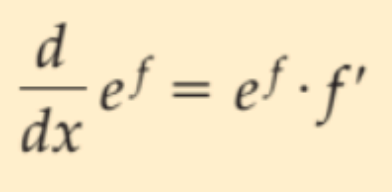
Use this formula to find d/dx e^(5x)
e^(5x)*5=5e^(5x)
300
These are the specific points you must check (along with the endpoints) when looking for an absolute maximum or minimum on a closed interval.
critical points
300
Differentiate y^3 with respect to x.
3y^2dy/dx
400
This rule is necessary when differentiating "composite" functions, or a "function within a function."
The Chain Rule
400
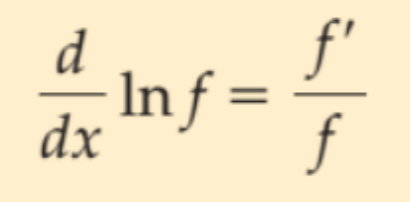
Use this formula to find d/dxlnx
1/x
400
A point where the second derivative changes sign (changing the graph from concave up to concave down) is called this.
inflection point
400
If interest is compounded annually, what is the value of m in the compound interest formula?
1