Respiratory Review
Overview/Ventilation
Gases
Mystery Box
Random Questions
100
What is the ease in which the lungs inflate?
Compliance
100
What are the muscles used when we breath at rest?
Muscles of principal inspiration
100
What is the volume of air inspired or expired during normal, quiet breathing?
Tidal volume
100
What is a common lung disease in which the lungs lose their elasticity?
Emphysema
100
What is the broad, sheet-like muscle that relaxes when you exhale?
Diaphragm
200
What is pneumothorax?
Air in the pleural cavity which can lead to collapsing lung
200
What is the thin, slick membrane that covers the chest wall and diapragm?
Parietal pleura
200
What aids in the switch between inspiration and expiration?
Pontine respiratory group
200
What is the infection of the lungs?
Pneumonia
200
How many lobes does the right lung have? Left lung?
Right: 3
Left: 2
300
What is the difference between the true vs. false vocal cords?
True vocal cords - actually produce sound
False vocal cords - help close the larynx to prevent food from traveling down the wrong pipe during deglutition
300
Why do children have a higher-pitched voice than adults?
Because they have shorter vocal cords
300
What do the carotid and aortic body chemoreceptors do?
Be sensitive to oxygen levels in the blood (but barely)
300
What is external respiration?
The process of oxygen and carbon dioxide being exchanged between the alveoli and the blood.
300
Why do infants have difficulty breathing?
Their bodies do not produce surfactants right away.
400
What is the difference between the nasopharynx and oropharynx?
Nasopharynx - upper portion of the pharynx
Oropharynx - where the tonsils are found
400
On the respiratory diagram, label: alveoli, alveolar duct, terminal bronchioles, uvula, larynx, right lung, bronchi, left lung, trachea, epiglottis, pharynx, and nasal cavity.
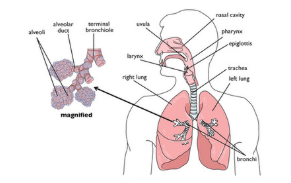
400
What is Dalton's Law?
The pressure exerted by a mixture of gases is equal to the sum of the partial pressure of each gas in the mixture.
400
What is the Hering Breur reflex?
Prevents you from overstretching your lungs during vigorous exercise.
500
What are four reasons as to why external respiration is very efficient?
Very thin cellular membranes
Large surface area (tons of alveoli)
Capillaries in the blood are very thin
Shape of the red blood cells
500
How does the body produce sounds at different pitches? Volume?
Pitches: Skeletal muscles shorten the vocal cords for a higher pitch and loosen the vocal cords for a lower pitch
Volume: quickly moving air through vocal cords to be loud, slowly moving air to be quiet
500
List the five steps of gas movement in the blood. Explain how the partial pressures of both oxygen and carbon dioxide differ from the alveoli to the tissues.
Deoxygenated blood gets to the lungs. O2 floods into capillaries, and CO2 floods out.
Gas exchange stops in the alveoli when partial pressures are the same in the alveoli and the capillaries
O2 pressure drops to 95 mmHg and raises CO2 pressure slightly because the bronchi and bronchioles need to use oxygen
Oxygenated blood is pumped through the aorta to the body tissues
Blood reaches the capillaries of the tissues, where high CO2 pressure in cells allows the gas to move into the blood and for Oxygen to move into the cells
At the alveoli: Oxygen is 104 mmHg and Carbon dioxide is 40 mmHg
At the body tissues: Oxygen is 44 mmHg and CO2 is 45 mmHg
500
Explain how carbon dioxide levels control ventilation.
Carbon dioxide affects the pH of the blood. The more CO2 is in the blood, the lower the blood pH is. To get rid of CO2, the depth and rate of ventilation is increased. If blood pH is too high, the body decreases ventilation.