Territory & Geographical Influence
Conflicts & Alliances
Social Hierarchy
Political Power & Government
Culture & Beliefs
100
What region of Greece is Athens located in?
Attica
100
Which major empire were the Greek city states fighting against together?
Persia
100
Who had the right to vote and participate in democracy?
Citizens: Free adult men who were born of Athenian parents and who had completed their military service
100
What type of democracy did Athens have?
Direct democracy
100
Was religion an important part of daily life in Athens? Explain.
Religion was an important part of daily life in Athens. People believed in many gods (polytheism) who controlled nature and influenced human life.
200
How did the landscape of this region impact how the Greek city states developed?
The rocky mountainous land made travelling by land more difficult. This led the city states to develop independently from one another instead of as one united empire.
200
Explain what a period of truce was.
A period of time in which the Greek city states agreed to temporarily stop fighting against each other so that people could travel safely, take time to honor their gods, work on their farms, and take part in peaceful competitions such as the Olympic Games.
200
Name the main groups in the social hierarchy of Ancient Athens (from most powerful to least powerful).
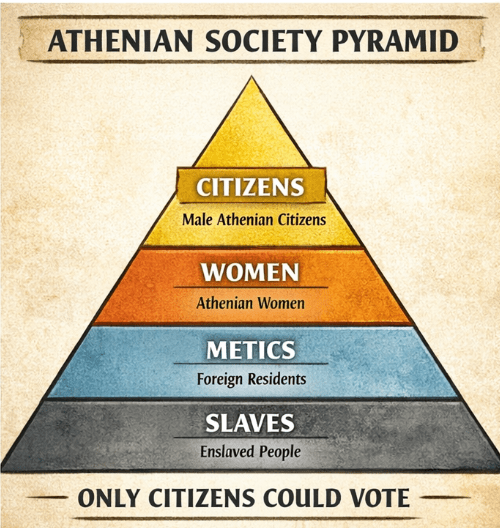
200
Where did democracy "actually" happen within Athens?
On Pnyx Hill, where citizens would gather to debate and vote new laws and ideas.
200
What public space hosted religious festivals and had important temples dedicated to the gods.
The Acropolis
300
Where is Athens on this map?
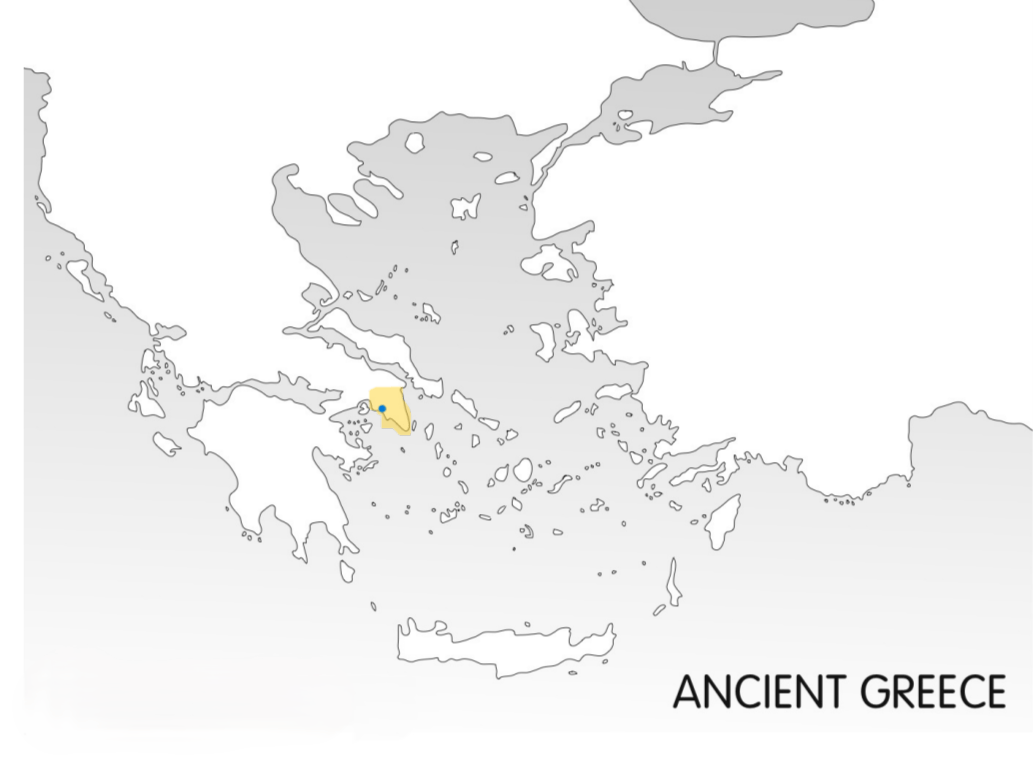
300
What is the Delian League?
The Delian League was an alliance of Greek city-states formed after the Greco-Persian Wars to defend against future Persian attacks. Members contributed money or ships, but Athens eventually took control and used the resources to strengthen itself.
300
Why were Athenian women still respected more than others in Athens?
Athenian women were given some respect because they played an important role in having and raising sons who could become citizens. This gave them value in society, even though they had limited rights and no political power.
300
What is the Boule and what role did it play in Athens?
This was the council of 500 who was selected at random every year. They were responsible for the daily government affairs of Athens; they prepared laws and set the agenda for the assembly.
300
Why were festivals important in Athenian society?
They brought people together, honored the gods, and helped them build a sense of loyalty and shared culture.
400
Why did the Greeks create colonies? Give examples of resources the colonies provided to them.
They created colonies because their population was growing and they lacked land for farming and had limited resources. The colonies were a way for the Greek city states to trade and import good that would support their economy and help them grow such as grain, woods and metals.
400
What did both the Battle of Marathon and The Battle of Salamis have in common?
The Greek city states were united to defend their independence. Even though the Persian empire was bigger, in both of these battles Athenian soldiers fought in tight formation and used their knowledge of the land and the sea as an advantage to defeat the Persian army.
400
Name some of the differences in education between boys and girls in Athens. How did this reinforce inequality in society?
Boys were trained in reading, writing, physical fitness, and public speaking so they could become active citizens, participate in government, and serve in the military.
Girls were taught domestic skills like cooking, weaving, and managing the household because they were expected to stay in the private sphere, raise children, and support the family.
This difference reflects the fact that only male citizens could participate in democracy, while women had no political rights and were excluded from public life.
400
Why were government roles (such as the council or those who would sit on juries) selected at random every year?
Some government roles in Athens were chosen randomly (by lottery) to make the system fairer. If positions were always elected, rich and powerful people would have more influence and might control the government.
By choosing people at random, ordinary male citizens had a chance to participate, even if they were not wealthy or well-known.
This helped prevent elite families from gaining too much power and ensured that more citizens could take part in decision-making. It also showed that Athenians believed many citizens were capable of helping govern, not just a few leaders.
400
Name one of the three philosophers of Ancient Athens.
- Socrates – remembered for asking deep questions and encouraging people to think about right and wrong
- Plato – remembered for writing about government and starting a school called the Academy
- Aristotle – remembered for studying many subjects like science, logic, and politics and teaching others how to think logically
500
Why was the sea crucial in the growth and prosperity of the Greek city states?
They could not travel easily on land and were isolated from one another, they had to rely on the sea for travel, trade and communication. The sea became their highway for trade and let them expand their reach by creating colonies and spreading their culture.
500
What led to the Peloponnesian War? What was the result of this major conflict?
After the Greco-Persian Wars, Athens became very powerful and made other city-states pay tribute to fund protection. Because Athens controlled the money, many city-states felt treated unfairly and feared losing their independence. Sparta led an alliance of city-states that opposed Athens, bringing them together to challenge Athenian power, which led to war. Sparta was eventually victorious, but the long conflict drained resources, caused division, and left all city-states vulnerable.
500
What did the public spaces and the private spaces of Athens tell us about the power dynamics within society?
Public spaces in Athens, like the Agora, showed that male citizens held political power, as they were the ones who could speak, vote, and participate in government.
While women, metics (foreign residents), and slaves could be present in some public spaces, they had no political rights or real influence there. Some public spaces, such as the Assembly, were limited to male citizens only.
Private spaces (homes) were also designed to reflect social roles, with separate areas that kept women focused on domestic duties and out of public view. Together, these spaces showed a clear hierarchy where male citizens had the most power, while others had limited roles and rights.
500
How did Athenian democracy both promote fairness AND exclude people? Was it fair for everyone living in Athens?
Athenian democracy promoted fairness because citizens could take part directly in making decisions. Male citizens could vote on laws, speak in meetings, and help run the government. This gave them a real voice and made the system more equal among citizens.
However, the system also excluded many people. Women, enslaved people, and foreigners (metics) were not allowed to vote or participate in government. This meant that most of the population had no political power.
So, while democracy was fair for citizens, it was not fair for everyone living in Athens.
500
Explain the difference between Mythology and Philosophy?
Mythology is a set of stories about gods and goddesses that explain how the world works and why things happen. These stories are often based on beliefs and traditions.
Philosophy is the study of ideas about life, right and wrong, and how people should live. Philosophers use thinking, questioning, and reasoning instead of stories about gods.
Mythology explains the world through stories, while philosophy explains it through thinking and questioning.