African Explorers (2.1) and Freedom Enslavement & Resistance (2.2)
Capture and impact (2.3) and Resistance on Slave Ships (2.4)
Slave Auctions & Domestic Slave trade (2.5) and Labor culture & economy (2.6)
Slavery in American Law (2.7) and Race as a Social Construction (2.8)
African American Culture (2.9) and Black Pride & Identity (2.10)
100
The ancestors of early generations of African Americans in mainland North America came from numerous West and Central African ethnic groups. Most of those who arrived in the United States came from societies that primarily practiced these religions.
What is Christianity and Islam?
100
This group of Africans were the primary victims of being caught and sold into slavery by rival tribes.
Who are Prisoners of War?
100
Slaves were divided into two different groups of workers with one holding more social status over the other. This category of enslaved person held more social status compared to other enslaved people based on where they worked on the plantation.
What were House Workers?
100
Article I and Article IV of the United States Constitution refer to slavery but avoid using the terms “slave” or “slavery”. These terms appear for the first time in this amendment to the United States Constitution, which abolished slavery.
What is the 13th amendment?
100
The Term meaning names used to identify and characterize racial, ethnic, and nationality groups
What is Ethnonym?
200
Portugal, Great Britain, France, Spain, and this country were the top five enslaving nations involved in the transatlantic slave trade.
What is the Netherlands?
200
This is the 3-part journey that Africans endured during the transatlantic slave trade.
What is Capture, Middle Passage (Transatlantic), and Second Middle Passage (Domestic)?
200

Depicted in the source above is a group of enslaved Africans working on a plantation in this form of an agriculture labor system. The laborers would often work from sunup to sundown under the watch and discipline of an overseer as they cultivated crops like cotton, sugar, and tobacco.
What is a Gang System?
200
These United States laws defined chattel slavery as a race-based, inheritable, lifelong condition and included restriction to movement, congregation, possessing weapons, and wearing fine fabrics, among other activities.
What are the Slave Codes?
200
These languages were developed by enslaved Africans who had participated in long distance trade and were accustomed to both African and European languages. These languages were developed through common languages to communicate across different dialects.
What are Creole Languages?
300
This 16th Century African Conquistador, born in the Kingdom of Kongo, became the first known African to arrive in North America when he explored present-day Florida during a Spanish Expedition in 1513.

Who is Juan Garrido
300
Depicted in this source is a courtroom sketch of an African captive who was on trial for staging a slave revolt on this famous slave ship, resulting in the Supreme Court decision that granted him, and the other group of enslaved Africans, abolition
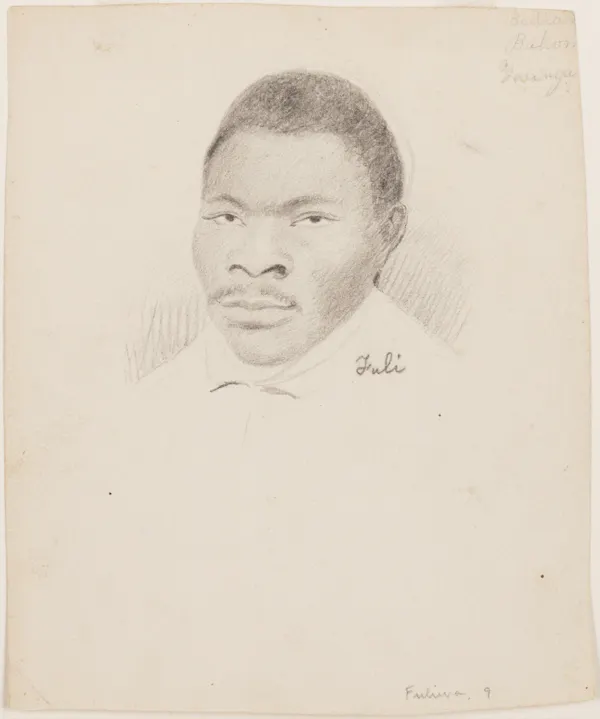
What is La Amistad?
300
Slavers leveraged power of the law and white supremacist doctrine to assault enslaved Africans bodies, minds, and spirits during auctions. Often enslaved Africans would experience this punishment as a result of resistance, at times in front of their families and friends.
What is Whipping?
300
This practice was a 19th and 20th century race classification policy to define a person as “Black” if the person had any degree of African descent as part of a singular, inferior status.
What is the one drop rule?
300
This country was founded as a place to send Free Black Americans to Africa
What is Liberia
400
In the 15th and 16th Centuries, Africans played a major role in participating in the work of conquest within North America. This label was a term used to describe an African Conquistador.
What is a Ladino
400
Depicted above Slave ship captains often used these items to minimize resistance and prevent captives from jumping overboard

What are Guns, Barricades, and Nets?
400
This massive displacement of enslaved Africans was the largest forced migration in American history.
What was the Second Middle Passage?
400
This 17th century law defined a child’s legal status based on the status of their mother and held significant consequences for enslaved African Americans. This law was designed to prohibit the mixed race children of Black women from inheriting the free status of their fathers.
What was Partus sequitur ventrem or “Partus”?
400
This distinct American musical genre became the foundation of genres including gospel and blues. Enslaved people adapted christian hymns with performative elements from Africa (call and response, clapping, improvisation) to perform during plantation work.
What are African American spirituals?
500
This port city in the United States became the center of the United States slave trade in the 19th Century. 48% of all Africans who were brought directly to the United States started their journey as a slave within the United States here.
What is Charleston, South Carolina?
500
This literacy genre, often written in the form of poems, was a way for formerly enslaved Africans to depict their experiences as a slave.
What are Slave Narratives?
500
In this year, the United States government banned the transatlantic slave trade. After this, the enslaved population grew primarily through childbirth rather than new imports to meet the growing demand for enslaved agricultural laborers.
What is 1808
500

Above is a depiction of this famous slave revolt in 1739, the largest slave revolt in United States History, which pushed South Carolina’s to update their laws on chattel slavery. The updated law classified all Black people and the Indigenous communities that did not submit to the colonial government as nonsubjects and presumed enslaved people.
What was the Stono Rebellion
500
Letters written by free African Americans and abolitionists in abolitionist newspapers such as Freedom's journal, and the Liberator which talked about slavery, colonization, and Identity. These letters mimicked a type of communication that was synonymous with slavery.
What are the Call and Response letters