Topic 1: Water
Topic 2: Elements of Life
Macromolecules
Macromolecules
Macromolecules
100
True or false? A water molecule has hydrogen bonds between the oxygen and both hydrogens.
False!
100
True or False - Functional groups are chemical groups attached to a carbon skeleton that participate in chemical reactions.
True!
100
Which type of reaction is happening in this image AND how do you know?
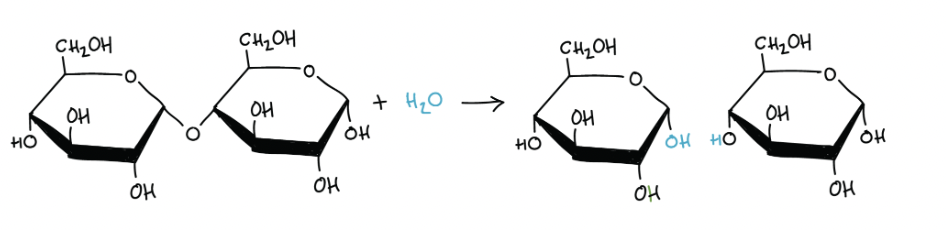
Hydrolysis! B/c since water is being added, bigger polymers break into smaller individual monomers.
100
If you're given a DNA strand 5' ATACGTA 3', what would the complementary strand of DNA be?
3' TATGCAT 5'
DNA runs antiparallel (opposite directions), so when you write the complementary DNA strand it's 3'-5'. Using the base pair rule, A bonds with T and C bonds with G.
100
Identify one structural difference between RNA and DNA?
DNA is double stranded and RNA is single stranded
DNA has a deoxyribose sugar and RNA has a ribose sugar
200
This property of water allows it to keep the Earth's temperature and climate relatively stable.
High specific heat
200
What are hydrocarbons?
Hydrocarbons are organic molecules consisting only of carbon and hydrogen.
200
(1) Which macromolecule provides structural support in plant cell walls?
(2) What is the specific name of that macromolecule?
(1) carbs!
(2) cellulose
200
Which of the following macromolecules is most directly linked to the observed increase in atherosclerotic plaques in the mice on the high-fat diet?
(a) Carbohydrates
(b) Proteins
(c) Lipids
(d) Nucleic acids
Lipids!
200
Which of the elements of life make up nucleic acids?
C, H, O, N, P
300
During a biology experiment, students are tasked with exploring the capillary action of water. They place a thin tube into a beaker of water and observe how water climbs up the tube without any external force. Which property of water is primarily responsible for the observed capillary action in the experiment?
Adhesion! The capillary action happens because of water’s cohesion and adhesion, which is water molecules sticking to the walls of the tube (adhesion) and pulling other water molecules up with them (cohesion).
300
Why is carbon so important in the formation of macromolecules?
Carbon can form 4 covalent bonds, allowing it to build complex and diverse molecules.
300
Which structural level of protein can the element of life sulfur be found in?
Tertiary - b/c disulfide bridges/bonds are a crucial part of proteins, stabilizing their structure and regulating their function.
300
Compared to saturated fat, unsaturated fat is suited for cold weather because it remains a liquid at lower temperatures!
(1) Which macromolecule is this?
(2) What molecular structural advantage allows unsaturated fats to perform better than saturated fats in cold weather?
Because unsaturated fat contains one or more double bonds AND it has a bent structure that allows for more flexibility. The double bonds prevent them from packing tightly together and thus maintaining membrane fluidity!
300
Which functional groups are found on the 5' and 3' end of DNA?
5' - phosphate group
3' - hydroxyl group
400
Why don't oil and water mix? Use polarity to help explain your answer.
Oil is nonpolar and less dense than water, which causes it to float. Because oil molecules cannot form hydrogen bonds with water molecules, they do not mix and instead spread out over the water's surface.
400
Which functional groups are found in all amino acids?
Every amino acid contains both an amino group (-NH2) and a carboxyl group (-COOH) attached to a central carbon atom.
400
Human bodies have the ability to digest carbohydrates, like starches or sugars, using enzymes. If in an experiment an enzyme was added to a solution containing glycogen and water, what chemical change would you expect to happen?
The enzyme would catalyze (cause or accelerate) the process of hydrolysis because it would break down the bonds between glycogen (which is a polymer) into glucose. This is hydrolysis because water is added.
400
In phenylketonuria (PKU), mutations in the PAH gene alter the amino acid sequence of phenylalanine hydroxylase, which disrupts R-group interactions, prevents proper 3D folding, and destroys the enzyme’s active site. Which structurally protein level is impaired?
The primary structure is impaired because the mutation in the gene (section of DNA) changes the amino acid sequence which alters the functions of everything else.
400
A scientist receives an unknown nucleic acid sample and needs to determine whether it is DNA or RNA. The sample is subjected to a series of tests to identify its chemical composition. The following results are obtained:
- The sample contains a pentose sugar
- The nitrogenous bases identified in the sample include adenine, cytosine, uracil, and guanine
- The sample is found to be single-stranded.
Based on these results, which nucleic acid is the scientist examining and how do you know?
This same is RNA! Because it contains the nitrogenous base uracil and it's single stranded. Those are the structural components of RNA!