Chemistry of Life
Energy
Cellular Processes
Heredity
Gene Expression
100
The presence of this feature can help you correctly identify what type of nucleic acid you're observing.
What is Uracil?
100
The shape and charge of the substrates are compatible with this region of the enzyme.
What is the active site?
100
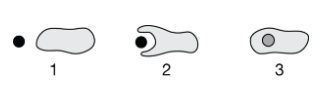
This is the theory that suggests prokaryotes partaking in a mutualistic relationship is where eukaryotes evolved from.
What is the Endosymbiotic Theory?
100
The first division reduces the number of chromosomes by half for each daughter cell, and the second division moves single chromatids to each gametic cell.
How does Meiosis result in haploid gametes?
100
This is a different form of the same gene.
What is an allele?
200
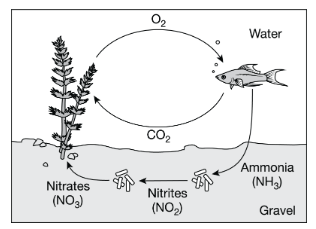
This is converted by the bacteria to nitrates which are then used by plants to make proteins and nucleic acids.
What is the function of Ammonia?
200
The synthesis of this molecule from ADP and inorganic Phosphate is essential to all cellular functions.
What is ATP?
200
During the Cell Cycle, this is the percentage increase in genetic material from the beginning of Interphase to just before Mitosis.
What is 100%?
200
Mitosis produces genetically identical daughter cells while Meiosis produces genetically unique daughter cells.
What is the difference between Mitosis and Meiosis?
200
This process of cutting premature mRNA molecules into different variations makes it possible to use the same segment of genetic material to achieve several different protein results.
What is alternative mRNA splicing?
300
This feature allows water at the surface to disform but not break under the weight of an insect.
What is surface tension?
300
This is the reason not every joule of energy can be retained within a metabolic process.
What is heat loss?
300
A drug inhibits thymine production in eukaryotic cells. This is the phase of the Cell Cycle that would most directly be impacted by this drug.
What is S-Phase of Interphase?
300
Four haploid gametic cells.
What is the result of Meiosis?
300
An RNA Polymerase and a positive transcription factor must bind to the promoter region of a gene.
How is transcription prompted?
OR
How does a gene create a protein?
400
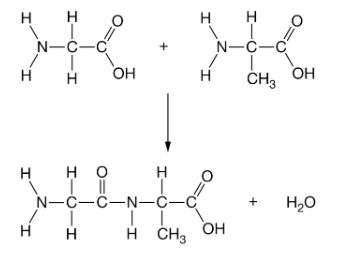
This type of bond is formed between a carbon atom and a nitrogen atom along with the formation of a water molecule.
What is a covalent bond?
400
Adding a catalyst to a chemical reaction lowers this, resulting in a faster enzymatic response.
What is activation energy?
400
Erwin Chargaff established that DNA is composed of equal parts Adenine and Thymine as well as equal parts Guanine and Cytosine. If an organism's DNA sample contains 20% Adenine, according to Chargaff the same sample will contain this much Guanine.
What is 30%?
400
Random alignment increases the number of possible chromosomes combinations in the gametes.
How does random assortment lead to genetic variation?
400
Prokaryotic genes only have exons, but eukaryotic genes have exons and introns
What is the difference between prokaryotic and eukaryotic genes?
500
The interaction of the different R-groups with other R-groups and their environment determine this structure of a protein.
What is the tertiary protein structure?
500
Species containing multiple of these can harvest energy from wavelengths of light that the other photosynthetic species cannot use.
What are light-filtering pigments?
500
By placing it in a hypotonic solution.
How do you get a cell to swell?
500
The female swamp wallabies' diploid germ cells contain 10 chromosomes. This is the number of homologous chromosomes and chromatids they will contain upon completion of Meiosis 1.
5 homologous chromosomes & 20 chromatids
500
An example of this type of transcription factor is CAP binding with cAMP. The result is an increase in the rate of transcription (gene expression).
What is a positive transcription factor?