Extreme Values
Mean Value Theorem
Modeling and Optimization
Tests
Graphical Analysis
100
True or False: The absolute maximum of the function f(x) = 4x - x^2 + 6 on the interval [0,4] is 10.
True
100
Suppose f(x) is continuous on [2,5] and -3 < f '(x) < 3 for all x in (2,5) . Use the Mean Value Theorem to estimate f(5)-f(2) .
-3 < [f(5) - f(2)]/(5 - 2) < 3.
so -9< f(5) - f(2) < 9
100
List the steps of optimization.
1) Draw and label picture
2) Create a variable (s) that represents the value to be found
3) Write a function in terms of the principal variables (substitution)
4) Find domain
5) Set f'(x) = 0 and perform first derivative test
6) Check answer graphically, don't forget units
100
The function increasing.
f(x)=x^4-3x^3+x^2-1
What is (0, 0.25), (2, inf)?
100
What is the difference between a relative extrema and absolute extrema?
Relative extremas are one of many minimas or maximas a graph may have but absolute is the overall maxima or minima with the greatest value
200
State the Extreme Value Theorem.
If a function f(x) is continuous on the interval [a,b], then f(x) has both a maximum value and a minimum value on the interval [a,b].
200
When does a given function satisfy the conditions of the Mean Value Theorem?
When the function is continuous over [a,b] and differentiable over (a,b).
200
Find two positive numbers whose sum is 47 and whose product is as large as possible.
47/2 and 47/2
This is true for any question like this!
200
The function decreasing.
f(x)=x^4-3x^3+x^2-1
What is (-inf, 0), (0.25, 2)?
200
Identify the steps in determining an ABSOLUTE maximum and what is this test called. Be as specific as possible!
1) Find the first derivative of the function. 2) Identify the critical values (first derivative = 0 or DNE). 3) Determine function values of critical values AND endpoints. 4) Identify ABSOLUTE maximum = greatest y-value.
300
How many critical points does the function f(x) = [(x-2)^5][(x+3)^4] have?
3
300
Find a value of c such that the conclusion of the mean value theorem is satisfied for f(x) = -2x 3 + 6x - 2 on the interval [-2 , 2].
f(-2) = -2(-2) 3 + 6(-2) - 2 = 2
f(2) = -2(2) 3 + 6(2) - 2 = - 6
Evaluate [f(b) - f(a)] / (b - a)
[f(b) - f(a)] / (b - a) = [ -6 - 2 ] / (2 - -2) = -2
Let us now find f '(x).
f '(x) = -6x 2 + 6
We now construct an equation based on f '(c) = [f(b) - f(a)] / (b - a)
-6c 2 + 6 = -2
Solve for c to obtain 2 solutions
c = 2 sqrt(1/3) and c = - 2 sqrt(1/3)
300
A girl is building a house without a roof. She has a sheet of cardboard that is 10 ft by 10 ft. Where and how much does she have to cut to make a roofless house with the largest possible volume?
She has to cut four 0.1 ft by 0.1 ft squares out of the four corners of the box.
300
The function is concave up.
f(x)=x^4-3x^3+x^2-1
What is (-inf, 0.121), (1.379, inf)?
300
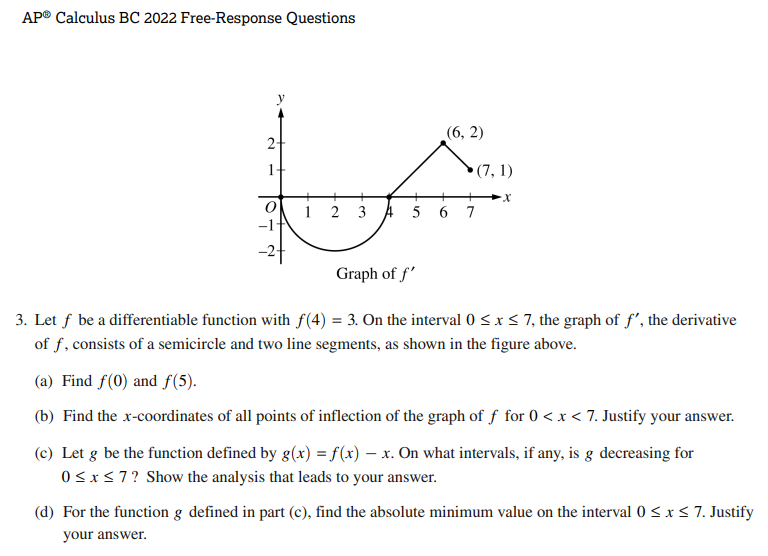 Questions b
b) 2 and 6 (where f' has max or min)
400
Find the extreme values of the function f(x) = x / (x^2 + 1). Where do these values occur?
Max: 1/2 at x=1
Min: -1/2 at x=-1
400
Let f(x) = a(x^4) + b(x^3) + c(x^2) + dx + e where a does not equal 0.
Show how many points of inflection the graph has. Pay us for a hint (100 points!).
Write a condition that must be satisfied by the coefficients of the graph if it has 0 or 2 points of inflection.
HINT: between 0 and 3
ANSWER: f''(x) is quadratic, so it will have 0,1, or 2 zeroes. Then we see that if it's 0 or 1, it won't change sign and the concavity won't change, so there isn't a point of inflection. If it has 2 it will change twice, and have two points of inflection. There are two iff 3b^2 is greater than 8ac.
ANSWER: f''(x) is quadratic, so it will have 0,1, or 2 zeroes. Then we see that if it's 0 or 1, it won't change sign and the concavity won't change, so there isn't a point of inflection. If it has 2 it will change twice, and have two points of inflection. There are two iff 3b^2 is greater than 8ac.
400
Two guys are hanging from bungee cords. Guy 1's position is represented by the equation P = 2sinT. Guy 2's position is represented by the equation P = sin2t.
P is in meters and T is in seconds.
a) At what times in the interval T>0 do the guys pass each other?
b) When in the interval [T is between 0 and 2π, inclusive] is the vertical distance between the guys the greatest? What is the distance?
We'll give you up to 2 hints for 100 points each.
HINT 1: sin2T = 2sinTcosT
HINT 2: cos2T = 2cos^2(T) - 1
ANSWERS: a) Whenever T is an integer multiple of π seconds. b) The greatest distance is (3√3)/2 meters when T = 2π/3 and 4π/3 seconds.
HINT 2: cos2T = 2cos^2(T) - 1
ANSWERS: a) Whenever T is an integer multiple of π seconds. b) The greatest distance is (3√3)/2 meters when T = 2π/3 and 4π/3 seconds.
400
The function is concave down.
f(x)=x^4-3x^3+x^2-1
What is (0.121, 1.379)?
400
 Draw f
| x-value | behavior of f |
|---|---|
| ~0 | local minimum |
| ~1 | inflection |
| ~3.5 | local maximum |
| ~5 | inflection |
| ~6.8 | local minimum |
500
The volume of an orange crate can be represented by the function:
V(x) = x(10 - 2x)(16 - 2x) over the domain 0 < x < 5
Find the extreme values of V.
What do these values mean when considering the volume of the crate?
Max: 144 at x = 2
The largest possible volume of the crate is 144 cubic units, which occurs when x = 2.
500
So there's a train, in Europe. It's going slowly, speeding up, and then slowing down again. Kind of like f(x) = (x^3)[(sin(x))^2] + 15(x^2). x is time in hours and f(x), or y, is distance in miles. Graph it! [Give us 200 points if you do it with your calculator.] Then look at t between 1 and 6, inclusive. Label points! Now, look at velocity with units. Draw a picture, if you'd like. What does this all mean? What does it have to do with the mean value theorem?
Unsimplified, v= [(3x^2)((sin^2)x)+2sinxcosx(x^3)] + 30x
So, in that window the train just keeps speeding up. The mean value theorem tells us that at some point on that interval, there's some point in between where it hits a certain point, which is the "average." For extra happiness, find it.
500
The reaction of a body to a dose of medicine can be represented by the equation R = M^2 ((C/2)-(M/3)) where:
C is a positive constant (pretend it's 6)
M is the amount of medicine absorbed in the blood
If the reaction is a change in pressure, R is measured in mmHg, and if it's a change in temperature, R is measured in degrees, ad nauseum.
Find dR/dM. Then find the amount of medicine to which the body is most sensitive.
Hint for 100 points.
HINT: Find the value of M that maximizes dR/dM.
ANSWER: M = 6/2 = 3
ANSWER: M = 6/2 = 3
500
The function's concavity changes.
f(x)=x^4-3x^3+x^2-1
What is x= 0.121 and x=1.379?
500
(a) f is increasing on (0,1) and (3,5). f is decreasing on (1,3) and (5,6.5).
(b) f has local extrema where f′(x)=0 and changes sign. Local maximum at x ≈ 1 and x ≈ 5. Local minimum at x ≈ 3.
(c) f is concave up where f′ is increasing and concave down where f′ is decreasing. Concave up on (2,4). Concave down on (0,2) and (4,6.5).
(d) Inflection points occur where f′ changes from increasing to decreasing or vice versa. x ≈ 2 and x ≈ 4.
(e) If f(0)=0, the graph of f starts at (0,0), increases to a local maximum near x≈1, decreases to a local minimum near x≈3, increases to a local maximum near x≈5, and then decreases again. The graph is concave down, then concave up, then concave down with inflection points near x≈2 and x≈4.