Derivatives & Differentiation
Integrals & Antiderivatives
Applications of Derivatives
Differential Equations & Slope Fields
Series & Sequences
100
The derivative of f(x) = 3x^2 equals?
f'(x)=6x
100
∫4x^3dx equals?
x^4+C
100
What does it mean if f'(x)>0 on an interval?
The function f(x) is increasing
100
What is the general equation for dy/dx=4?
y=4x+C
100
What is the next term in the sequence:
2, 4, 8, 16, ...
32
200
The derivative of f(x) = sin(x) equals?
f'(x)=cos(x)
200
∫cos(5x)dx equals?
1/5sin(5x) + C
200
What is the slope of the tangent line to f(x)=x^2?
f'(x)=2x
f'(3)=6
200
What does y = if dy/dx=3x^2 and y(0)=2?
y=x^3+2
200
Does the geometric series ∑(1/n)^5 converge or diverge?
Converges by p-series: p=5
300
The derivative of f(x) = cos(5x) equals?
f'(x) = -5sin(5x)
300
∫3x^2dx from x=0 to x=2 equals?
-2
300
Find the maximum value of f(x)=−x^2+4x+1?
5
300
What does a slope field represent?
A slope field shows the slopes of tangent lines for a differential equation at different points.
300
Find the sum of the geometric series:
1+1/2+1/4+1/8+...
S=2
400
The derivative of f(x) = x^2e^x equals?
f′(x) = xe^x(x+2)
400
∫x^2e^xdx equals?
e^x(x^2−2x+2)+C
400
What is the equation of the tangent line to f(x)=x^3 −2x at x=1?
y=x-2
400
A population follows a logistic growth model:
dt/dP = kP(1-P/M)
At what population value does the population grow the fastest?
P=M/2
400
What is the radius and interval of convergence for the power series?
∞
∑[(x-2)^n]/[n(3^n)]
n=1
R=3
I.O.C. = [-1,5)
500
The derivative of f(x) = arctan(3x^2+1) equals?
f′(x) =(6x)/[1+(3x^2+1)^2]
500
Simplify ∫(x^3lnx)/[(x^2+1)^2]dx from x=3 to x=9^(1/2)
0
500
A ladder 13 ft long leans against a wall. The bottom slides away from the wall at a rate of 2 ft/s
How fast is the top sliding down the wall when the bottom is 5 ft from the wall?
-5/6 ft/s
500
What is the differential equation that generates this slope field?
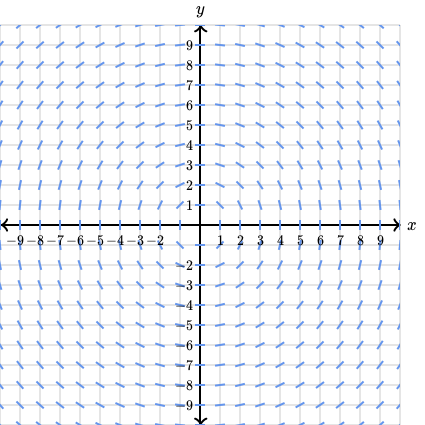
dy/dx=-x/y
500
Let
f(x)=ln(1+x)
(a) Find the first 4 nonzero terms of the Maclaurin series for f(x).
(b) Use your result to find the general term of the Maclaruin series.
(c) Determine the interval of convergence.
a) x-1/2x^2+1/3x^3-1/4x^4
b) ∞
∑ (-1)^(n+1) x^n/n
n=0
c) I.O.C. (-1,1]