Slope Fields
Differential Equations
Euler's Method
Logistical growth
Mixed Bag
100
A visual representation of a differential equation.
What is a slope field?
100
The particular solution to
dy/dx=6x^2+5
With the initial condition of (1,10)
What is
y=2x^3+5x+3
100
It's the approximation of y(0.4) using Euler's Method with 2 steps given
dy/dx=x^2-y
and starting at (0,1)
What is 0.648?
100
Its when the population in a logistic model is growing most rapidly.
dy/dx=kP(L-P)
What is
L/2
100
The general solution for
dy/dx=2(1+y^2)x
What is
y=tan(x^2+C)
200
A differential equation for the following slope field
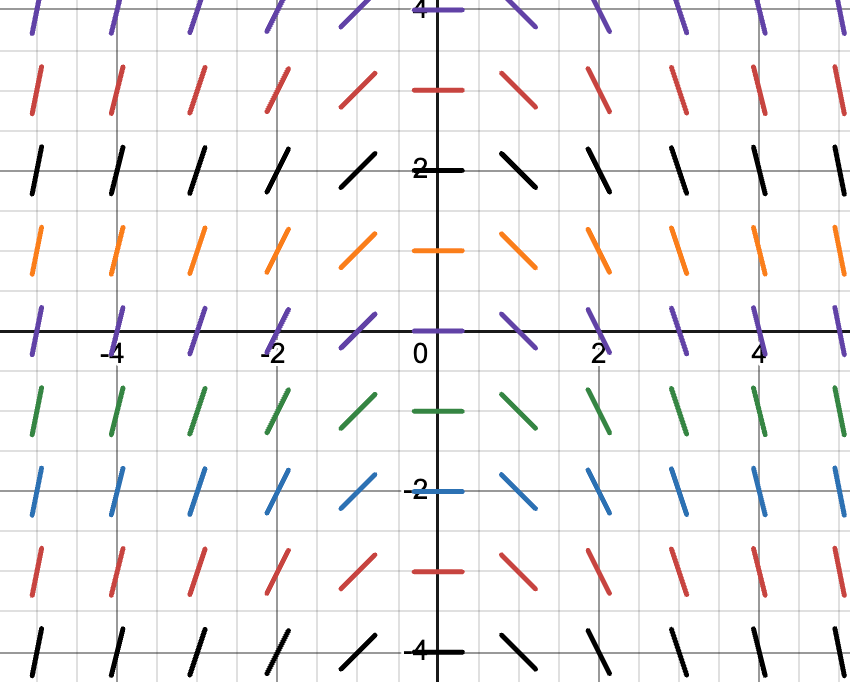
What is
dy/dx=-x
200
The general solution to
dy/dx=3xy^2
What is
y=2/(-3x^2+C)
200
Its the approximation of y(0.6) using Euler's method with 2 steps given:
dy/dx=1-x-2y
and starting at (1,3)
What is 5.84?
200
The carrying capacity of a population that grows accordingly
dP/dt=0.01P(3-P/2000)
What is 6000
200
A differential equation for the following slope field:
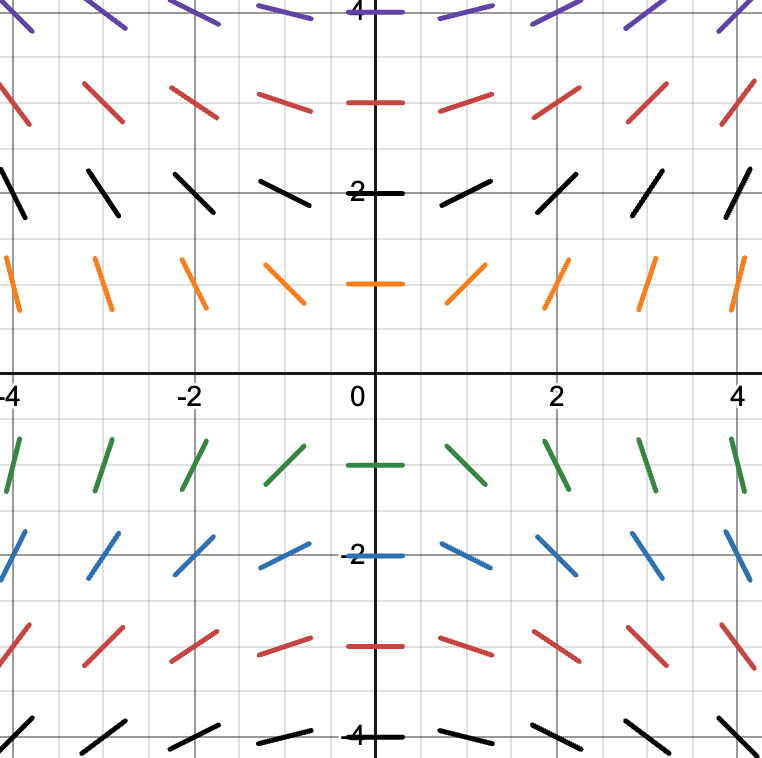
What is
dy/dx=x/y
300
A possible differential equation for:
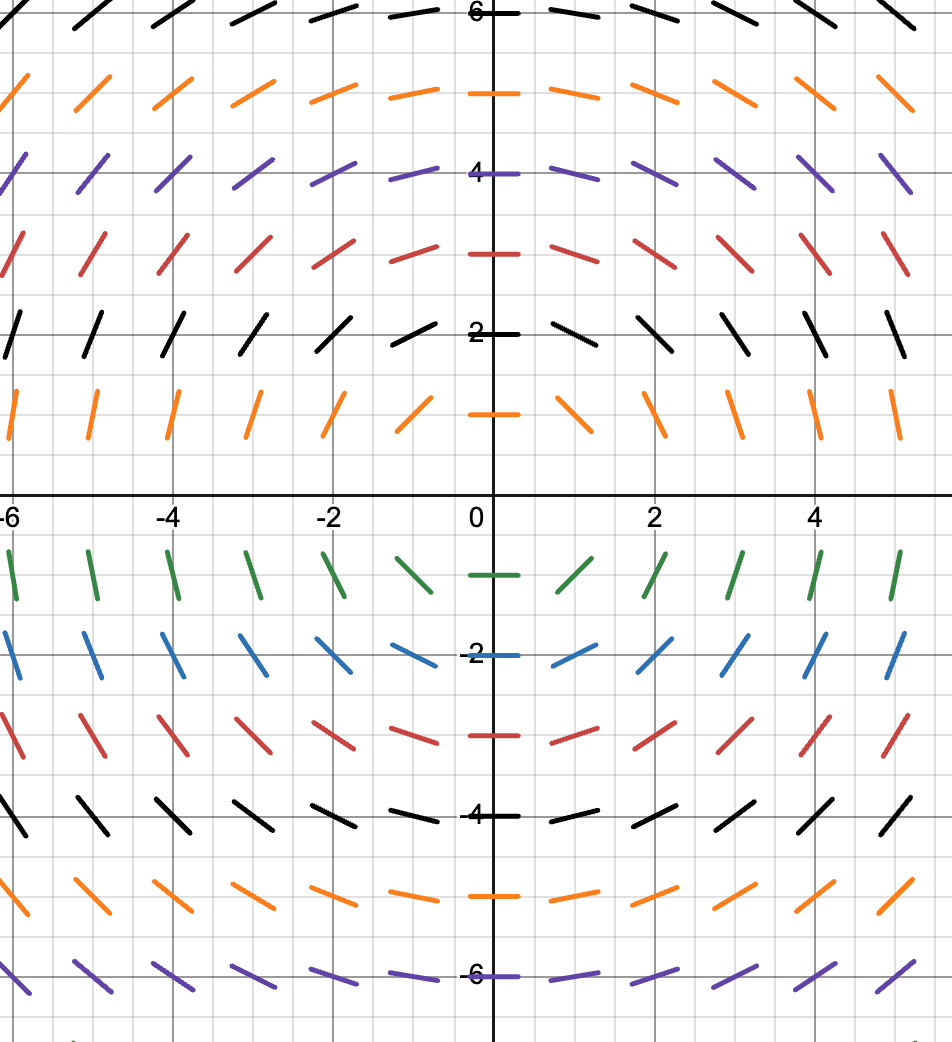
What is
dy/dx=-x/y
300
The particular solution given:
dy/dx=x/cosy
and the initial condition
(2,pi)
What is
Sin^-1(x^2/2-2)
300
Its the approximation for f(1.2) using Euler's Method for
dy/dx=3x-2y
starting at f(1)=5 and using 2 equal steps.
What is 3.77
300
The fastest rate of growth for a population of rabbits where the population grows according to the differential equation:
dy/dt=y(1-1/10y)
where t is measured in months and y is measured in hundreds of rabbits. [(0,1) initial condition states that at t=0 there are 100 rabbits]
What is 250 rabbits per month?
300
The temperature of the thermometer 5 minutes after being brought into a room that is 30 degrees C if the thermometer initially read 4 degrees C, and reads 10 degrees C after being in the room 2 minutes.
Newton's law of Heating states: the rate of change of temperature with respect to time is proportional to te difference between the temperature of the object and the ambient temperature.
What is 16.507 degrees C
400
A slope field for
dy/dx=x+y
What is 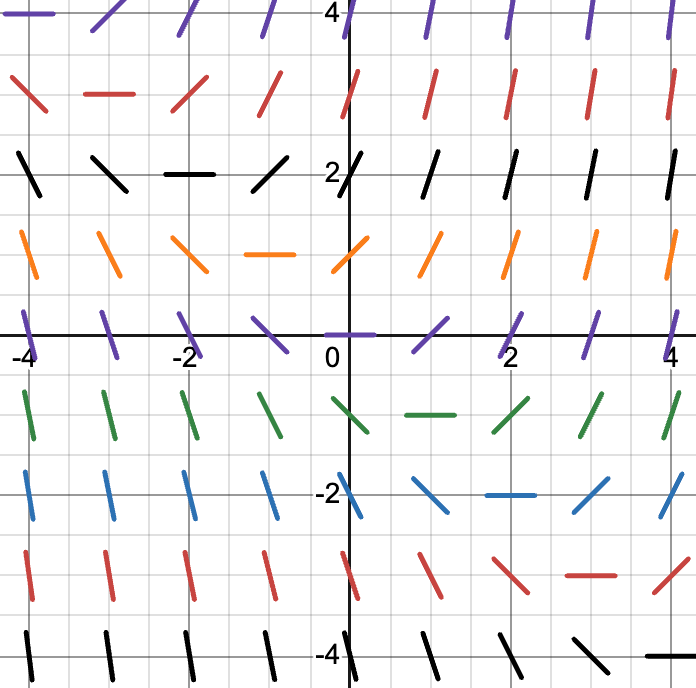
400
The time it will take a colony of bacteria to triple if the population doubles in 5 hours, and the rate at which it is growing is proportional to the number of bacterial that is present.
dN/dt=kN
What is ~8 hours
Specifically:
5ln3/ln2
400
It is the approximation for y(0.3) using Euler's Method for
dy/dx=x+2y
with an initial condition of (0,1) and step increments of 0.1
What is 1.76
400
The differential equation that models the spread of a virus among a population of N people at a rate proportional to the product of the number of people infected with the virus and the number of people not infected with the virus, assuming k is positive.
What is
(dP)/dt=kP(N-P)
400
The temperature of an object after 20 minutes when it is first heated to 90 degrees C, and allowed to cool in a room with a constant ambient temperature of 20 degrees C. You measure that after 10 minutes the object is 60 degrees C.
(du)/dt=k[u(t)-T]
What is 42.86 C
Specifically:
70e^(2ln(4/7))+20
500
A slope field for
dy/dx=2x-y^2
What is 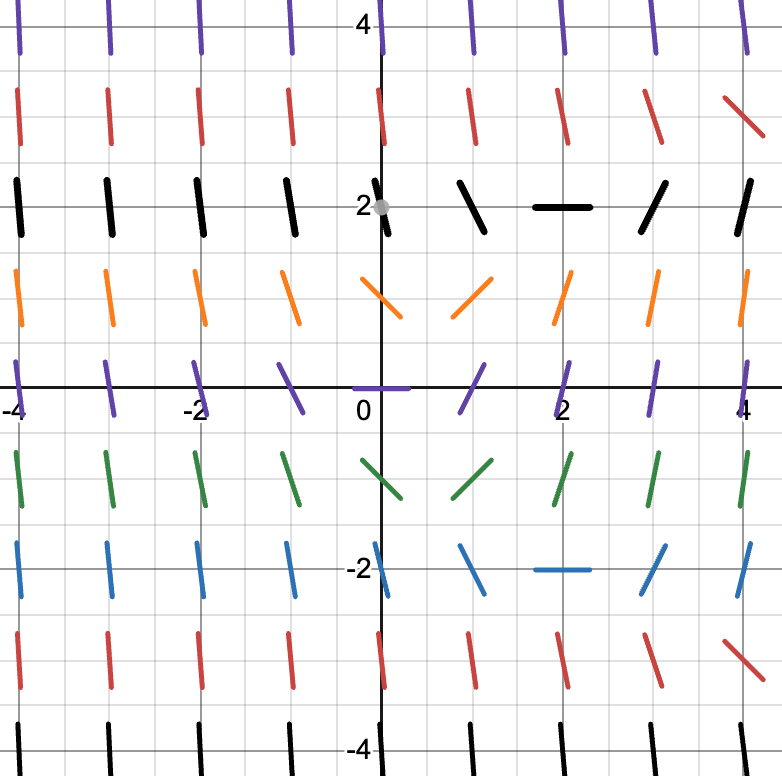
500
A)It models the rate of radioactive decay of Radium. Where the rate of decay is proportional to the amount of radium present and the half-life of radium is 1690 years.
B) Find the particular solution to the differential equation with the initial condition A(0)=8g
C) How much radium will be present in the sample in 100 years?
What is:
A)
(dA)/dt=ka
B)
A=8e^((-ln2/1690)t)
C)7.6979 grams
500
Suppose
dy/dx=cos(πx)
with initial condition (0,1).
A) Use Euler's Method to approximate y(1) with 0.2 step.
B) Find the particular solution
C) Find the error in your approximation.
A)
y(1)~~1.2
B)
y=1/pisin (πx) +1
C) Error= lActual-Approxl=l1-1.2l=.2
500
What is the time it tales for 1/2 the population to become infected, if a person with the flu is placed in a group of 49 people without the flu, and the rate of change of those with the flu, with respect to time ,(in days) is proportional to the product of the number of those with the flu and those without.
What is 26 days?
500
Given that y=g(x) is the solution of the differential equation:
dy/dx=2x-4y-2
with the initial condition g(1)=k where k is a constant. Eulers method starting at x=1 yields g(2)=0, with an equal increment of 1/2 find k.
What is
k=-1/2