Derivative Definitions
The Power Rule
Transcendental Derivatives
Tangent Lines & Approximation
Differentiability
100
At x=3, f(x) is increasing. What do you know about the derivative at x=3?
It is positive.
100
If
f(x)=2x^3-x^2+5x+10
13
100
Find the derivative of
g(x)=e^(x)-ln(x^2)+x^3
g'(x)=e^(x)-(2/x)+3x^2
100
What is the equation of the line tangent to
y=-3x^2+1
at the point x=-1 ?
y+2=6(x+1)
100
Identify the points where the function is nondifferentiable. 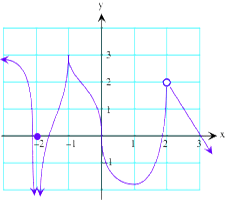
x = -2, -1, 0, 2
200
lim_(h->0)(4(x+h)^3-4x^3)/(h)=
12x^2
200
Find the derivative of
g(x)=sqrt(x)-3/x^4
g'(x)=1/(2sqrt(x))+12/x^5
200
Find the second derivative of
h(x)=e^(mx)+1/x
h''(x)=m^2 e^(mx)+2/x^3
200
Use the tangent line at x = 2 to approximate the value of f(2.2) given that
f(x)=2x^3-x
y=18.6
200
Identify all points where the function is non-differentiable. 
x = -1, 1, 2, 2.5
300
lim_(h->0)(2(-1+h)^4-2)/(h)=
-8
300
Find the derivative of
f(x)=4^(5x)+sqrt(x-2)
f'(x)=5(4^(5x))ln(4)+1/(2sqrt(x-2))
300
Find the second derivative of
h(x)=5ln(sqrt(x))
h''(x)=-5/(2x^2)
300
Find the slope of the line normal to
f(x)=3e^(4x)-sqrt(x+1)
at x = 0.
-2/23
300
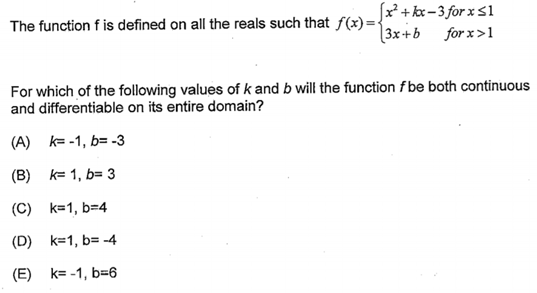
(D)
400
Given that
lim_(h->0)(f(-2+h)-f(-2))/(h)=3
Which of the following statements must be true? Select all that apply.
I. f(x) is positive
II. f(x) is increasing
III. The slope of the line tangent to f(x) is increasing
II only
400
What is the derivative of
g(x)=6x^2-sqrt(x-3)+ln(3x^5+1)
where x = 3
Does not exist!
400
What is the slope of the line tangent to
h(x)=e^(x-3)/4+5sqrt(x)-ln(x^2)
h'(x)=e^(x-3)/4+5/(2sqrt(x))-2/x
400
Find an equation of the line tangent to f(x) at x = 2:
f(x)=e^(3x)-12/x^2
y-(e^8-3)=(3e^8+3)(x-2)
400
Find the values of a and b that make the function differentiable:
f(x)={(asqrt(x),x>1),(bx^2+9, xleq1):}
a = 12, b = 3