Unit 1
Unit 2
Unit 3
Unit 4
Unit 5
Unit 6
Unit 7
Unit 8
Unit 9
100
An ion contains 26 protons, 30 neutrons, and 23 electrons. Identify the element and ionic charge.
Iron, Fe3+
100
What type of bond forms between elements with very large electronegativity differences?
Ionic
100
What IMF exists between all molecules?
London dispersion
100
Find the coefficient for oxygen gas in the reaction between oxygen gas and iron to form iron (III) oxide.
3
100
What happens to the rate constant k as temperature increases?
It increases
100
If Delta H is negative, is the reaction exo- or endothermic?
Exothermic
100
What condition must be true for a reaction at equilibrium?
Forward and reverse reaction rates are equal
100
What is the conjugate base of H2CO3?
HCO3-
100
What is oxidation and where does it occur?
Loss of Electrons LEO! and at the anode (an ox)
200
An element exists as two isotopes: one with mass 63 amu and abundance 69.2%, and another with mass 65 amu and abundance 30.8%. Calculate the average atomic mass and identify the element.
63.6 amu, Copper
200
What is the geometry of methane (CH4)?
Tetrahedral
200
Which has a higher boiling point: H2O or H2S?
H2O b/c hydrogen bonding
200
Write the net ionic equation for the reaction AgNO3+NaCl-->AgCl+NaNO3
Ag++Cl--->AgCl(s)
200
Describe at the particulate level why powdered solids react faster than large chunks of the same substance.
The greater surface area increases the collisions.
200
Given: Delta H=-150 kJ and Delta S=-250 J/K, at what temperature does the spontaneity change?
600 K
200
N2(g)+3H2(g)<-->2NH3(g)
What happens to equilibrium when pressure increases? (describe K and direction)
K stays the same, reaction shifts right
200
What is the pH of a 1.0*10-3 M HCl solution?
3
200
A reaction has DeltaH=-100 kJ and DeltaS=-200 J/K. At high temperature, is the reaction more or less favorable?
less favorable
300
An electron transition emits light with wavelength 486 nm. What region of the electromagnetic spectrum is this in and what is the frequency of the wave?
Visible light and 6.17*10^14
300
Which has a lowest vapor pressure: CH4, NH3, HF or CO2 and why?
HF due to hydrogen bonding
300
A student conducts a thin-paper chromatography experiment with water as the solvent. What can the student determine about dye A vs. dye B if dye A travels further up the stationary phase?
dye A is more polar than dye B
300
What type of reaction happens when a solid is the product of two aqueous solutions?
Precipitation reaction
300
Determine the rate law based on the table.
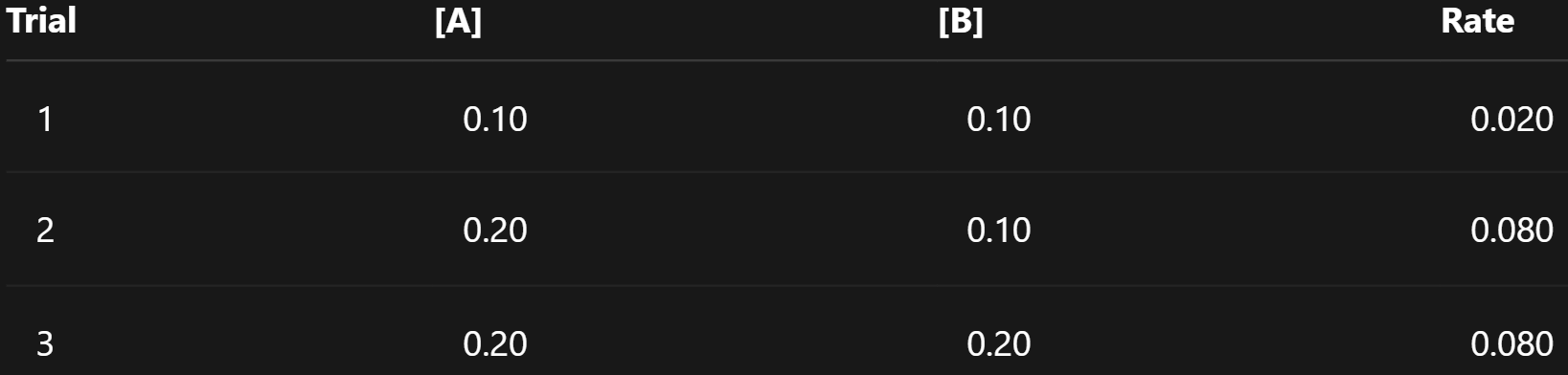
Rate=k[A]2
300
For the exothermic reaction: 2H2(g)+O2(g)-->2H2O(g), explain in terms of bonds breaking and forming, why this reaction releases energy.
Less energy is required to break the H-H and O=O bonds than is released when the O-H bonds are formed.
300
Write the equilibrium expression for 2SO2(g)+O2(g)<--->2SO3.
K=[SO_3]^2/([SO_2]^2[O_2])
300
Sketch a strong acid dissociating vs. a weak acid
SA - all molecules dissociate, WA - only some
300
Given: Zn2++2e--->Zn(s) E=-0.76 V and Cu++e--->Cu(s) E=0.52
Calculate the Ecell for the spontaneous reaction.
1.28
400
Successive ionization energies for an unknown element are:
- IE1 = 578
- IE2 = 1817
- IE3 = 2745
- IE4 = 11,600
Predict the valence electron configuration and likely group.
Three ve-, Group 13
400
Draw the Lewis Structure for SO2 and determine it's geometry
bent
400
Name three ways of separating mixtures, and describe what situation to use that method.
Distillation - different boiling points, Filtration - different solubility, Chromatography - different IMFs
400
What is equal at the end point of a titration?
The moles of titrant and analyte
400
A first-order reaction has a half-life of 20 seconds. How long will it take for the concentration to decrease to one-eighth of its original value?
60 seconds
400
A 25.0 g sample of ice at 0 C is melted completely and then heated to 35 C. Heat of fusion of water = 334 J/g and Specific heat of liquid water = 4.28 J/gC. How much energy is required?
1.20*10^4 J=12.0 kJ
400
For the reaction N2(g)+3H2(g)<-->2NH3(g): At a certain moment, the concentrations are [N2]=0.50, [H2]=0.20, [NH3]=0.80 M. If Kc=150, predict the direction the reaction will shift to reach equilibrium.
Q=160>K therefore the reaction will shift left toward reactants
400
Calculate the pH of a 0.10 M acetic acid solution given Ka=1.8*10-5.
2.88
400
CaCO3(s)-->CaO(s)+CO2(g)
What is the sign of Delta S for the above reaction? Delta G is known to be positive and the reaction is endothermic.
positive
500
A compound contains 40.0% carbon, 6.7% hydrogen, and 53.3% oxygen by mass.
If the molar mass of the compound is 180 g/mol, what is the molecular formula?
Answer: C₆H₁₂O₆
500
What makes something able to conduct, and what substances are able to conduct?
electrons can flow through, metals and graphite
500
Identify all the IMFs that would be present in a solution of CaCl2 with C2H2OH
ion-dipole between them
Hydrogen bonding (dipole-dipole), London Dispersion in between the enthanols
500
If 50 mL of 0.200 M HCl reacts with 25.0 mL of 0.100 M NaOH, determine the limiting reactant.
NaOH
500
For a reaction, a plot of ln[A] vs. time gives a straight line with slope −0.025 s⁻¹. Determine the reaction order and calculate the half-life.
First order, half-life=27.7 s
500
The combustion of propane is represented by C3H8(g)+5O2(g)-->3CO2(g)+4H2O(l) Delta H=-2220 kJ/mol
If 12.0 g of propane reacts completely, how much energy is released?
604 kJ
500
For the reaction: N2O4(g)<-->2NO2(g)
A sealed container initially contains only N2O4. At equilibrium, [N2O4]=0.40 M and [NO2]=0.60 M. Calculate Kc.
Kc=0.90
500
A buffer solution contains NH3(aq) and NH4Cl(aq). A small amount of HCl is added. What species in the buffer reacts with the added acid, and why does the pH change only slightly?
NH3 reacts with the H+ from HCl to form NH4+. The pH only changes slightly because more NH3 will disassociate, causing the concentration of H+ to only increase slightly.
500
A galvanic cell is constructed using the reaction: Zn(s)+Cu2+(aq)-->Zn2+(aq)+Cu(s) with Estandard=1.10 V, [Zn2+]=0.50 M, [Cu2+]=0.010 M at 25 degree Celsius. Calculate the cell potential.
1.05 V