Vocabulary
The Demographic Transition Model
Population Pyramids
Rates
Odds and Ends
100
This is the scientific name given to the study of population.
Demography
100
This is real name of the acronym DTM
Demographic Transition Model
100
The three "groups" of people that a population pyramid shows.
Kids(0-15), Adults(16-64), Old People(65- )
100
This is the average number of children every family needs to have to keep the population steady (no increase or decrease)
2.1 (will accept 2)
100
China instituted this policy in hopes of controlling an out of control population.
One child policy
200
The largest number of people that the environment of a particular area can support is called a _______ capacity.
Carrying Capacity
200
The main characteristics of the third stage of the DTM. (There should be 3)
Declining Birth Rates, Declining Death Rates, Population growth begins to slow.
200
Concave sides on a population pyramid will tell you this about a country….
That there is a high death rate
200
The total number of deaths in a year for every 1000 people alive in a society
Crude death rate
200
These are two of the five most populated countries in the world.
China, India, United States, Indonesia, Brazil
300
This is the movement of people within a country.
Internal Migration
300
The main revolution that allowed for rapidly declining death rates in the 2nd stage of the DTM and started in the 1800's in Europe (England specifically).
The Industrial Revolution
300
Seen here... is a population pyramid of Scotland, which is in this stage of the demographic transition model.
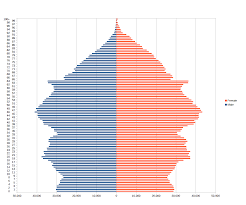
Stage 3, (Low birth rates, low death rates, lower natural increase)
300
The total number if live births in a year for every 1000 people alive.
Crude Birth Rate
300
The ratio comparing those who are too young or too old to work compared to the economically active.
dependency ratio
400
This English economist that argued that population will increase geometrically rather than arithmetically.
Thomas Malthus
400
Two approaches to reducing birth rates that governments could implement (put in place) are...
Education for women; access to contraception; antenatal advertising, policies such as China's one child policy;
400
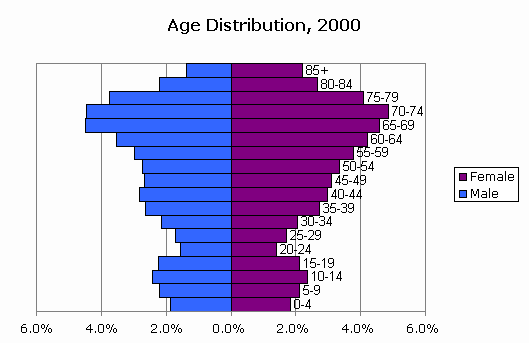 A government would need to do this to help it's citizens if this was their population pyramid.
Build more retirement centers/hospitals/elder care facilities.
400
Having a high rate of this means there is a large portion of children younger than 1 dying due to illness, disease or hunger.
Infant mortality
400
This is the "stage of pestilence and famine". Give an example of a country in this stage.
Stage 1 and no country is in stage one
500
Some one who is forced out of their country because of political reasons
What is an asylum seeker?
500
These two countries are currently in stage 5 of the DTM
Declining populations-Eastern Europe; Japan; South Korea; Croatia, Estonia, Germany, Greece, Portugal, Ukraine, Moldavia, Italy,
500
Listen to Elon Musk (3 minutes long) then name one thing that he said that was correct and one thing that was incorrect. https://www.youtube.com/watch?v=_U2kR6TOQcY
correct-US (1.57)is below the the replacement number (2.1) but the population continues to increase because of immigratrion; Japan's population is decreasing
incorrect-the population is not currently declining (eventually it will, but not at the moment...it is still increasing especially in South East Asia, South Asia, and Africa, Central America;
500
If a country has a crude birth rate of 37 per 1000 and a death rate of 13 per thousand, what will their rate of natural increase be?
24 per thousand
500
This is one of the top 4 most populated regions in the world (Must be specific) where nearly 3/4 of the worlds population is located.
East Asia, South Asia, Europe, Southeast Asia