Factoring
Limits
Horizontal Asymptotes
End Behavior
Domain
100
Factor f(x)=x^2+22x+7 .
Multiply: 21; Add: 22 -> 1 and 21
f(x)=3x^2+21x+1x+7
f(x)=3x(x+21) + 1(x+7)
f(x)=(3x+1)(x+7)
100
How would you read lim_(x->3^+)f(x) ?
What is the limit of f(x) as x approaches 3 from the right?
100
Does r(m) = (3m^3+6m-4)/(5m^5-2) have a horizontal asymptote? If so, where is it?
Degree of denominator > Degree of numerator
There is a horizontal asymptote at r(m) = 0
100
Find the end behavior of f(x)=-3x^5+6x^2+2.
Leading term: -3x^5
lim_(x->infty)f(x)=-infty
lim_(x->-infty)f(x)=infty
100
State the domain of f(x)=(2x^2-7x-15)/((x-7)(x+4)(x-2))
(-infty, -4) cup(-4,2) cup(2,7) cup (7,infty)
200
Factor g(x) = 5x^2-21x+22 .
Multiply: 5*22=110 , Add to -21 -> -10, -11 .
5x^2-10x-11x+22
5x(x-2)-11(x-2)
(5x-11)(x-2)
200
Find lim_(x->-1^-)g(x)
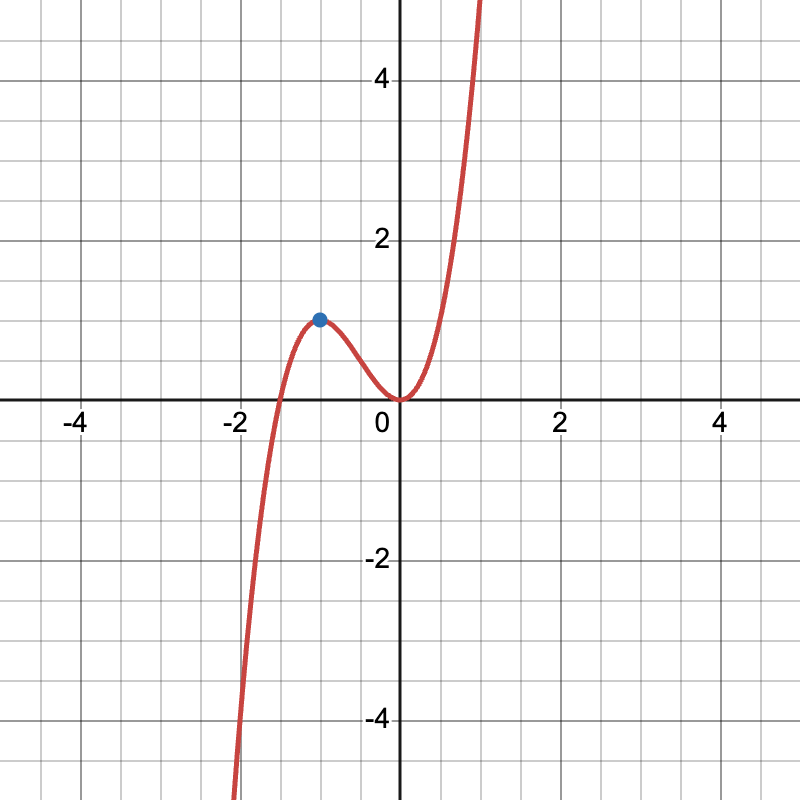
lim_(x->-1^-)g(x)=1
200
Does g(x)= (4x^2+9x+2)/(3x+6) have a horizontal asymptote? If so, where is it?
Degree of numerator > Degree of denominator.
There is no horizontal asymptote.
200
Find the end behavior of g(x)=3x^2(-2x+4)^3(x-3)^5
Leading term: (3x^2)(-2x)^3(x^5)=3x^2(-8x^3)(x^5)=-24x^10
lim_(x->infty)g(x)=- infty
lim_(x->-infty)g(x)=-infty
200
State the domain of (4x^5+3x^3+9x-13)/(x^2(x+3)(x-1)
(-infty,-3)cup (-3,0)cup(0,1)cup(1,infty)
300
Factor a(b) = 3b^3-7b^2-6b .
Factor out b: b(3b^2-7b-6) .
Multiply to: 3(-6) = -18, Add to -7 -> -9, 2 .
b(3b^2-9b+2b-6)
b(3b(b-3)+2(b-3))
b(3b+2)(b-3)
300
Find lim_(x->5^+)g(x)
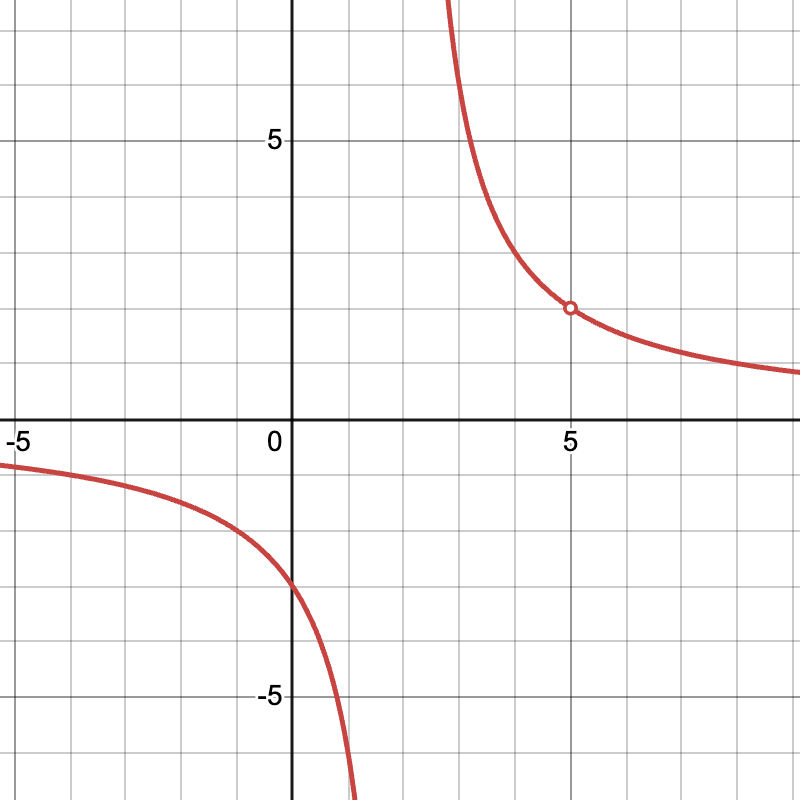
lim_(x->5^+)g(x)=2
300
Does f(x)= (6x^3+8x^2+2)/(3x^3+9x+9) have a horizontal asymptote? If so, where is it?
Degree of numerator = Degree of denominator
Horizontal asymptote at f(x)=6/3=2
300
Find the end behavior of f(x)=(2x^4+6x-2)/(3x^5-2x^4+6x^2+19)
Degree of numerator < Degree of denominator
Horizontal asymptote at f(x)=0
lim_(x->infty)f(x)=0
lim_(x->-infty)f(x)=0
300
State the domain of ((x+6)(4x-16))/((2x+3)(x-19))
2x+3 = 0 -> 2x = -3 ->x=-3/2
Domain: (-infty,-1.5)cup(-1.5,19)cup(19,infty)
400
Factor r(x) = 2x^4+4x^3-16x^2.
Factor out 2x^2 -> r(x) = 2x^2(x^2+2x-8)
Multiply to: 1*(-8)=-8 , Add to: 2 -> 4, -2 .
2x^2(x^2+4x-2x-8)
2x^2(x(x+4)-2(x+4))
2x^2(x+4)(x-2)
400
Find lim_(x->1^+)f(x) 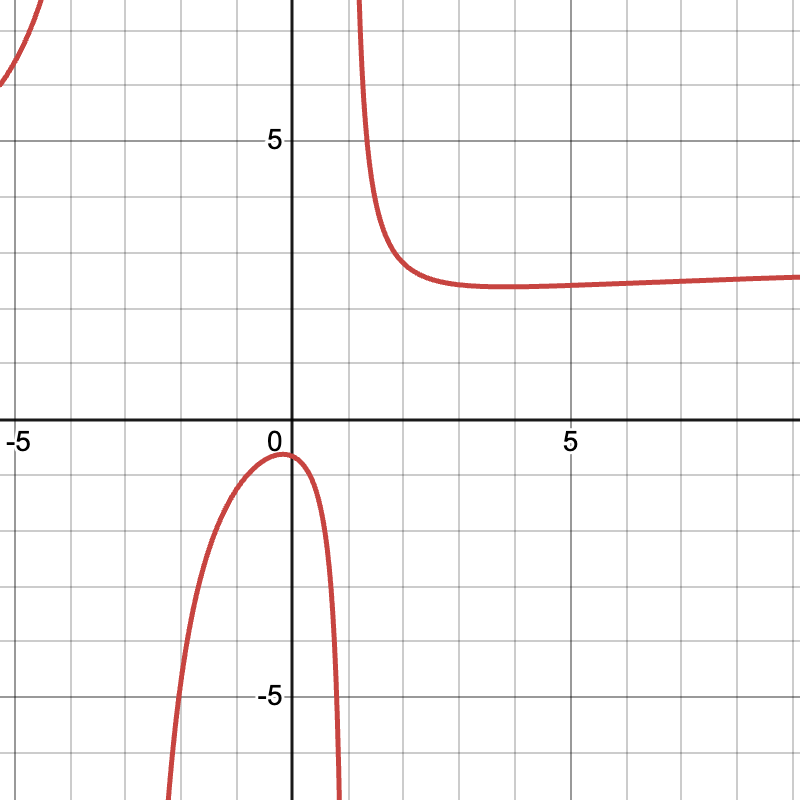
lim_(x->1^+)f(x)= infty
400
Does g(x)= ((x+2)^3(2x-1))/((x-2)^2(3x+1)^2) have a horizontal asymptote? If so, where is it?
Leading term of N(x) = (x^3)(2x) = 2x^4
Leading term of D(x) = (x^2)(3x)^2=x^2(9x^2)=9x^4
Degree of numerator = Degree of denominator
Horizontal asymptote at g(x) = 2/9
400
Find the end behavior of f(x)=(8x^4+9x^2-42)/(-2x^4+12x^3+82x)
Degree of numerator = Degree of denominator
Horizontal asymptote at y= 8/(-2)=-4
lim_(x->infty)f(x)=-4
lim_(x->-infty)f(x)=-4
400
State the domain of (6x^2+18)/(2x^5-7x^4-15x^3)
Factor the denominator, factor out: x^3 , Multiply to -30, Add to -7 -> -10 and 3
x^3(2x^2-10x+3x-15)
x^3(2x(x-5)+3(x-5))
x^3(2x+3)(x-5)
2x+3 = 0 -> 2x=-3 -> x=-1.5
Domain: (-infty,-1.5)cup(-1.5,0)cup(0,5)cup(5,infty)
500
Factor k(x) = -3x^2+3x+6 .
Factor out -3 -> k(x)= -3(x^2-1x-2) .
Multiply to: 1*(-2)=-2 , Add to: -1-> -2, 1
k(x)=-3(x^2-2x+1x-2)
k(x)=-3(x(x-2)+1(x-2))
k(x)=-3(x-2)(x+1)
500
Find lim_(x->3^+)f(x) and lim_(x->3^-)f(x).
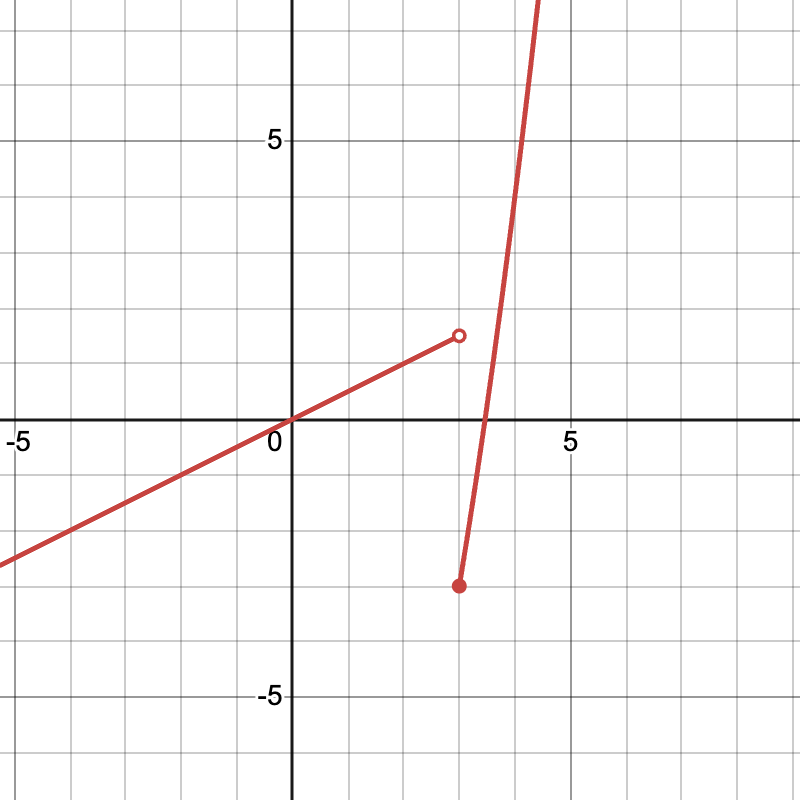
lim_(x->3^+)f(x)=-3
lim_(x->3^-)f(x)=1.5
500
Does h(x)= ((-x+2)^5(-6x-1)^2)/((x+8)^6(3x^2+4)^2) have a horizontal asymptote? If so, where is it?
Numerator leading term: (-x)^5(-6x)^2 = -x^5(36x^2)=-36x^7
Denominator leading term: x^6(3x^2)^2=x^6(9x^4)=9x^10
Degree of denominator > Degree of numerator
Horizontal asymptote at h(x) = 0
500
Find the end behavior of (15x^7+19x^6+3x^5-2x^4-84x^2)/(-3x^3+7x+10).
Degree of numerator > Degree of denominator (15x^7)/(-3x^3)=-5x^4
lim_(x->infty)f(x)=-infty
lim_(x->-infty)f(x)=-infty
500
State the domain of (2x^2-7x+5)/(3x^2-10x+8)
Factor the denominator:
Multiply to 24, Add to -10 -> -6 and -4
3x^2-6x-4x+8
3x(x-2)-4(x-2)
(3x-4)(x-2)
3x-4=0->3x=4 ->x=4/3
Domain: (-infty,4/3)cup(4/3,2)cup(2,infty)