Logarithms <=> Exponents
Graphs of Logarithms
Expanding/Condensing Logarithms
Relate the Bases & Other Methods of Solving
Miscellaneous
100
Rewrite the following as an exponential function.
log_6x=2y
6^(2y)=x
100
Find the asymptote of the following.
f(x)=ln(x-5)-2
VA @ x=5
100
Condense the following logarithm.
6lnx+\frac{1}{2}lny
ln(x^6\sqrt(y))
100
Solve the following equation.
5^x/5^3=1/25
x=1
100
An exponentially decaying function graphed on a semi-log plot would have what appearance? Draw me a picture.
Should have a line with a negative slope
200
Rewrite the following as a logarithmic function.
x^(5y)=z+3
log_x(z+3)=5y
200
Find the domain and range of the following.
f(x)=-5log_6(x+2)-9
Domain = (-2,inf)
Range = (-inf,inf)
200
Expand the following logarithm.
log_2(x^4y)
4log_2x+log_2y
200
Solve the following equation.
log(x-3)-log(x-4)=log(5)
17/4
200
Scientists are worried about the cardinal population in Northeast Ohio. Each year the measured the number of tagged cardinals. They find a regression equation, f(x), that models the number of cardinals as a function of how many years has passed.
f(x) = 1199.725 - 99.962 ln(x)
How many cardinals can we predict that there will be in year 20?
900 cardinals
300
Determine whether the following functions are inverses of each other.
f(x)=10^(5x) and g(x)=\frac{1}{5}logx
Inverses
300
Find the domain and range of the following.
f(x)=-2log_2(2-x)+4
Domain = (-inf,2)
Range = (-inf,inf)
300
Condense the following logarithm.
\frac{1}{3}(logx+2logy)
log(xy^2)^\frac{1}{3}
300
Solve the following equation.
1/2e^(x-4)=14
ln(28)+4
300
Scientists are worried about the cardinal population in Northeast Ohio. Each year the measured the number of tagged cardinals. They find a regression equation, f(x), that models the number of cardinals as a function of how many years has passed.
f(x) = 1199.725 - 99.962 ln(x)
After how many years will there be 800 cardinals?
55 years
400
Find the inverse of the following.
g(x)=log(2x-3)-5
g^-1(x)=\frac{10^(x+5)+3}{2}
400
Sketch a graph of the following. Be sure to label your asymptote.
f(x)=-5log_6(x+2)-9
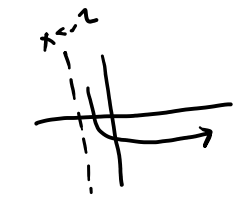
400
Expand the following logarithm.
log_3\sqrt(\frac{x^2}{y})
\frac{1}{2}(2log_3x-log_3y)
400
Solve the following equation.
12-log_2(x+9)=14
-8.75
400
Solve the following inequality.
8*4^(2x)-5> -3
x> -1/2
500
Find the inverse of the following.
f(x)=2(3^(x+1))+10
f^-1(x)=log_3(\frac{x-10}{2})-1
500
Find the end behavior of the following (should see two limits in your answer).
f(x)=log(7-x)+4
lim_(x->7^(-))f(x)=- infty and lim_(x->-infty)f(x)=infty
500
Find all of the transformations from f(x) to g(x).
f(x)=log(x)
g(x)=log(27-27x)
Vertical translation up 3
Horizontal translation right 1
Horizontal reflection (reflection over y-axis)
500
Solve the following equation.
5(2^(3x))-4=46
\frac{log_2(10)}{3}
500
Solve the following inequality.
log(3x-2)\gelog(5)+log(x-4)
(4,9] or
4<x<=9