Unit 1A: Polynomial and Rational Functions
Unit 1B
Unit 2A: Exponential and Logarithms
Unit 2B
Unit 3: Trig Functions
100
Let w(x) give the weight of a baby giraffe, in pounds, 'x' months after birth. Write an that can be used to find the average rate at which the giraffe gained weight between month 4 and month 7?
\frac{w(7)-w(4)}{7-4}=\frac{w(7)-w(4)}{3}
100
Information about a certain polynomial is given, what must be true?
 (A) The graph has a relative max at x=-2
(B) the graph has a relative min at x=4
(C) f(x)=0 for some x in the interval [-2,4]
(D) The range of g is (- infinity, 11]
(A)
100
For a logarithmic function, as the inputs grow _________ the outputs are expected to grow ____________.
...multiplicatively.....additively
100
Solve the following completely, writing the answer as a fraction
4^(4x-1)=8^(x/4)
x=8/37
100
On the interval [0<x<2pi], where are cos(x)=sin(x)?
x=pi/4, and x=5pi/4
200
The graph of a smooth, continuous function 'f' has a single inflection point at x=3. Which of the following statements is true?
(A) 'f' is increasing at x=3
(B) The graph of f is concave down at x=3
(C) 'f has an absolute minimum value at x=3
(D) The rate of change of 'f' changes at x=3, from either increasing-->decreasing, or decreasing-->increasing.
(D)
200
If (7-4i) is a root of a given polynomial, what other root is guaranteed?
(A) -7+4i
(B) 4i
(C) 7+4i
(D) -7-4i
(D)
200
The function 'f' is given by:
f(x)=2^(3x)
Which of the following statements describes characteristics of the graph 'f' in the xy-plane?
(A) The graph is a vertical dilation of y=2^x and f(x) is equivalent to 8^x
(B) The graph is a vertical dilation of y=2^x and f(x) is equivalent to 8*2^x
(C) The graph is a horizontal dilation of y=2^x and f(x) is equivalent to 8^x
(D) The graph of f is a horizontal dilation of y=2^x and f(x) is equivalent to 8*2^x
(C)
200
The function 'g' is given by
g(x)=ln(3x+1)-ln(x^2+x-2)
What are all the values of 'x' for which g(x)<0?
(3,\infty)
200
On the interval [0,pi/2], how do you describe the concavity of y=cos(x)?
decreasing concave down
300
Which point is considered a point of inflection?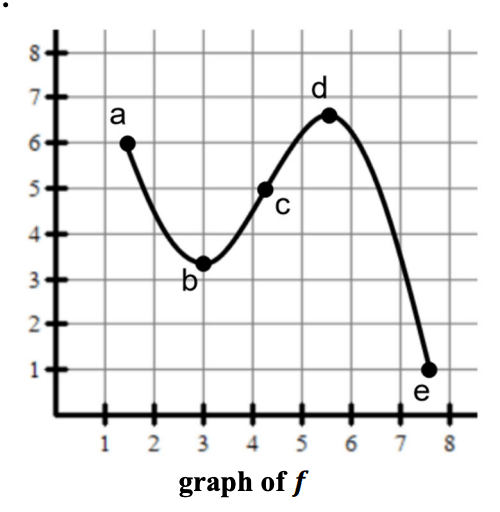
(C)
300
The following is a graph of 'f'. Does it have (i) an even or odd degree? (ii) what is the multiplicity of the root at x=5?
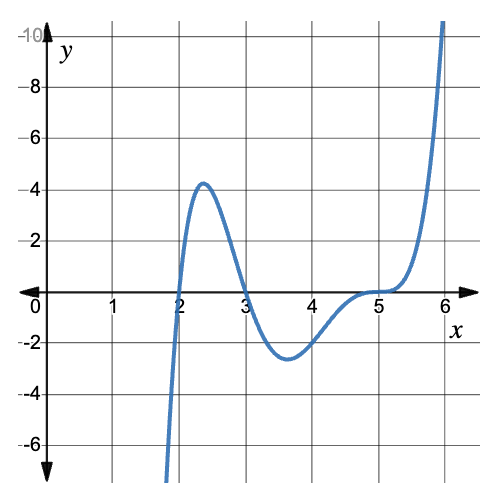
(i) odd (ii) odd multiplicity, so 3 for example
300
A data set that appears exponential is modeled by the function 'y' given by:
y=7\cdot 5^x
The data are represented using a semi-log plot, where the vertical axis is logarithmically scaled with the natural logarithm (e).
After taking "ln" of both sides, what is the slope of the linearized function?
the slope is ln(5)
300
To solve the equation:
log_8(x-3)+log_8(x+4)=1
one method is to apply the properties of logarithms to write a new equation that can be used to identify possible solutions. Of the following, which is such an equation?
(A) 2x+1=8
(B) (x-3)/(x+4)=8
(C) x^2-12=8
(D) x^2 + x -12 = 8
x^2 +x - 12=8
300
On which interval(s) is sin(x) concave up?
(A)pi < x < 3pi / 2
(B)3pi / 2 < x< 2pi
(C)0 < x < pi/2
(D)pi/2 < x < pi
(A) & (B)
400
Describe how 'f' changes as x increases without bound
f(x)=-17x^6+5x^3-2x^2+8x+11
\lim_{x\to \infty}f(x)=-\infty
400
The cost of renting a bowling alley for an event is a $200 flat fee and a $25 per person that attends. Let C(x) represent the cost per person when 'x' people attend the event. The equation for C(x) is given:
C(x)=\frac{25x+200}{x}
What is the behavior as x tends to infinity, what is the correct interpretation?
the limit tends towards 25, this is because as x grows and grows, the $200 fee becomes smaller and smaller in comparison. Example: C(1000)= (200+25000)/(1000)=25200/1000=25.2. This decimal just keeps getting closer and closer to 25.
400
The function 'h' is given by:
h(x)=8\cdot 2^x
For which value of 'x' is h(x)=256?
h=5
400
The range of function 'f' is the positive real numbers. The function 'g' is
g(x)=ln(f(x))
Solutions to which of the following equations are useful in solving g(x)=2
(A) f(x)=2
(B) f(x)=e^2
(C) f(x)=10^2
(D) f(x) = 2/ (lnx)
(B)
400
Given,
asin(4(x-pi/2)+5
What 'a' value would be necessary to have an x-intercept?
a>=5
500
Sketch a 4th degree polynomial with 2 real roots whose multiplicities are both 2
answers vary
500
Which interval is decreasing and concave down?
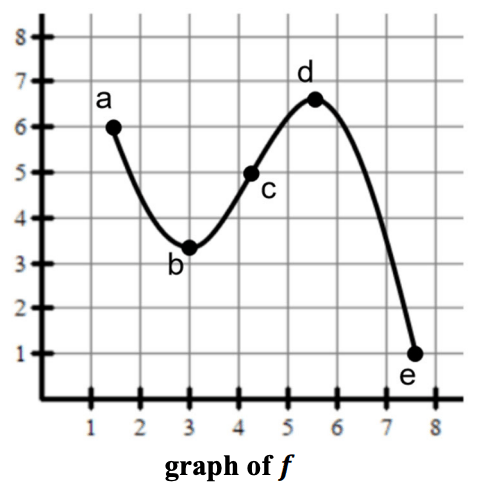
[d,e]
500
Given the data points:
(2,10), (4,20), (6,40), (8,80)
y=5(2^(x/2))
500
Use a calculator/desmos to solve! The function 'f' is given by
f(x)=4\cdot 3^(x-2)+1
The function 'g' is given by
g(x)=f^(-1)(x)
For which of the following values does g(x)=-3x?
1.0156 or 1.016
500
Given,
7sin(8(x-pi/3))+2
How many complete cycles would you see between 0<x<2pi?
8