Political
Innovations
Environment + Human Interactions
Cultural Developments
Economics
Social Interactions
100
This concept from ancient China called for merit based government positions by testing individuals for their talents.
(UNIT 1 / 589 A.D. - 1905)
What is the Civil Service Exam?
100
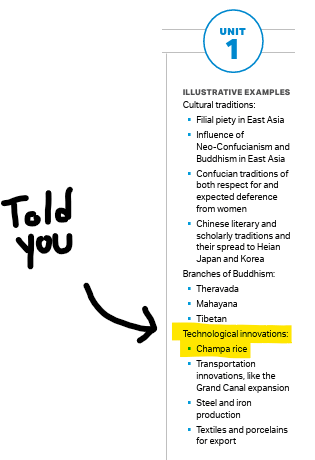
The introduction of this crop to China during the Song Dynasty led to a surplus of food, and led to an increase of the population.
What is Champa Rice?
100
This global pandemic during the Middle Ages significantly reduced the global population, and directly contributed to the end of Serfdom in Europe.
(Unit 1 / Mid-1300s)
What was the Black Death/Bubonic Plague?
100
This period of development in Europe followed the end of the Bubonic Plague outbreak, and started in Northern Italy. It saw a renewed interest in art, philosophy, and the rise of the Humanist movement.
(Unit 3 / 1300s - 1600s)
What was the Renaissance?
100
This land based trade route is one of the oldest, and most famous in the world. It helped facilitate trade all throughout Eurasia, helped spread new religions, and innovations. The Mongols would later control it.
(Unit 2 / 1200-1450)
What was the Silk Road?
100
Considered "The Father of Communism," this economist/philosopher proposed the end of capitalism through the rise of the proletariat.
(Unit 5/ 1800s)
Who was Karl Marx?
200
This Islamic Empire based in India assisted in unifying the country. One way that they did this was by practicing religious tolerance under Emperor Akbar.
(Unit 3 / 1500s - 1800s)
What was the Mughal Empire?
200
This technological innovation by Johannes Gutenberg helped spread new ideas during the Renaissance by helping to mass produce books, and even printing the Bible in the vernacular.
(Unit 3 / 1400s - 1700s)
What is the Printing Press?
200
This seasonal weather pattern in the Indian Ocean helped facilitate trade by allowing sailor merchants to plan out their voyages.
(Unit 2 / 1200-1450)
What are Monsoon Winds?
200
This wandering group of Islamic mystics were able to traverse along the Silk Road, and help spread Islam to South and South East Asia.
(Unit 1 / 1200 - 1450)
What are Sufis?
200
This innovation was made during the Tang Dynasty. It allowed for lighter currency, was considered an alternative to coins, and helped banks give out credit to loaners.
(Unit 2 / 1200-1450)
What is Paper Money/Currency?
200
This social hierarchy was upheld during the Middle Ages, and typically called for the impoverished to work the land of their feudal lord.
(Unit 1 / 900-1300s)
What was serfdom?
300
This Islamic Empire consolidated power in the Middle East by overthrowing the Abbasid Caliphate. They are considered one of the "Gunpowder Empires."
(Unit 1 / 1300 - 1922)
What was the Ottoman Empire?
300
This era of human development followed the Renaissance and called for the direct questioning of old world beliefs, challenging Catholic Church teachings, skepticism, and facilitated new inventions such as the telescope.
What was the Scientific Revolution?
300
The Columbian Exchange brought a number of crops, animals, peoples, and diseases between the Eastern and Western hemispheres. This disease in particular wiped out a significant number of the Native population in the Americas.
(Unit 4 / 1500s)
What was small pox?
300
This vocabulary term is considered the combination of two or more religions, cultures or even languages. Examples of this term include building like the Hagia Sophia, religions like Sikhism, and languages like Creole.
(ANY UNIT)
What is syncretism?
300
Developed during the Age of Exploration, this economic concept allowed for an entrepreneur to buy a share, so it allowed minimal investment for a potentially maximized profit.
(Unit 4 / 1450-1750)
What are Joint Stock Companies?
300
Chattel slavery reinforced a societal hierarchy by placing an emphasis on race. This region of the world is where African slaves were primarily sold in.
(Unit 4 / 1500s - 1800s)
Where is West Africa?
400
France's involvement with the American Revolution left a massive debt, in addition to excessive state spending. To gain more revenue, taxes where raised on this group that made up 98% of the population.
(Unit 5 / 1789-1799)
What was the Third Estate?
400
This technological innovation was built by the Portuguese that allowed for faster, and further travel on the seas. It would be used in the Age of Exploration and was famously used by Christopher Columbus.
(Unit 4 / 1400s - 1500s)
What was the Caravel?
400
The Industrial Revolution started primarily because of these natural resources. Great Britain in particular had an abundance of these two natural resources.
(Unit 5 / 1700s-1800s)
What are Coal and Iron?
400
Led by the Catholic Priest, Martin Luther, this religious schism would cause the Catholic Church to lose followers, and send missionaries around the world to gain more.
(Unit 3 / 1517)
What was the Protestant Reformation?
400
This economist famously wrote Wealth of Nations in which he argued that in order for a nation's economy to succeed, it must allow entrepreneurs to guide the market through supply and demand. He is considered "The Father of Capitalism."
(Unit 5 / 1700s)
Who was Adam Smith?
400
In Confucianism, this system of belief reinforces hierarchal bonds withing society to stabilize political and social order.
(Unit 1 / 500 BCE-Present)
What are the 5 relationships?
500
These two countries' fear of European influence would culminate into isolationist policies that included strict trade restrictions, forceful expulsion of missionaries, and limiting trade to nearby countries.
(Unit 4 / 1500s to 1600s)
What are China and Japan?
500
This process made famous by Andrew Carnegie, would cheapen the steel making process, and help build the foundation of the Industrial Revolution.
(Unit 5 / 1800s)
What is the Bessemer Process?
500
The process of urbanization during the Industrial Revolution was significantly boosted by these two transportation technologies.
(Unit 5 / 1750-1900)
What are steamboats and railroads (locomotive)?
500
This famous building in South East Asia is an example of how Buddhist and Hindu cultures successfully spread past their places of origin, and even blended together. It was built by the Khmer Empire.
(Unit 2 / 1100s)
What is Angkor Wat?
500
This currency was directly sourced from South America after the discovery of the New World, and flowed back into the European economic system. It then allowed Europe to buy luxury goods from places like China, and India.
(Unit 4/ 1500s)
What was Spanish silver?
500
The infamous Casta system implemented in the Americas, was a social structure that was based on racial identity. Which group couldn't hold government positions, despite being of Spanish descent?
(Unit 4 / 1500s-1800s)
Who were the Creoles/Criollos?