Coulomb's Law
Conductors
Capacitors
Resistors
RC Circuits
100
The unit of charge.
What is a coulomb?
100
The value of the electric field in a conductor carrying a charge.
What is zero?
100
The unit of capacitance.
What is a farad?
100
The unit of resistance.
What is an ohm?
100
The two values that determine the charging time of a capacitor in a circuit.
What are resistance and capacitance?
200
The reason that a gold foil electroscope separates when a negatively charged object is brought near.
Why do negative charged electrons move away from the object and collect in the leaves? (negatives particles move leaving positives behind)
200
The charge left on a conductor if it is grounded, then a negatively charged object is touched to it, then it is ungrounded, and the object is pulled away.
What is zero? (they touched!)
200
A way to physically raise the capacitance of a capacitor.
What is inserting a dielectric with a higher value, making the plate surface area longer, or bringing the plates closer together?
200
The equivalent resistance of this circuit.
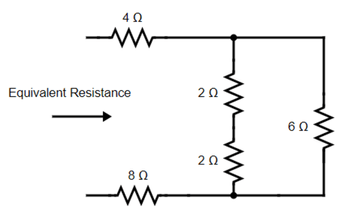
What is 14.4 ohms?
200
A graph of the voltage in a charging capacitor.
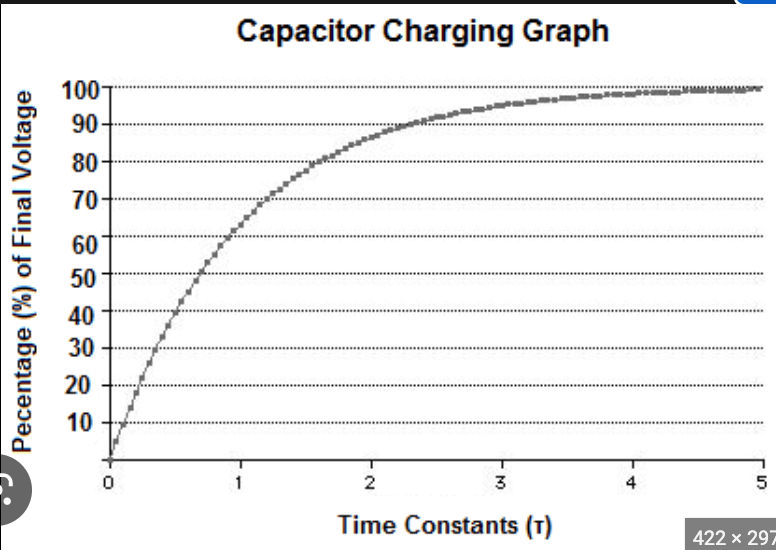
(make sure to label the limit it is approaching as Vmax)
300
The charge, in coulomb's, of an atom with 4 protons and 6 electrons.
What is (-2)*(1.6*10-19) = -3.2*10-19 C?
300
An equation that represents equilibrium for the two charged spheres shown below.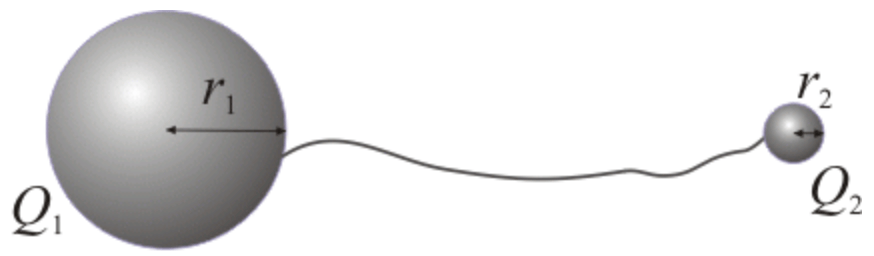
V1=V2
kQ_1/r_1=kQ_2/r_2
300
A way to lower capacitance by adding more capacitors.
What is adding capacitors in series?
300
The effect of doubling length and cutting radius in half in a resistor on the resistivity of the material.
What is no change? Resistance, not resistivity will change.
300
The fully charged voltage of the capacitor in the circuit below if V = 10, R1 = 2 ohms and R2 = 3 ohms.
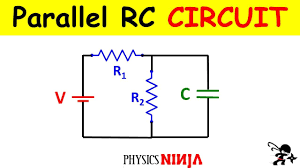
What is 6 Volts? (when fully charged, the equivalent resistance is 5 ohms and the current is 2 amps. That means the voltage drop across Ra is 4 volts, leaving 6 for the capacitor)
400
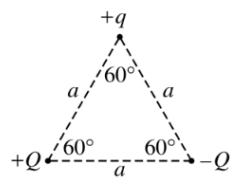
The direction of the force pushing on the top charge in the triangle above.
What is horizontally to the right?
400
The charge on the inside of the outer shell if it carries an excess charge of +10 C.
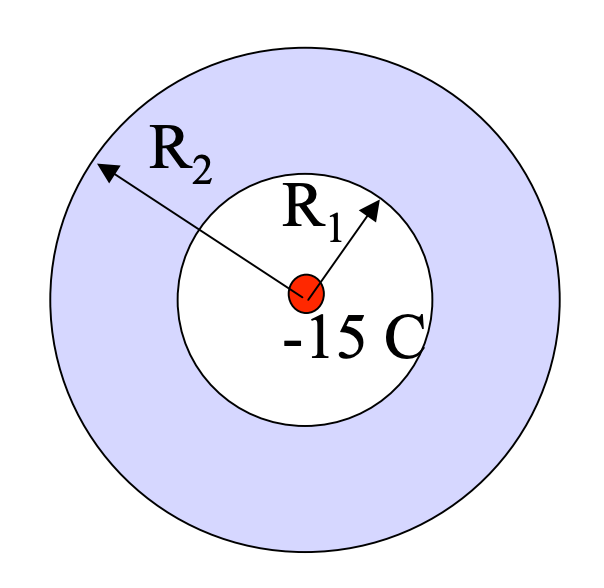
What is +15 C? (-15 is pushed away from the inner edge)
400
The effect of doubling the area of the plates, cutting the distance between the plates in half, and inserting a dielectric with constant k=2 into an air gap capacitor.
What is multiplying capacitance x8?
400
The current in the resistor marked below
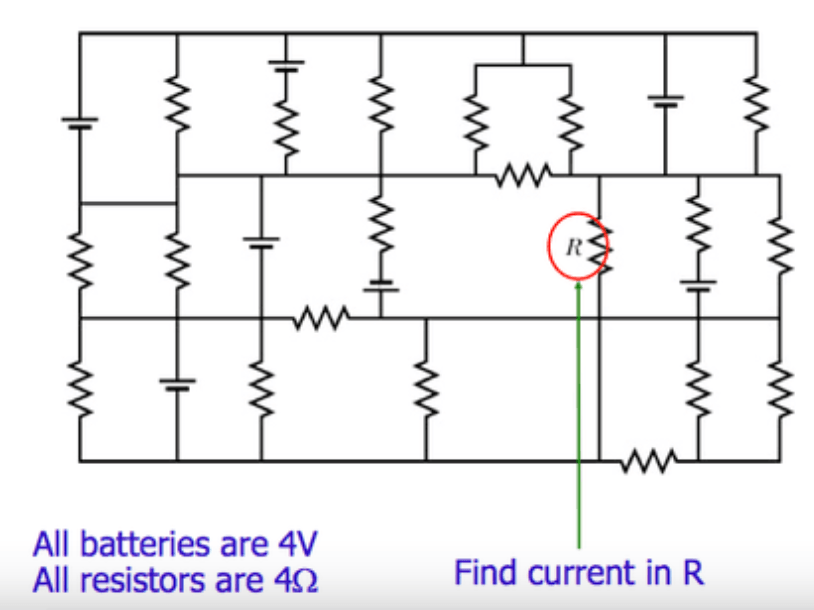
What is 2 amps? (There's a loop that goes through 3 batteries the right way and one the wrong way and only one resistor. This makes the potential difference across the resistor 8V)
400
The initial current in the resistor parallel to C if the switch is closed opened after C is fully charged if V = 10, R = 5 ohm, and C = 1 F.
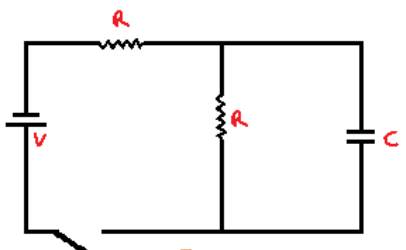
What is 1 amp? (C charges to 5 V and discharges through 5 ohms)
500
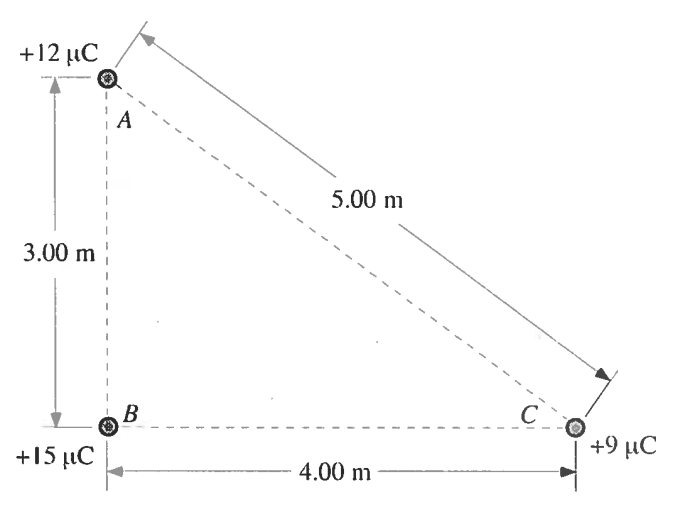
The magnitude of the net force felt by the +15 microcoulomb charge in this picture.
What is 0.195 Newtons? (use coulomb's law twice and pythagorean theorem to put them together!)
500
The surface area charge density on the outside of the outer sperical shell if it carries an excess charge of +10 C.
What is
(-5C)/(4piR_2^2)?
500
The equivalent capacitance of this circuit.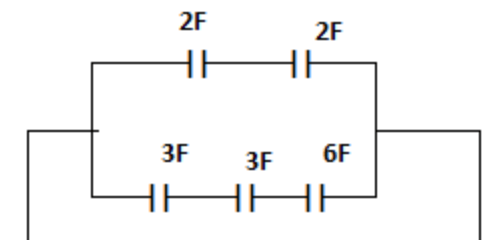
What is 2.2 F? (use the inverse adding formula in series and add in parallel)
500
The current in the 12 ohm resistor shown below.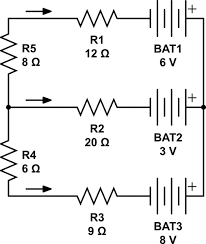
What is 0.005 amps to the right? (use loop rule and or junction rule to make a system of 3 equations and solve!)
500
The charge on a 1 F capacitor in series with a 1 ohm resistor and a 1 V battery when when the current in the resistor is .25 Amp.
Q = 0.75 coulombs (the resistor has a .25 V drop leaving 0.75 V for the capacitor)