Generalists/Specialists
Limiting Factors
population growth/age structure diagrams
Demographic Transition
Randoms
100
These types of organisms can live in many different places and can consume many different resources.
What are Generalists?
100
What causes a population to increase?
Births and Immigration
100
If the population of rabbits in an ecosystem grows at a rate of approximately 4% per year, the number of years required for the rabbit population to double is...?
70/4 = 17.5 years
100
The greatest rate of population growth takes place in this phase.
Transitional
(death rates lower but birth rates still high)
100
What claim can we make about trends in population size over time that would be supported by the data?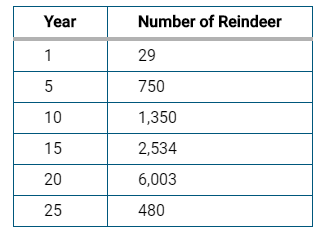
The Population exceeded the carrying capacity
200
These organisms live in specific locations and consume limited types of resources.
What are specialists?
200
What causes a population to decrease?
Deaths and Emigration
200
If a country has a crude birth rate of 24 per 1,000 and a crude death rate of 8 per 1,000, the natural annual percent increase of its population is:
1.6%
200
Explain why a country may have a declining death rate in stage 2. (why is there a longer life expectancy)
improvements in public health, sanitation, and access to food
200
A population was 1,000,000 and now is 600,000. What is the percent decrease?
40%
300
This is the term used to describe a habitat or process for which an organism occupies or is responsible.
What is a niche?
300
What shape represents an exponential growth curve?
J-shaped
300
Compare the population growth rate of India and that of China.
India has a higher population growth rate than China and Australia
300

The rate of population growth starts to slow down at which phase?
The beginning of Phase III
300
what type of growth curve is shown?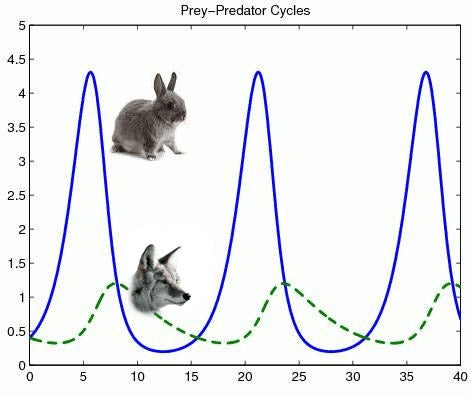
Cyclic
400
List four different categories of resources.
Food
Water
Shelter/Habitat
Mates
400
The maximum population size that a given environment can sustain
Carrying Capacity
400
How does replacement level fertility differ among stage 2 and stage 3 countries?
It is lower in stage 3 countries and higher in stage 2 countries.
400
What is the most likely cause of high death rates in phase I?
Infant and childhood mortality
400
what type of growth curve is shown?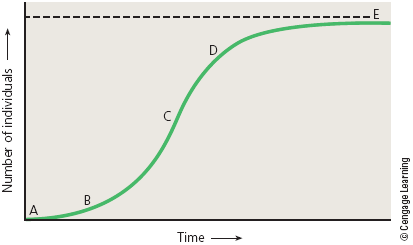
Logistic
500
A natural disaster has occurred. Explain who will fare better: a generalist or a specialist and why?
Generalist will fare better.
Specialist species are more likely to become endangered because they can only survive in specific habitats with specific resources.
500
describe two things that separate r-selected and k-selected species
level of parental care
life span
# of offspring
reproductive maturity age
population regulation
size of offspring
500
Princeton starts the year with 50,000 people. During the year there are 800 births, 600 deaths, 300 immigrants and 150 emigrants. What is the population by the end of the year?
50,350
500
Zero population growth is associated with which phases?
Phases I and IV
500
Label the following as density dependent (DD) or density independent (DI) factors
1. A tornado
2. amount of food available
3. availability of water
4. climate change
5. predation
DI
DD
DD
DI
DD
600
A scientist is studying a biome that experiences large seasonal fluctuations in both temperature and precipitation patterns. Describe the characteristics an organism that inhabits this biome may have.
generalists- resources available to an organism is constantly changing.
traits like hibernation, seasonal molt (shedding), burrowing behaviors, seasonal camouflage, etc
600
List 3 abiotic limiting factors and 3 biotic limiting factors.
abiotic- sunlight, oxygen, temperature, wind, water, currents, nutrients (specifically phosphorus or potassium).
biotic- food, disease, competition, predation,
600
What is doubling time and why can’t we predict it with certainty? What is the rule of 70 equation?
Doubling time is the number of years it takes for a population to double.
We can never determine a country’s doubling time with certainty because growth rates may change in future years. We can calculate it if we know the growth rate of a population and assume the growth rate is constant.
The rule of 70 can be used to approximate doubling time. Doubling time (years) = 70/growth rate (expressed in %).
600
Draw and label population pyramids for all 4 demographic stages. Provide an example country for each stage.
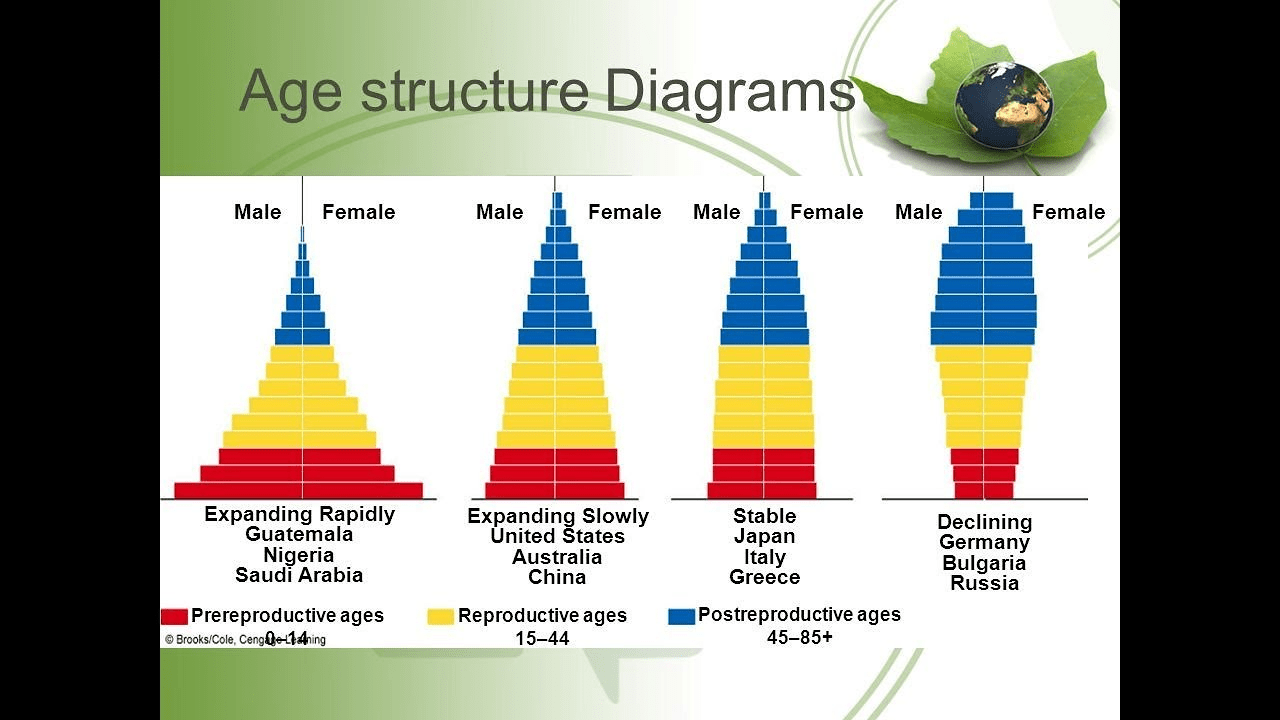
600
The one-child policy was a program in China that was implemented nationwide by the Chinese government in 1980 in order to limit most families to one child each. The policy was enacted to address the growth rate of a country's population. It has drastically reduced the total fertility rate to 1.4 and has led to a reduction in the population growth rate to 0.50% in 2012.
Describe a potential future economic effect of China's one-child policy.
Labor crisis, shrinking workforce, aging population putting strain on healthcare systems, etc