Properties of water
Chemistry
Productivity
Geomorphology
Bonus
100
This property of water occurs because hydrogen bonds form between slightly positive hydrogen atoms and slightly negative oxygen atoms, causing water molecules to stick together.
What is cohesion?
100
This measure of hydrogen ion concentration controls the balance between dissolved carbon dioxide, bicarbonate, and carbonate in inland waters.
What is pH?
100
What is the main limiting reactant (chemically) for productivity in aquatic ecosystems?
The main chemically limiting reactant for productivity in most aquatic ecosystems is phosphorus, usually in the form of phosphate (PO₄³⁻).
100
Where are meandering streams moving the fastest?
thalweg
100
What are Seiches?
•Seiches (Long Standing Waves)
•Oscillations of the entire lake surface from side to side.
•Caused by strong winds or rapid atmospheric pressure changes.
•Can influence thermocline depth, mixing, and nutrient redistribution.
200
Because oxygen is more electronegative than hydrogen, water molecules have a partial negative charge on oxygen and partial positive charges on hydrogens, giving water this chemical property.
What is polarity (a polar molecule)?
200
In oxygen-poor sediments, iron is chemically reduced from Fe³⁺ to this more soluble form, often releasing previously bound phosphate back into the water column.
What is ferrous iron (Fe²⁺)?
200
What is the path of terrestrial to aquatic productivity?
Wetland -> stream -> basin
200
High altitude glacial lakes that have little organic content are called?
Paternoster Lakes.
200
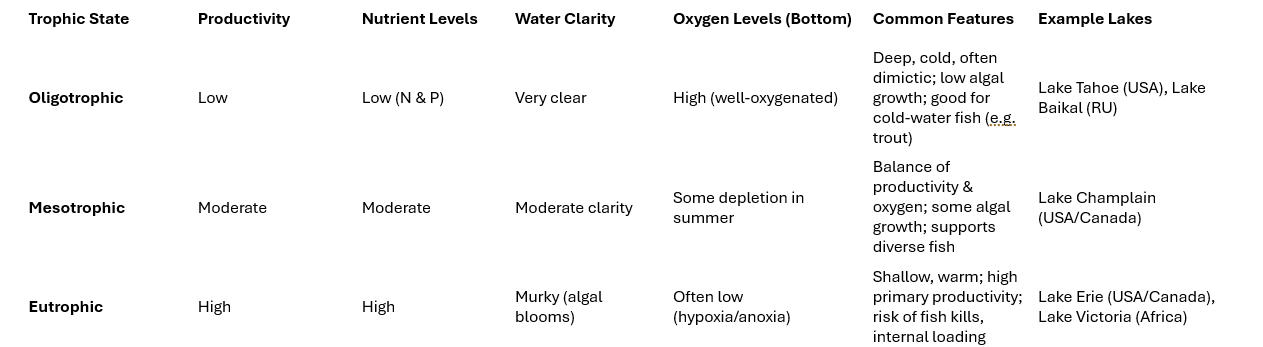
What are the trophic states? What do they describe? Explain each
300
Water can absorb large amounts of heat before its temperature changes significantly because hydrogen bonds must first be broken.
What is high specific heat capacity?
300
This sequence ranks electron acceptors used by microbes in aquatic environments based on the energy gained from oxidation–reduction reactions, typically starting with oxygen and progressing through nitrate, iron, sulfate, and carbon dioxide.
What is the oxidation–reduction (redox) energy ladder?
300
What are P/B ratios? How do they help us?
•The production-to-biomass (P/B) ratio describes how rapidly biomass is replaced over time
•A high P/B ratio indicates fast growth, short life spans, and rapid turnover of individuals
•A low P/B ratio reflects slow growth, long life spans, and low turnover
•P/B ratios integrate growth, reproduction, and mortality within a population
•Turnover rates generally decrease with increasing trophic level
•P/B ratios allow comparisons of energy flow efficiency among populations and ecosystems
300
Why are meandering streams a balancing act?
Sedimentation = Erosion
300
Nitrogen Cycle! Draw it
Check
400
Water absorbs longer wavelengths like red and orange first, allowing these shorter wavelengths to penetrate deepest into aquatic environments.
What are blue wavelengths (or blue light)?
400
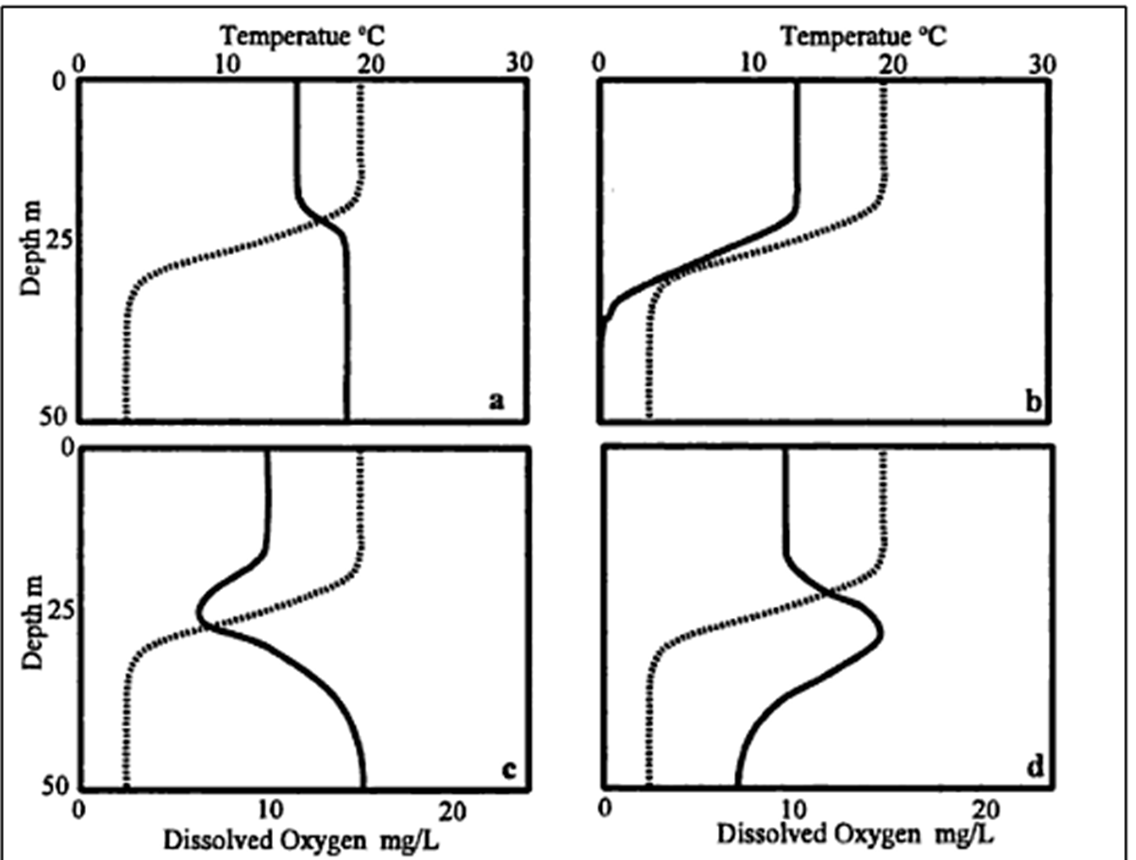
label
400
Label the following, In terms of productivity, what occurs where? Explain what you expect to find and what kind of photosynthesis and algae to expect at each location.
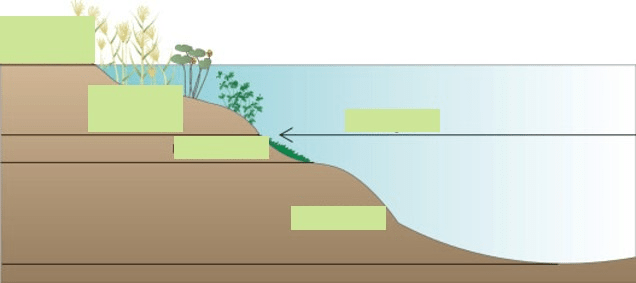
Look at powerpoints together.
400
What is the fluvial progression?
Alluvial fan->braided streams->meandering streams->straight channel->delta or estuary
400
Worked Example: AHOD vs VHOD
Lake Data
•Surface area (A₀) = 2.0 × 10⁶ m²
•Hypolimnion volume = 6.0 × 10⁶ m³
•Oxygen at start of stratification = 10 mg/L
•Oxygen after 40 days = 2 mg/L
•Stratification period = 40 days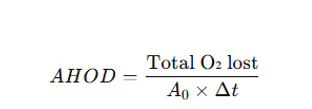

Results:
•AHOD = 0.60 g m⁻² day⁻¹
•VHOD = 0.20 mg L⁻¹ day⁻¹
Moderate oxygen depletion rate
•The lake is consuming oxygen steadily but not extremely fast.
•Suggests moderate organic matter sedimentation.
•Likely mesotrophic to mildly eutrophic.
Ecological Interpretation
•Hypolimnion will likely become hypoxic if stratification persists.
•Fish habitat compression may occur late in summer.
•Internal phosphorus loading is possible if anoxia develops.
500
Describe the inherent, apperent optical properties of water. Describe the thermal and chemical properites of water too. How do these affect stratification and productivity?
Look at slides together.
500
What is the inorganic Carbon cycle?
Draw on board
500
Which algaes use what chlorophyll?
Green algae/ Chlorophyll a, b/ Same pigments as land plants
Red algae/ Chlorophyll a, d/ Also use phycobilins (especially phycoerythrin), allowing deeper water photosynthesis
Brown algae/ Chlorophyll a, c/ Also contain fucoxanthin, giving them their brown color
500
Explain the concept of base-level vs sea level
Talk about it. or draw it.
500
How and when does each type of mixing occur? What causes mixing?
Talk about it