Relationships in Space
Distances in Space
Properties of Stars
Solar Properties
Review
100
This structure is the largest of all; it contains billions of galaxies and everything that exists.
What is the Universe?
100
This unit of measurement, equal to about 93 million miles, is used to measure distances inside our solar system.
What is an Astronomical Unit (AU)?
100
On an H-R Diagram, stars are plotted based on these two main characteristics.
What are Absolute Brightness and Temperature?
100
This is the center of the sun where nuclear fusion transforms hydrogen into helium.
What is the core?
100
This is the correct order of the levels of classification from most general to most specific.
What are Domain, Kingdom, Phylum, Class, Order, Family, Genus, Species?
200
This massive collection of gas, dust, and billions of stars is held together by gravity; ours is named the Milky Way.
What is a Galaxy?
200
This unit of measurement is used to describe the distance between stars and galaxies.
What is a Light Year?
200
Between a red star and a blue star, this color indicates a much higher surface temperature.
What is blue?
200
These dark, cooler patches on the sun's photosphere change in number over time in a predictable cycle.
What are sunspots?
200
In the hierarchy of an animal's body, this level is more specialized than a tissue but less specialized than an organ system.
What is an Organ?
300
While galaxies contain billions of stars, the universe is estimated to contain this many galaxies
What is billions?
300
Why do astronomers use Light Years instead of Kilometers or Miles when describing the Universe?
What is because distances in space are so vast that miles/kilometers would result in numbers too large to work with?
300
This term refers to how bright a star actually is from a standard distance, rather than how bright it looks from Earth.
What is Absolute Magnitude (or Absolute Brightness)?
300
Energy moves out from the sun's core first through radiation and is then carried to the outer layers by this process.
What is convection?
300
An organism that is multicellular, has cell walls, and makes its own food belongs to this kingdom.
What is the Plant Kingdom?
400
Place these in order from smallest to largest: Galaxy, Solar System, Star, Universe.
What are Star, Solar System, Galaxy, and Universe?
400
This unit represents the distance light travels in one single year.
What is a light-year?
400
If Star A is higher up on the Y-axis of an H-R diagram than Star B, Star A must have a greater amount of this.
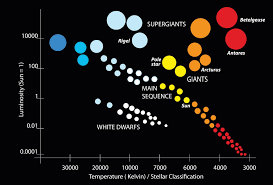
What is Absolute Brightness?
400
Unlike the solid Earth, the sun exhibits "differential rotation," meaning it rotates fastest at this specific latitude.
What is the equator?
400
This "junk drawer" kingdom contains single-celled organisms that can be plant-like, animal-like, or fungus-like.
What is the Protist Kingdom?
500
This is the most massive object in our solar system, making up about 99.8% of its total mass.
What is the Sun?
500
If a star is 10 light years away, this is how long it takes for the light from that star to reach your eyes on Earth.
What is 10 years?
500
A star might have a very low apparent magnitude (looks dim) but a very high absolute magnitude (is actually bright) because it is located at this kind of distance.
What is a vast or very far distance?
500
This outermost layer of the sun's atmosphere is actually much hotter than the surface (photosphere).
What is the corona?
500
This level of organization is the "basic unit of life" and sits at the bottom of the specialization hierarchy for multicellular organisms.
What is a Cell?