The Universe
The Solar System
Stars
Earth Motions
The Moon
Random
100
The age of the universe.
13.8 billion years
100
The age of the Solar System
4.6 billion years old
100
The four categories of stars.
Main sequence, white dwarf, giant, supergiant
100
The age of the Earth
4.6 billion years old
100
The distance the Moon is from Earth.
0.386 million km
100
The date and time of the Earth Science Regents exam.
June 14th, 9:15 am
200
What is a scientific theory?
A theory is an accepted explanation for a real-world phenomenon.
200
Describe the relationship between period of revolution and distance from the Sun.
Positive, direct
As distance increases, period increases.
200
Describe the life stages of a star, starting with the Main Sequence.
Main Sequence, Giant or Super Giant, White Dwarf.
200
Describe at least two pieces of evidence for Earth's rotation.
-Apparent motion of stars and Sun across the sky
-Night and day
-Foucault's Pendulum (Extra 100 points)
200
About how many days between a First Quarter Moon and a Third Quarter Moon?
About 15 days
200
The sport Ms. V played in college.
Rugby!
300
List two pieces of evidence for the Big Bang Theory.
-Cosmic microwave background information
-Red shift of distant galaxies/stars
300
List the terrestrial planets and the Jovian planets.
Terrestrial: Mercury, Venus, Earth, Mars
Jovian: Jupiter, Saturn, Uranus, Neptune
300
Describe the relationship between temperature and luminosity of main sequence stars.
Positive, direct
As temperature increases, luminosity increases.
300
Describe evidence for Earth's revolution.
-Constellations changing throughout the year
-Seasons
300
Draw what the Moon looks like from NYS in Position 2.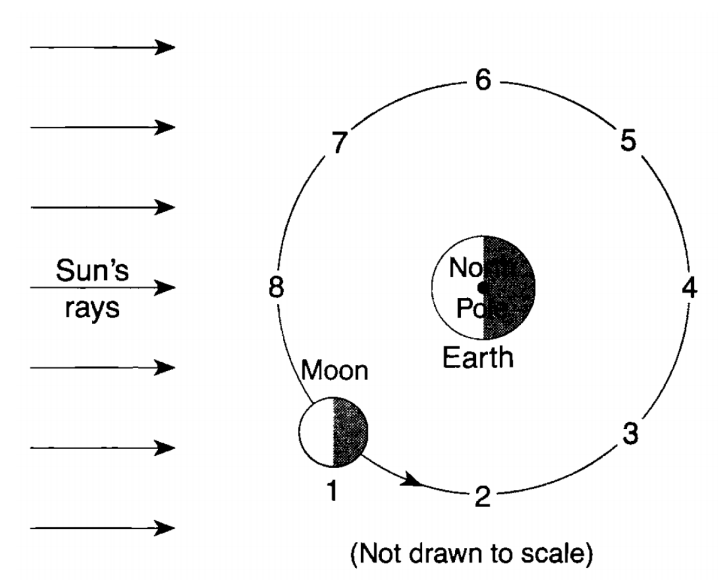

300
Mr. Long's favorite color.
PINK.
400
Scientists have observed galaxies are moving ___________ one another, providing evidence that the universe is ________________.
Away
Expanding
400
Compare the density and size of the terrestrial and Jovian planets.
Terrestrial are denser and smaller (rocky planets)
Jovian are less dense and larger (gas giants)
400
Compared with our Sun, the star Betelgeuse is...
A) smaller, hotter, and less luminous
B) smaller, cooler, and more luminous
C) larger, hotter, and less luminous
D) larger, cooler, and more luminous
D) larger, cooler, and more luminous
400
Define the Coriolis Effect and why it occurs.
Wind and water curving on Earth's surface because of Earth's rotation
400
Identify the Moon phase below: 
Waxing gibbous
400
Where Mr. Long went to college and where Ms. V went to college.
Buffalo State
Williams College
500
Put these things in order from LARGEST TO SMALLEST.
Moon, Earth, Solar System, Milky Way Galaxy, Universe, Jupiter, Galaxy Cluster, Galaxy Super Cluster, Dwayne "The Rock" Johnson
Universe, Galaxy Super Cluster, Galaxy Cluster, Milky Way, Solar System, Jupiter, Earth, Moon, "The Rock"
500
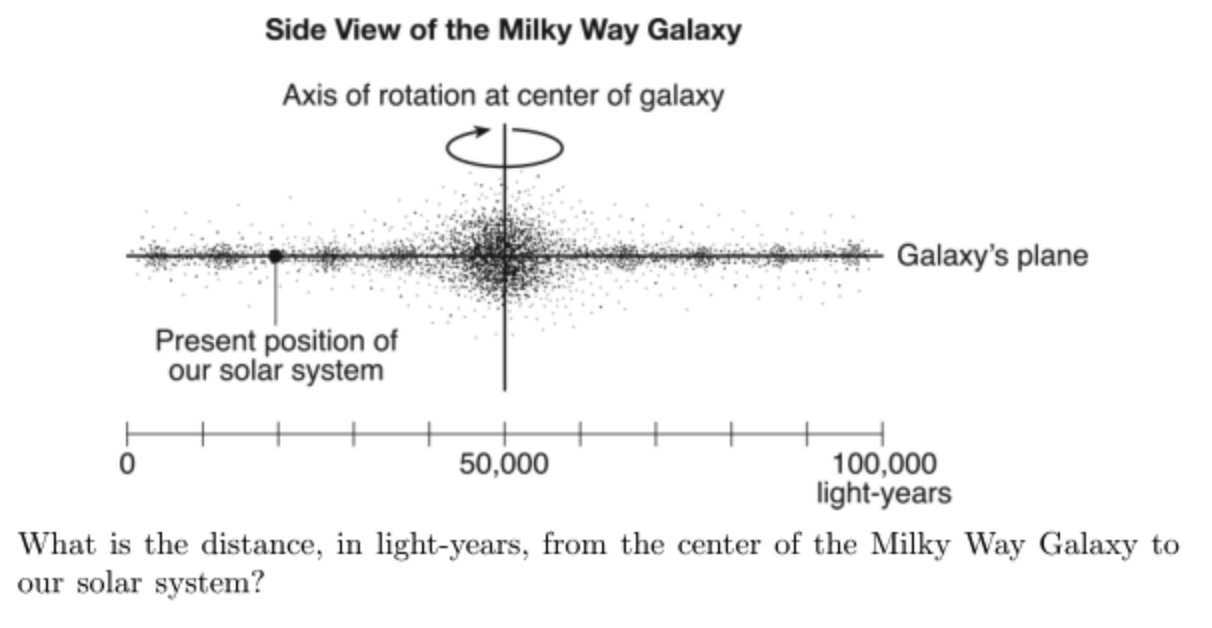
30,000 light years
500
Light and other forms of electromagnetic radiation are given off by stars using energy released during what nuclear process?
Nuclear FUSION
500
During what Northern Hemisphere season is Earth closest to the Sun?
Winter!
500
Why do we only ever see one side of the Moon?
The Moon revolves and rotates at the exact same rate (27.3 days), so only 1 side of it is ever facing Earth at a time.
500
List 3 strategies you need to remember for the Regents exam.
- USE THE ESRT
-Process of elimination
-Answer every question
-Annotate the questions
-If you don't know an answer, make your best guess, OR skip it and go back later
-Read the questions CAREFULLY
-You often don't need the diagrams or paragraphs