Origins and Models of the Universe
The Solar System
Space Debris
Seasons
Moon Phases and Eclipses
100
A widely accepted scientific explanation about why things happen
What is a theory?
100
For a planet, like the Earth, to orbit a star, like the Sun, these two things must be in balance
What are gravity and inertia.

100
This small object is composed of dust and ice, has a tail, and is most often found in the Kuiper Belt and Oort Cloud.
What is a comet?
100
The reason we have seasons is that the Earth is ______ on its axis as it revolves around the Sun.
What is tilted?
100
The Moon phase that is seen during a lunar eclipse
What is a full moon?
200
According to this scientific explanation, the universe began as a single point that expanded and is still expanding today.
What is the Big Bang Theory?
200
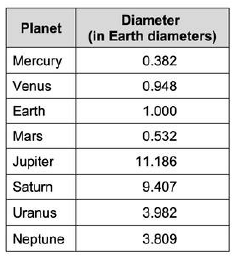
According to the table, the smallest planet is ________.
What is Mercury?
200
Asteroids are large, rocky objects that orbit the Sun. They are most often found in __________________.
What is the Asteroid Belt?
200
In summer, the hemisphere experiencing summer receives ________ sunlight because it is tilted towards the Sun.
In winter, the hemisphere experiencing winter receives ________ sunlight because it is tilted away from the Sun.
What is direct, indirect?
200
The Moon phase that occurs during a solar eclipse
What is a new moon?
300
The evidence supporting the Big Bang Theory
What is .... the Universe is still expanding?
300
Identify this planet:
red, has two moons, second smallest planet, fourth planet from the Sun
What is Mars?
300
Meteoroids, meteors, and meteorites are all rocks that break off of asteroids. The difference between them is ______________________.
What is....
Meteoroids are found floating in space,
Meteors are the "shooting stars" that burn up when they enter Earth's atmosphere,
and Meteorites are rocks that land on the Earth.
300
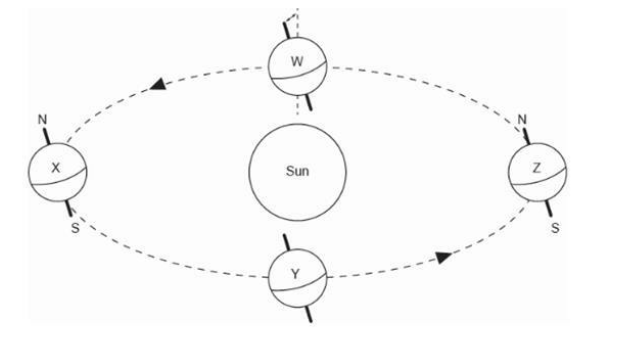
The position (W, X, Y, or Z) in which the Southern Hemisphere is experiencing the most direct sunlight and longest days
What is Position X?
300
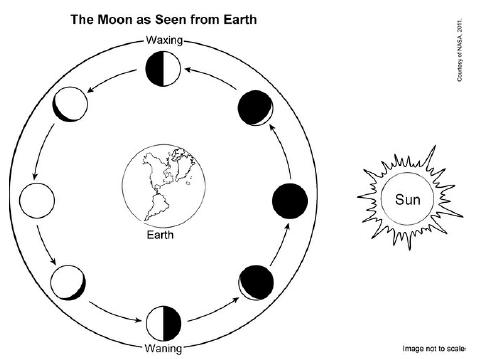
The moon phase that follows, or comes after, the full moon
What is waning gibbous?
400
Ptolemy supported this model of the universe in which the Earth is in the center, and the Sun revolves around the Earth.
What is the Geocentric Model?
400
Identify this planet:
Outer planet, has water, spins on its side, next to Saturn, blue due to methane in the atmosphere
What is Uranus?
400
A bright object with a tail moving across the sky is most likely to be a _____________
What is a comet?
400
The season that Georgia is experiencing at position Z
What is summer?
400
The number of days for the Moon to complete a lunar cycle (New moon to full moon and back to new moon)
What is 29 days?
500
List the following in order of size, from smallest to largest:
Solar System, Earth, Local Group, Universe, Sun, Milky Way Galaxy
What is
Earth, Sun, Solar System, Milky Way Galaxy, Local Group, Universe
500
Three characteristics of the outer planets (gas giants)
What is ...
made of gas, larger, no solid surface, many moons, rings, colder temperatures.
500
When Earth passes through the trail of dust and debris left by a comet or asteroid, this type of shower can occur.
What is a meteor shower?
500
The season that Georgia is experiencing at postion Y
What is Spring?
500
The Moon phases in order, starting and ending with the New moon
What is ....
New moon, Waxing crescent, First Quarter, Waxing Gibbous, Full moon, Waning Gibbious, Third Quarter, Waning Crescent, New moon.