All Things Amtospheric
More things Atmospheric
Weather this or whether that
100
The arrows in the picture below show several ways heat is transferred from the Sun as it strikes sand on the surface of a beach.
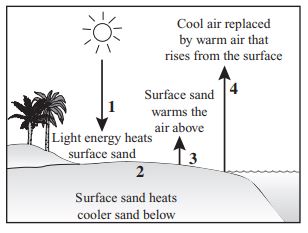
Which arrow shows convection?
Responses
- A- 1
- B- 2
- C- 3
- D- 4
What is D? Line 4 is representing cool air replaced by warm air that rises from the surface. This shows convection.
100
Which of the following statements would best describe an affect that losing the atmosphere would have on Earth?
Responses
- A- Severe storms would occur around the world.
- B- There would be flooding along rivers and coasts.
- C- The planet would increase in temperature.
- D- Ultraviolet (UV) waves would reach the surface unfiltered.
What is D? Ultraviolet (UV) waves would reach the surface unfiltered.
100
An increase in the levels of greenhouse gases is causing climate change due to global warming. What is most likely to occur if the amount of greenhouse gases were reduced to zero?
Responses
- A- Earth’s climate would return to what it was before global warming.
- B- Earth would be cooler overall because more heat would radiate into space.
- C- Global warming would continue because it cannot be reversed after it has started.
- D- The climate would show no change because the greenhouse effect would not exist.
What is B? Earth would be cooler overall because more heat would radiate into space.
200
How do the three methods of heat transfer—radiation, conduction, and convection—affect the Earth's atmosphere?
Responses
- A- Radiation from the Sun heats the Earth’s surface, conduction transfers that heat to the air, and convection moves warm air upward.Radiation from the Sun heats the Earth’s surface, conduction transfers that heat to the air, and convection moves warm air upward.
- B- Conduction warms the Earth’s surface, while radiation cools the air and convection has no effect.Conduction warms the Earth’s surface, while radiation cools the air and convection has no effect.
- C- Radiation cools the Earth, conduction heats the oceans, and convection does not occur in the atmosphere.Radiation cools the Earth, conduction heats the oceans, and convection does not occur in the atmosphere.
- D- Convection is the only method that affects the Earth’s atmosphere.Convection is the only method that affects the Earth’s atmosphere.
What is A? Radiation from the Sun heats the Earth's surface, conduction transfers that heat to the air, and convection moves warm air upward.
200
Many interactions occur between the biosphere and the atmosphere. One of these interactions results in changes in atmospheric carbon dioxide levels. The graph below shows these changes over a two-year period.
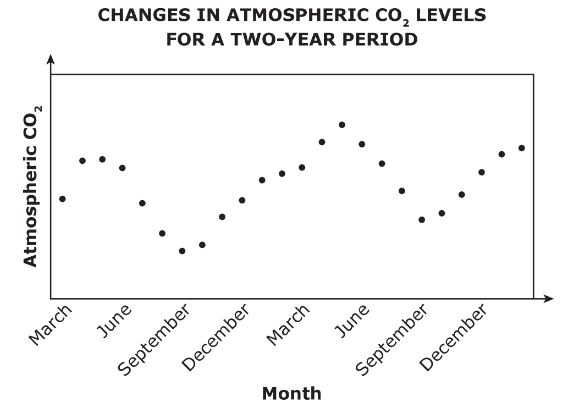
Which of the following statements is supported by the data in the graph?
Responses
- A- Carbon dioxide in the atmosphere is constant and does not vary seasonally.
- B- There is more carbon dioxide in the atmosphere in the spring than in the fall.
- C- There is more carbon dioxide in the atmosphere in the winter than in the summer.
- D- Carbon dioxide levels in the atmosphere have only been measured over the last 100 years.
What is B? There is more carbon dioxide in the atmosphere in the spring than in the fall.
200
Raphael is comparing various factors at two locations in the Northern Hemisphere. Both locations are in the interior of a continent. The table shows the location and weather data that he has collected in his research.
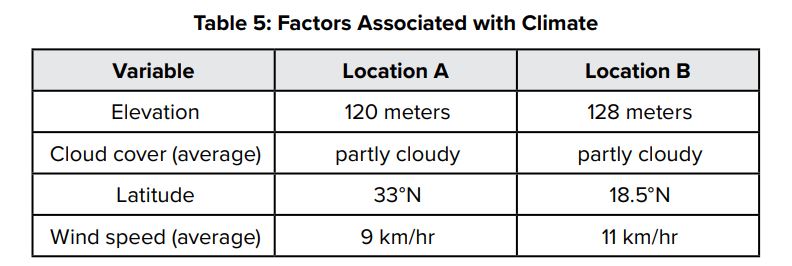
If there are no other factors affecting the climates of the two locations, which conclusion is best supported by the information in the table?
Responses
- A- Location A likely has a warmer climate than Location B because it has a lower elevation.
- B- Location A likely has a warmer climate than Location B because it receives more sunlight during the year.
- C- Location A and Location B likely have similar climates because they have similar levels of cloud cover.
- D- Location A and Location B likely have similar climates because they are at similar latitudes and have similar wind patterns.
What is B? Location A likely has a warmer climate than location B because it receives more sunlight during the year.
300
Which description best represents heat transfer through radiation?
Responses
- A- Warm air moves upward, and cold air moves downward.Warm air moves upward, and cold air moves downward.
- B- Energy from the Sun heats the Earth's surface.Energy from the Sun heats the Earth's surface.
- C- Warm air transfers heat to the land as it blows across the Earth's surface.Warm air transfers heat to the land as it blows across the Earth's surface.
- D- A stream of hot air from the mouth of a volcano heats the air that touches the stream.
What is B? Energy from the Sun heats the Earth's surface.
300
Which statement is NOT a major factor involved in how energy from the Sun influences weather and climate?
Responses
- A- Thermal energy differences between locations create wind.
- B- Thermal energy is released in the atmosphere, forming clouds.
- C- Thermal energy received by a location depends largely on altitude.
- D- Thermal energy is absorbed by the hydrosphere, driving evaporation.
What is C? Thermal energy received by a location depends largely on altitude.
400
Earth's atmosphere is important to the living organisms of the biosphere. Which of the following describes how the atmosphere best protects living organisms?
Responses
- A- by providing enough carbon dioxide in the ocean to support sea animalsby providing enough carbon dioxide in the ocean to support sea animals
- B- by changing oxygen into nitrogen, which can be used as a nutrient for animalsby changing oxygen into nitrogen, which can be used as a nutrient for animals
- C- by refracting visible light, allowing certain animals to see and capture their preyby refracting visible light, allowing certain animals to see and capture their prey
- D- by trapping electromagnetic radiation, keeping temperatures within a range best suited for animal lifeby trapping electromagnetic radiation, keeping temperatures within a range best suited for animal life
What is D? By trapping electromagnetic radiation, keeping temperatures within a range best suited for animal life.
400
The table indicates the changes that occur during the passing of a cold front at a fixed location over time.
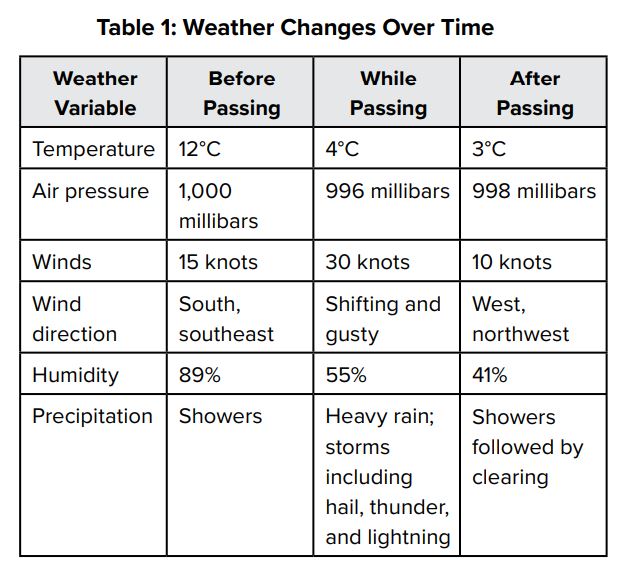
Which statement describes a change that takes place during a cold front?
Responses
- A- Winds shift as the front passes.
- B- Humidity rises as the front passes.
- C- Air pressure increases, then decreases.
- D- Temperatures increase after the front passes.
What is A? Winds shift as the front passes.
500
Which of the following is NOT an efficient greenhouse gas that traps heat in Earth's atmosphere?
Responses
- A- helium
- B- methane
- C- carbon dioxide
- D- water vapor
What is A? Helium
500
Jamaica is an island in the Caribbean Sea. It has a latitude of 18.1096° N.
The map shows global wind patterns.
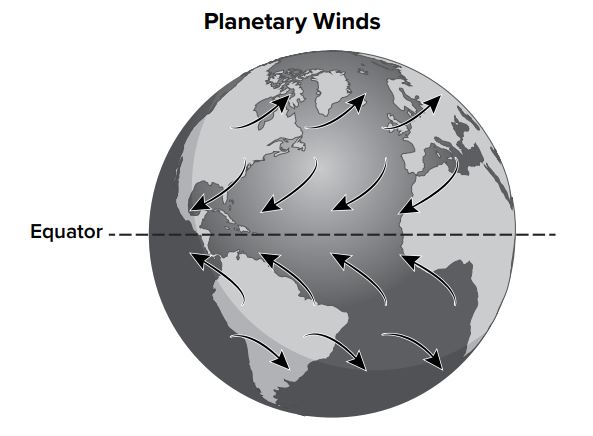
What type of wind does Jamaica experience most of the time?
Responses
- A- trade winds coming from the northeast
- B- trade winds coming from the southeast
- C- westerlies from the northwest
- D- westerlies from the southwest
What is A? Trade winds coming from the Northeast.