The Basics
The Periodic Table
Periodic Table Trends
Ionization vs Atomic Radius
Random
100
These are the only particles in an atom without a charge.
What is a neutron?
100
These are found on the outmost orbital.
What are valence electrons?
100
The atomic radius trend ________ as you go from left to right across a row.
What is decreases?
100
The atomic radius can be measured by finding 1/2 the distance between the ________ of two atoms of the same element.
What is nuclei?
100
This is the term for an ion with a negative charge.
What is an anion?
200
These atomic particles do not contribute to the atomic mass of an element.
What are electrons?
200
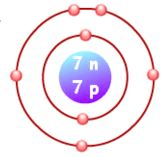 This Bohr Model represents which element?
What is nitrogen?
200
The atomic radius trend ________ as you go from the bottom to the top of a group.
What is decreases?
200
This is the energy required to remove the outermost electron from the ground state of a gaseous atom.
What is ionization energy?
200
This is the term for an ion with a positive charge.
What is a cation?
300
This the alternate term for a row on the periodic table.
What is a period?
300
Determine the atomic mass of this atom (include units).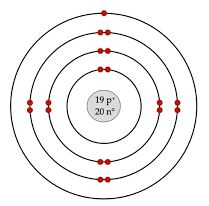
What is the 39 amu?
300
Atoms with a smaller atomic radius tend to have ___________ ionization energies.
What are larger/higher?
300
One atom has 7 valence electrons. Another has 4. Another has 2. Both are found in the same row.
This one has the highest ionization energy.
What is the atom with 7 valence electrons?
300
This is a bond that results from the uneven distribution of electrons in a molecule.
What is a polar bond?
400
Atomic numbers change due to the change in numbers of these.
What are protons?
400
This is the number of core electrons that silicon has.
What is 10?
400
The trend for this follows the same pattern as ionization energy.
What is electronegativity?
400
Put these elements in order of increasing atomic radius:
Mg, O, Ar, Li, Rb
What is:
O, Li, Ar, Mg, Rb?
400
The strength of the force between two charged particles depends on the charge of the particles and the distance between describes this law.
What is Coulomb's Law?
500
These are shared between elements in the same group.
What are properties or characteristics?
500
This is the location of the non-metals on the periodic table.
What is the upper right corner?
500
Oxygen, sulfur, and selenium all share this common ion charge.
What is 2-?
500
This is why the atomic radius increases as you go down a group.
What is adding/increasing a orbital?
500
These elements are shiny, good conductors, malleable, and ductile.
What are metals?