B17 - Variation & selection
B18 - Energy & Cycles, food webs
B18 - Carbon cycle
B19 - Habitat destruction
B19 - Conservation
100
What term describes the observable features of an organism?
A Phenotype.
100
What process do plants use the sun to do?
Photosynthesis
100
State the word equation of photosynthesis.
Carbon dioxide + water -> Glucose + Oxygen
100
Describe biodiversity
the number of different species that live in an area
100
What is hunting?
This cause of endangerment happens when animals are killed by humans for food, sport, or trade.
200
Define Mutation
A genetic change.
200
What is the principal source of energy for most ecosystems?
Sun
200
What is the carbon cycle?
Describes how carbon moves through the environment.
200
Describe an ecosystem
a unit containing the community of organisms and their environment, interacting together
200
What is pollution?
This occurs when harmful substances enter ecosystems and damage living organisms.
300
Explain 2 differences between Natural selection and selective breeding.
- Environmental factor vs human chosen
- Purpose: survival vs produce traits useful to humans
- Speed: slow vs fast
- Genetic diversity: maintained vs reduced (due to human selection)
300
How efficient is energy passed on from one trophic level to another? And how is it eventually lost?
- 10% passed on.
- Eventual loss through heat energy.
300
How much % of Earth's atmosphere is composed of CO2? Bonus 200 pts for composition of inspired & expired air (optional).
0.04%
Bonus:
Oxygen - 21% inspired, 16% expired
Nitrogen - 78% inspired, 78% expired
CO2 - 0.04% inspired, 4% expired
Other gases - 1% inspired, 2% expired
300
Name two reasons for habitat destruction.
(a) increased area for housing, crop plant production and livestock production
(b) extraction of natural resources
(c) freshwater and marine pollution
300
What is habitat destruction?
This cause of extinction happens when environments are destroyed, such as through deforestation.
400
Contrast Discontinuous and continuous variation with examples.
Discontinuous:
- Limited phenotypes, no intermediates (eye colour, blood groups, seed colour)
Continuous:
- A range of phenotypes (Height, body mass, Leaf surface area)
400
Define the term "Decomposer" and explain why they are not usually given a specific trophic level in a simple food chain.
- Gets its energy from dead or waste organic matter.
- Because they feed on dead organisms from all trophic levels.
400
State the 4 main reservoirs carbon is stored in.
Carbon is stored and cycles between four main reservoirs:
- the atmosphere
- oceans
- land biomass
- fossil fuels
400
List 4 undesirable effects of deforestation
reducing biodiversity
extinction
loss of soil
flooding
increase of carbon dioxide in the atmosphere
400
What are captive breeding programmes?
This conservation method involves breeding endangered species in controlled environments to increase their population.
500
Explain how antibiotic resistant bacteria are created.
1. Bacteria reproduces
2. Genetic mutated bacteria appears
3. When antibiotic is used, it kills the normal bacteria but the genetic mutated bacteria survives.
4. The genetic mutated bacteria begins to reproduce.
5. Antibiotic no longer is effective.
500
Use the concept of energy transfer to explain why the number of organisms usually decreases as you move up a food chain.
- Energy is lost at each level (via heat from respiration, waste, or uneaten parts).
- Less energy available
- Cannot support a large number of individuals at higher trophic levels.
500
Label the carbon cycle: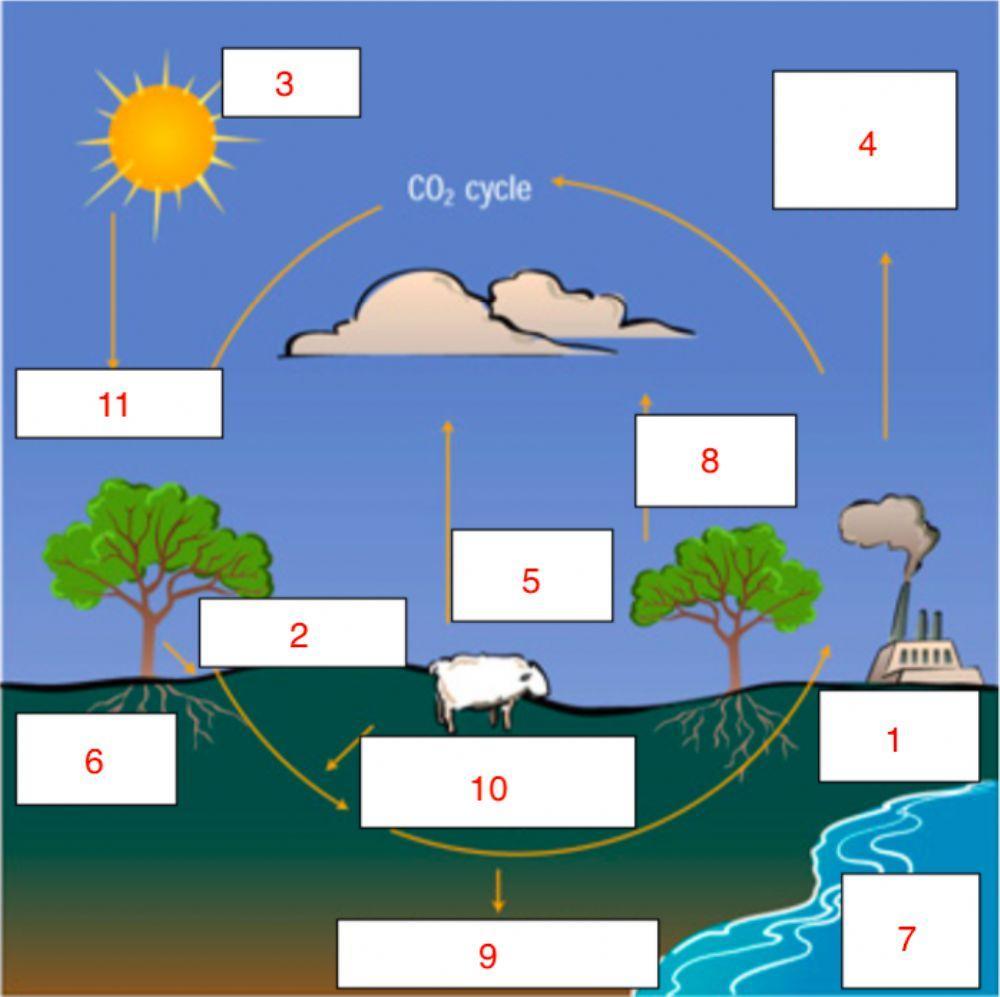
1: Combustion
2: Feeding
3: Solar energy / Sunlight
4: Carbon dioxide in atmosphere
5: Respiration (Animal)
6: Decomposition
7: Fossil fuels
8: Respiration (Plant)
9: Fossilization
10: Death and waste
11: Photosynthesis
500
Explain the undesired effects of deforestation
- Reducing biodiversity: Deforestation destroys habitats, causing many species to lose their homes and reducing the variety of life in the area.
- Extinction: Some species cannot survive without their forest habitat and may die out completely when it is removed.
- Loss of soil: Without tree roots to hold it in place, soil is easily eroded by wind and rain.
- Flooding: The removal of trees reduces water absorption, causing more surface runoff and increasing the risk of floods.
- Increase of carbon dioxide in the atmosphere: Cutting and burning trees reduces carbon dioxide absorption and releases stored carbon, raising atmospheric CO₂ levels.
500
What are introduced species?
This happens when non-native species are introduced and outcompete or prey on native organisms, causing their decline.