Bacterial Transformation
Enzymes Everywhere
Introducing DNA
Structure & Such
Techniques
Operons
100
Small accessory rings of DNA that replicate independently of an organism’s genome
What are plasmids
100
The enzyme used to produce the molecule of DNA in the figure.
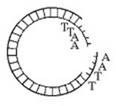
What is a restriction enzyme?
100
A type of gene transfer that occurs when two bacterial cells, which are not descendants of one another, exchange genetic information
What is horizontal gene transfer?
100
This virus has bacteria as its primary target.
What is a bacteriophage?
100
The molecular biology technique is used for separating DNA fragments based on their size.
What is electrophoresis?
100
This gene in the pARA-R plasmid codes for the enzyme B-lactamase, which inactivates ampicillin and allows the bacteria to continue growing in its presence.
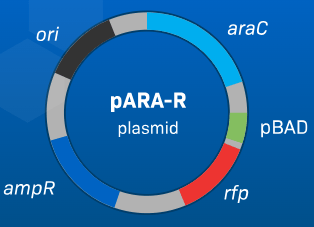
What is ampR?
200
DNA from two different sources
What is recombinant DNA?
200
These enzymes act at specific nucleotide sequences within a double-stranded DNA molecule and cleave DNA at specific sequences.
What are restriction enzymes?
200
The process where DNA is transferred from one bacterial cell to another through a pilus.
What is conjugation?
200
This RNA molecule is a copy of the information in a gene.
What is mRNA?
200
The technique used to amplify a single gene or small sequence of DNA.
What is PCR?
200
This gene in the pARA-R plasmid codes for the expression of red fluorescent protein in the presence of arabinose.
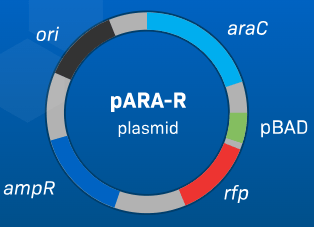
What is rfp?
300
When the DNA being transformed by the bacteria contains antibiotic resistance genes, scientists are able to identify these cells that were able transform the transferred DNA.
What are competent cells?
300
The enzyme which targets phage (viral) DNA and destroys it before it can infect the bacterial cell.
What is Cas?
300
The process of using DNA from one organism to alter the characteristics of another.
What is transformation?
300
This RNA molecule is a major component of ribosome.
What is rRNA?
300
Negative fragments of DNA in gel electrophoresis move away from the negative cathode and towards this.
What is the positive anode?
300
This promoter is a sequence of DNA that is located before the protein-coding sequence; provides a landing site for RNA polymerase so that the gene can be transcribed and the protein can be made.
What is pBAD?
400
The bonds connecting the strands of the smaller circular plasmid DNA molecules that are broken under alkaline conditions.
What are hydrogen bonds?
400
The enzyme used to seal plasmid DNA to non-plasmid DNA in the final step of splicing foreign DNA into a plasmid.
What is ligase?
400
The process of transfer of genes from the recipient to the donor through bacteriophage.
What is transduction?
400
This RNA molecule carries an amino acid to the ribosome.
What is tRNA?
400
These types of DNA fragments migrate to the bottom of the gel.
What are small fragments?
400
This binds to the AraC protein, causing AraC to change shape and bind to another AraC protein and the region next to the PBAD promoter, allowing RNA polymerase to bind to the promoter and transcribe the genes.
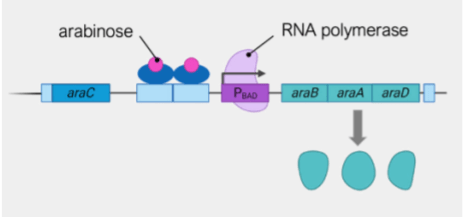
What is arabinose?
500
When single strands of plasmids that remained linked in the lysis step of a mini prep reconnect into soluble, double-stranded molecules.
What is anneal?
500
This enzyme builds the new DNA strand during the final step of Extension in a standard PCR cycle.
What is Taq polymerase?
500
An organism which has foreign genes incorporated into its genomes.
What is a transgenic organism?
500
The 5' to 3' sequence of the complementary strand of DNA if a DNA strand contains the sequence 5ʹ-ATG-3ʹ
What is 5'-CAT-3'?
500
Bacteria are typically harvested late in this phase, when the bacterial number is high and the cells are still healthy and dividing.
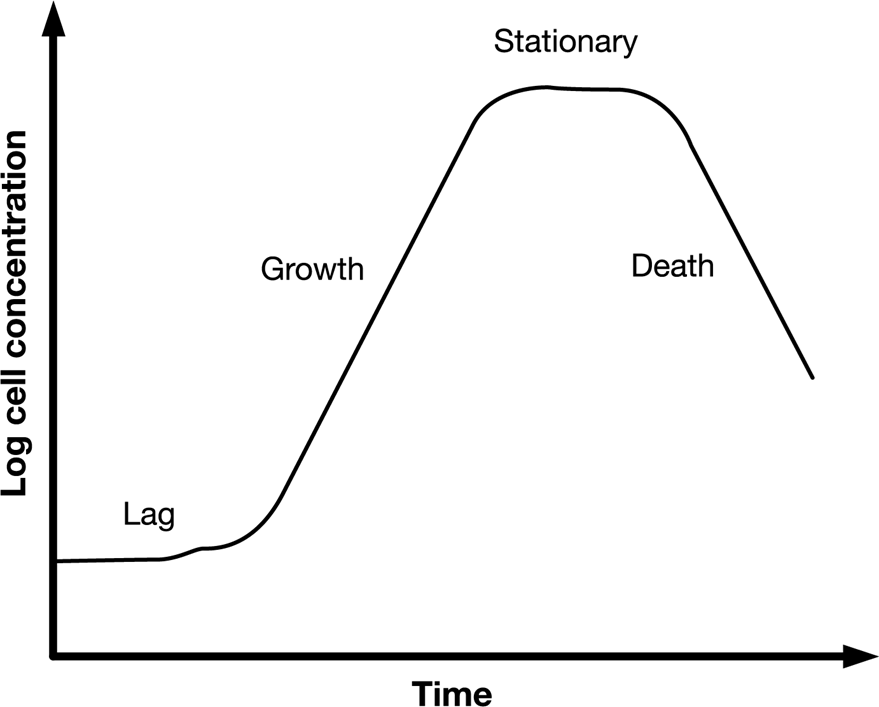
What is the growth phase?
500
This regulatory protein binds to the DNA operator regions when arabinose is not present, blocking the RNA polymerase from binding to the promoter and transcribing the gene.
What is araC?