Logarithms
Numbers
Solving Equations
Exponentials
Rate of Change
100
The inverse operation of raising a value to the power of x, such as the exponential relation below.
(5)^x
What is a logarithm?
100
How mathematicians write really big and really small numbers to make working with them a bit easier.
What is Scientific Notation?
100
The result of solve for x in the following equation:
y=-x-4
What is
x=-y-4
100
The world population in 2000 was approximately 6.08 billion. The annual rate of increase was about 1.26%. The function that models the world's population.
What is
f(x)=6.08(1.0126)^x
100
 The rate of change and what it represents.
What is $1.75 per ride at the fair?
200
The base of the following logarithmic functions:
ln(4) and log(5)
What are e and 10 respectively?
200
A rough measure of an objects size expressed as a power of 10
What is an order of magnitude?
200
The result of solve for x in the following equation:
(2x+1)/(5y)=10
What is
x=25y-1/2
200
A computer valued at $6500 depreciates at the rate of 14.3% per year. The function that models the value of the computer over time.
What is
f(x)=6500(1-0.143)^x
200
The slope of the line that passes through (1, -3) and (2, 3).
What is 3?
300
The result when you solve for x with the following function:
5^x=50
What is
log_5(50)
300
Scientific Notation of
0.000002688731
What is
2.688731*10^-6
300
The following formula when solved for radius
C=2pir
What is
C/(2pi)=r
300
The bear population increases at a rate of 2% per year. There are 1573 bear this year. The population of bears in 10 years.
What is about 1,917 bears?
300
The slope of the line that passes through (-9, 1) and (1, 1).
What is 0? (this line is perfectly flat!)
400
The result when you solve the following function for x:
10^x=14
What is
log(14)
400
An estimate for the average global strain rate in mountains is 1 x 10-14 sec-1. The estimated order of magnitude of this value.
What is -14?
400
The following formula when solved for m:
y-y_1=m(x-x_1)
What is
m=(y-y_1)/(x-x_1)
400
An isotope of cesium (cesium-137) has a half-life of 30 years. If 1.0 g of cesium-137 disintegrates over a period of 90 years, this is how many grams of cesium-137 would remain.
What is 0.125 grams?
400
The slope of the line that passes through (1, -9) and (1, 1).
What is undefined? This vertical line is not possible in the real world as you can't be in two places at the same time (1 second at each point) and you can't divide by zero!
500
f^-1=e^(3x-2)+4
What is
y=(ln(x-4)+2)/3
500
Two students have calculated values for viscosity based on field measurements they gathered from the same locality. They come up with two different values; student #1:
4.66217 * 10^12
poise; student #2:
3.8145 * 10^12
poise. The difference in the estimated orders of magnitude for their calculations.
What is 1?
10^12-10^12=10^0=1
500
The result of solve for x in the following equation:
(-x+1)/(2y+4x)=1/(2)
What is
x=(y-1)/-3 or
x=y/-3+1/3
500
The half-life of isotope X is 2.0 years. This is the amount of years it would take for a 4.0 mg sample of X to decay and have only 0.50 mg of it remain.
What is 6 years?
500
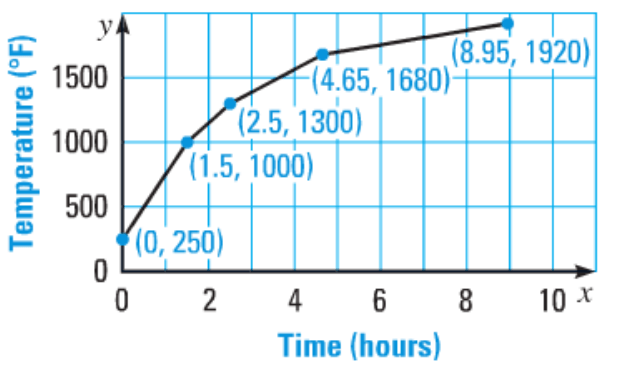 The time interval in which the temperature had the greatest rate of change.
What is [0, 1.5]? In other words, what is within the first hour and a half?