Enzymes and Metabolism
Cell Structure and Functions
Intermediary Metabolism and Regulation/Cellular Respiration
Photosynthesis + Membrane
Lab
100
What does delta G being negative mean? Delta G=positive?
-DeltaG being negative is exergonic (releases energy) = means the reaction is spontaneous, ends with less free energy, and loses energy to the surroundings
-DeltaG being positive is endergonic (needs energy), meaning the reaction is not spontaneous, ends with more energy, and gain energy from the surroundings
100
Why is supercoiling of DNA effective in prokaryotic cells?
Helps us store more genetic information in smaller space. Think about how small a bacteria is.
100
What's the first step when sugar enters the cell in glycolysis? What does this make the sugar do?
Hexokinase phosphorylates sugar, adding a negatively charged phosphate group so the sugar can't leave the cell through the same channel it came in, and is now trapped in the cell
100
What are cellular membranes made out of? How does this help their semi-permeable function?
Phospholipid bilayers. The heads are polar and the tails are nonpolar, making it so only very small, nonpolar things (or water) can pass freely.
100
What does a DNA polymerase do? On what side does it attach? What functional group does it need to attach?
DNA polymerase synthesizes nucleotides to build a DNA strand. Polymerase attaches to the 3' end and needs an OH group to attach.
200
What is energy coupling? Why is it often necessary? Give an example about a process that we've talked about that used energy coupling.
When an endergonic reaction occurs with an exergonic reaction, so energy can be supplied to the endergonic reaction from the exergonic reaction.
Ex: phosphates hydrolyze off nucleotides to synthesize nucleic acids
200
List the functions of microtubules, microfilaments, and intermediate filaments.
-Microtubules = cellular highways/transport tracks where vesicles are moved by motor proteins, made of globular tubulin
-Microfilaments = help w structural support, can move and be assembled or disassembled, drive changes in cell shape or movement (motility), ex: muscle cell contraction
-Intermediate filaments = help with structure, support, tether organelles, made of fibrous proteins like keratin
200
What happens to the citric acid cycle when there's no oxygen? Why?
Because the ETC no longer works, there is a buildup of NADH. NADH is an inhibitor for multiple enzymes in the citric acid cycle, so the citric acid cycle no longer functions.
Without oxygen, both ETC and CAC don't work, so we can only use glycolysis/fermentation to make ATP
200
Compare and contrast facilitated diffusion and active transport.
Facilitated diffusion is when there are protein channels available for molecules to passively diffuse in/out through osmosis, no energy is needed.
Active transport also has protein channels, but energy is needed.
200
Name the three steps of Kunkel Mutagenesis. Give a short description of each.
Phosphorylation = phosphorylate 33 bp oligo beforehand with kinase
Annealing = Heat up ssDNA and oligo to denature it, they anneal/bind (except for the 3 bp mutation)
Polymerization = DNA polymerase comes in and adds nucleotides until its' complete, then polynucleotide kinase changes OH group to phosphate, and ligase seals it up
300
What's the difference between competitive inhibitors and allosteric regulators? If something is inhibited only at high concentrations, what type of inhibitor does that usually indicate?
-Competitive inhibitors = resemble natural substrate and bind to the active site
-Allosteric regulators/non-competitive inhibitors = bind to a separate site away from the active site, can activate or inhibit the enzyme
-Usually indicates a competitive inhibitor, bc it'll have to compete with the actual substrate before it can inhibit
300
Name three pieces of molecular evidence for the endosymbiotic theory for chloroplasts or/and mitochondria.
-metabolic processes that happen in chloroplasts/mitochondria are similar to what happens in prokaryotic organisms
-mitochondria/chloroplasts both have their own double-stranded, circular, supercoiled DNA genomes like prokaryotic cells
-mitochondria/chloroplasts can divide on their own through binary fission like prokaryotic cells
-mitochondria/chloroplasts both have highly convoluted membrane structure that maximizes surface area and energy processes, which is similar to what aerobic bacteria/cyanobacteria have
300
Which kind of metabolic poison would most directly interfere with glycolysis?
a.) an agent that reacts with oxygen and depletes its concentration in the cell
b.) an agent that prevents pyruvate from entering the mitochondrion
c.) an agent that closely mimics the structure of glucose but is not metabolized
d.) an agent that reacts with NADH and oxidizes it to NAD+
e.) an agent that blocks the passage of electrons along the electron transport chain
c.) an agent that closely mimics the structure of glucose but is not metabolized
300
What happens during "fixation", "reduction", and "regeneration" of the Calvin cycle?
Fixation = Rubisco catalyzes the covalent attachment of CO2 to RuBisCO, an organic compound, in the cell as a carboxyl group.
Reduction = ATP and NADPH made in light reactions are used to convert 3-phosphoglycerate molecules to GAP. GAP can be used to build glucose and other carbs
Regeneration = remaining 5 GAP sugars (bc 1 GAP is used for energy) are used to regenerate the starting substrate
300
What did UC Davis give us to start our lab? (Hint: 2 things)
- single stranded BgIB plasmid with antibiotic resistance gene, WT BgB gene, lac gene, T7 promoter
- 33 base pair oligonucleotide that has our 3 bp mutation in it and the rest 30 are wildtype
400
The final rxn of glycolysis catalyzes the hydrolysis of a phosphate from phosphoenolpyruvate yielding pyruvate, an exergonic rxn with a deltaG of -50.9 kJ/mol.
The total deltaG of the coupled rxn is -21.5 kJ/mol, and is overall exergonic.
Based on this info, what is the deltaG of this unknown rxn, and would it be exergonic or endergonic?
DeltaG of unknown rxn is 29.4 kJ/mol, and is overall endergonic.
400
Draw a eukaryotic cell, and label/draw/explain the function of: nucleus, Rough ER, Smooth ER, Golgi Complex, Mitochondria, Centrosome, endosome, lysosome, nucleolus
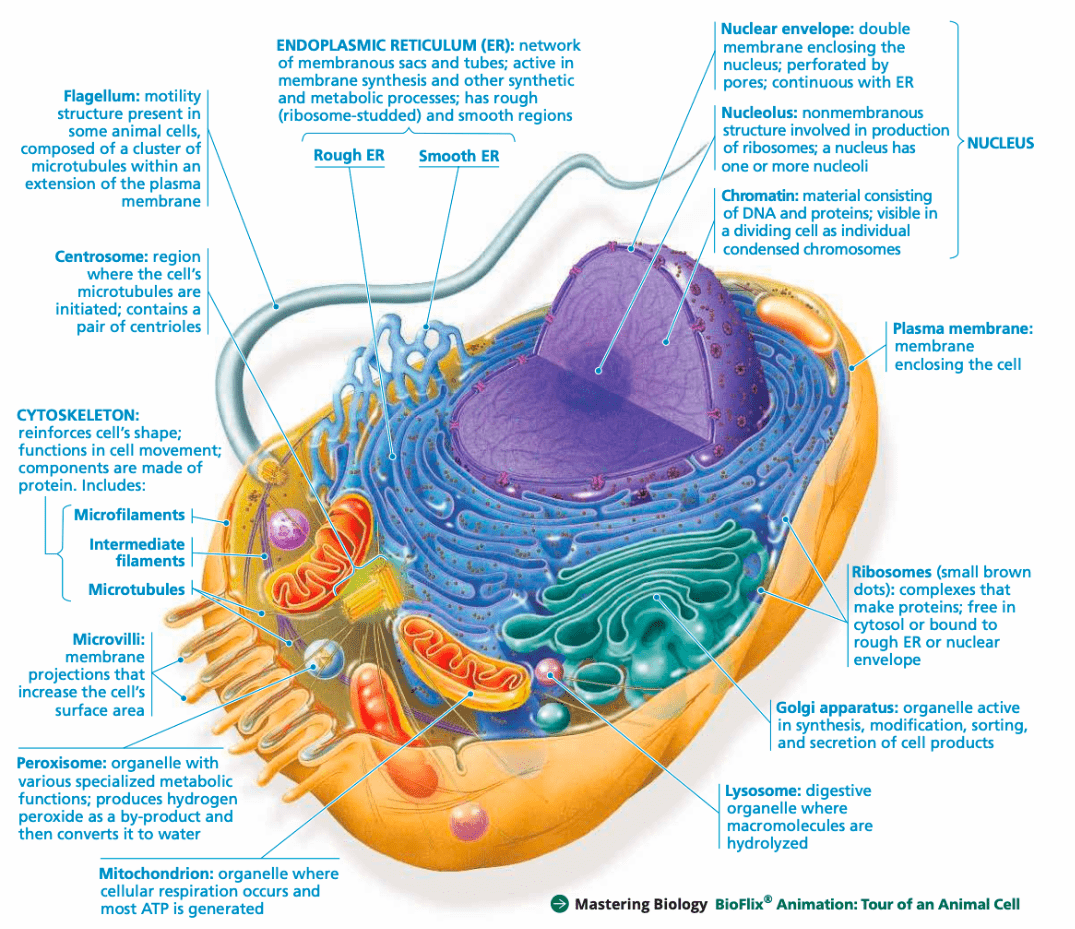
400
Why is phosphofructokinase an ideal inhibitor in glycolysis?
By having PFK be the inhibitor, we can trap glucose in the cell for possible storage/cellular respiration with hexokinase, but our body can now decide if we need to undergo cellular respiration and 'choose' where to use PFK to make more ATP
400
How is the ATP synthesis that occurs in the light reactions similar to ATP synthesis in cellular respiration?
What is the ATP synthesized by the light reactions used for?
What is the ATP synthesized in cellular respiration used for?
-both create a chemiosmosis concentration gradient as a form of stored energy, and then use facilitated passive diffusion through the ATP synthase to turn it and make ATP
-ATP in light rxns uses CO2 and organic compounds to create 6 GAP sugar, where one of them is used for energy
-In cellular respiration, ATP is directly used for energy
400
What happened when we put our double-stranded oligos into bacteria? Why? What was our end product?
The bacteria sensed uracil in the DNA plasmid and cut out the uracil, effectively deleting that strand. A new strand could then be synthesized from the remaining strand. We ended with a complete double-stranded oligonucleotide that was normal (no uracil) and had our 3-base pair mutation on both strands.
500
During exercise, your muscles make more AMP as ATP is used up.
The enzyme phosphofructokinase-1 (PFK-1) helps break down glucose by turning fructose-6-phosphate into fructose-1,6-bisphosphate.
Scientists find that:
At low substrate levels, PFK-1 works slowly.
Once substrate concentration gets high enough, its activity suddenly increases.
Adding AMP makes this sharp increase happen at lower substrate levels.
PFK-1 shows positive cooperativity — when one substrate binds, it makes other subunits bind substrate more easily (higher affinity).
AMP is an allosteric activator that keeps the enzyme in its high-affinity form, so it becomes active at lower substrate concentrations.
.
500
Name the steps of how we get from a hydrolase gene to a fully functioning protein we can use.
DNA transcribed to mRNA -> cytoplasmic ribosome translates to synthesize protein (ribosome will move along mRNA as tRNA molecules will deliver correct amino acids specified by mRNA) -> protein folding -> glycosylation(adding carb groups)/phosphorylation modifications to protein to help direct it to destination -> transported to final destination
500
Why does ATP act as a substrate at low concentrations, but an inhibitor at high concentrations for PFK? Consider a possible molecular explanation for this difference.
PFK (phosphofructokinase) has two ATP binding sites, an allosteric site and an active site
Naturally, the allosteric site has low affinity for ATP, and the active site has high affinity for ATP. If there's a lot of ATP, it'll bind to the allosteric site, induce a shape change, and the active site will change to have a low affinity for ATP, effectively inhibiting the enzyme. Possible explanation= allosteric site has more polar R groups, while active has negative charged R groups.